Google missed in EPA Green Power Leadership Awards - Apple, Cisco, Dell, Intel, Microsoft

The EPA released the Green Power Leadership Awards.

NewImage

This was a good chance for the technology vendors who go Green to highlight their achievements.  Apple, Cisco, Dell, Intel and Microsoft are on the list.  What happened to Google?  They are not on the list.

Apple Inc.
Apple Inc., one of the largest information technology companies in the world, became an organization-wide Green Power Partner in 2013, increasing its green power use from 2012 by more than 285 million kilowatt-hours (kWh) to an annual total of more than 537 million kWh. Apple is pursuing a net zero energy strategy for its data centers, corporate facilities, and retail stores worldwide, and currently has achieved 85 percent green power for all its U.S. consumption. An important component of the strategy is creating new, Apple-owned renewable energy projects – utility-scale if necessary – located near the company's centers of energy demand.

Apple supplies all of its data centers with 100 percent renewable energy though its own projects or through grid-purchased renewable energy. For its largest data center, in Maiden, North Carolina, it has committed to more than 60 percent Apple-owned generation and achieves this by having constructed the nation’s largest end user-owned, solar photovoltaic array — a 20-megawatt (MW) facility on 100 acres of land — and a 10-MW fuel cell installation supplied by directed biogas, the largest non-utility fuel cell installation operating anywhere in the country. These projects produce 125 million kWh of green power a year. A second 20-MW solar photovoltaic array is installed and will be operational in October, increasing total green power generation at the data center to 167 million kWh a year, which is substantially beyond their 60 percent goal.

Many of Apple's other facilities also operate on 100 percent renewable energy from a combination of green power purchases and Apple-owned renewable projects, including its data center in Newark, California; its two newest data centers in Reno, Nevada and Prineville, Oregon; and corporate facilities in Cupertino, California; Elk Grove, California; Austin, Texas; and several overseas facilities.

By developing its own on-site projects, Apple ensures that it provides renewable energy that supports the company’s load and provides power to the local grid, and that this energy comes from new projects that would not have been built without Apple's involvement.

In the future, as its facilities and data centers grow, Apple plans to increase its green power use to keep pace with growth and pursue its goal of using 100 percent clean, renewable energy.

If you think you should be on this list you can submit here.

Application Process

Green Power Leadership Awards

EPA’s Green Power Leadership Awards recognize exceptional achievement among EPA Green Power Partners and among green power suppliers. Green Power Partners and green power suppliers may apply for an award, or another party may nominate them. EPA recognizes eligible organizations and suppliers in the award categories listed below:

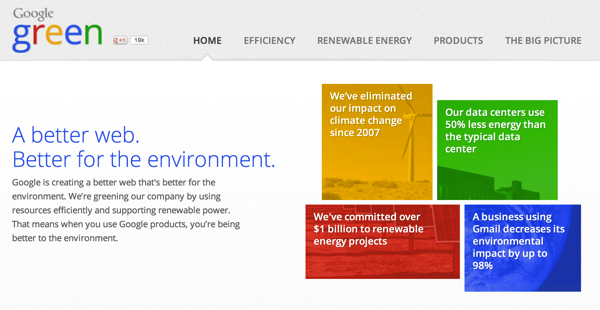
Google Green has their content here.
NewImage

iPhone 5s vs. Galaxy Note 3 comparison, Part 1

I spend at least 10x more time thinking about mobile than desktop solutions.  Mobile is interesting because of what it is going to enable people to do.  Thinking further out and being focused on users two new devices I will have to play with will be the iPhone 5S and the Galaxy Note 3.

Actually, I am going to stick with my iPhone 5 and ordered two 5s's for my family so the 5s will be close at hand, but I won't spend time with it every day.  I am the only Android user in the family, so I will have the Galaxy Note 3, upgrading from the Note 1 I bought 1 1/2 years ago.  I was an early Note 1 users for the stylus and big screen.  Something many don't think are important like the iPhone 5/5s audience.

Here is a comparison of size and resolution.  

NewImage

I'll get the new phones in two weeks and will write more on comparing.  But, forewarned my focus is mainly on the Galaxy Note 3 because the target audience I am focusing on prefers the Galaxy Note 3 vs. the iPhone 5s.  We will address the iPhone market, but first is the Galaxy Note.

It is so much easier to develop really cool solutions when you don't develop across multiple platforms.  Think about it most of the mobile apps out there are cross platform or if they are on one platform, they really don't have to be.

Here is one piece of data iPhone 5/5s = 727,040 pixels on the screen vs. Samsung Galaxy Note 3 = 2,073,600 pixels on the screen. Almost 3X more pixels.  There is a close relationship between the # of pixels you can see and the amount of information you can communicate. 

Underground Hydropower Energy Storage System - Gravity Power

Storing Renewable Energy is a tough problem.  Here is a wiki on Grid Energy Storage.

One I just found is Gravity Power.

Gravity Power, LLC, a spin-off of LaunchPoint Technologies, Inc., is developing a revolutionary grid-scale electricity storage system. The company's new Gravity Power Module(GPM) exploits the established principles of pumped storage hydropower, but extends the concept in a new direction: Down

Here is a presentation if you are interested.

Sometimes the Environmental Group is wired for damage control, example China's Hydropower

The majority of corporations environmental groups are part of a marketing organization.  This group can be used to coordinate the grass roots efforts in the company as employees are passionate about making a difference in the world beyond just shipping their services.

Here is an example at eBay Green. https://twitter.com/eBayGreen

eBay Green

eBay Green

@eBayGreen

Join us to help the world buy, sell and think green every day!

green.ebay.com


But, sometimes the green efforts are primarily wired for damage control.  An example is here in this Economist article on China's hydroelectric dams.

Yet it does not matter how strong the case may be against Xiaonanhai, because the battle against a hydropower scheme in China is usually lost before it is fought. The political economy of dam-building is rigged. Though the Chinese authorities have made much progress in evaluating the social and environmental impact of dams, the emphasis is still on building them, even when mitigating the damage would be hard. Critics have called it the “hydro-industrial complex”: China has armies of water engineers (including Hu Jintao, the former president) and at least 300 gigawatts of untapped hydroelectric potential. China’s total generating capacity in 2012 was 1,145GW, of which 758GW came from coal-burning plants.

...

There is also a political reason why large hydro schemes continue to go ahead. Dambuilders and local governments have almost unlimited power to plan and approve projects, whereas environmental officials have almost no power to stop them.

Here is where damage control is used.

Environmental officials who have not been financially captured by the dambuilding economy find themselves as scarce as some of the fish they are charged to protect. Environmental activists, meanwhile, can request access to public records and demand public hearings, both required by law. But they say that these avenues are barred when they are most needed—on controversial projects that face vocal opposition. For example, the authorities have rejected requests for public records on Xiaonanhai and they have not granted a public hearing.

This is something I learned over 5 years ago when watching how one corporation had its environmental group set up, and I knew it was not really that interesting to me as they were like a faux green effort.

Oh oh, Solar Panels on your roof may increase the risk of fire damage

I was having my annual backflow testing on the sprinkler system in the house.  The City of Redmond where I live requires sprinklers for my house, office, and beach house which means I have backflow prevention valves and i found a reasonable cost done by Linda Pfeiffer.

Linda Pfeiffer

A Women’s Touch LLC

State Certified B4287

Backflow Technician

Licensed, Insured and Bonded

When chatting with Linda we were discussing roofs and fire departments risk to getting up there, then she said the big thing now is the solar panels are changing how fire departments can fight a fire and whether they will be electrocuted.

Here is a story of a warehouse with solar panels was quite possibly completely destroyed because the environmentally sensitive solar panels.  Whatever environmental impact was accumulated was most likely undone by the fire.

Firefighters battling the massive 11-alarm blaze at the Dietz & Watson distribution center in South Jersey faced an unlikely foe during the fight -- solar panels.

A solar array with more than 7,000 photovoltaic panels lined the roof of the nearly 300,000 square-foot refrigeration facility which served as a temporary storage center for the company’s deli meats and cheeses. But the panels, while environmentally sustainable and cost-saving, may have led to the complete destruction of the warehouse.

Fighting the fire under bright blue skies Sunday, Delanco Fire Chief Ron Holt was forced to keep firefighters from attacking the blaze from the roof because of electrocution concerns.

"With all that power and energy up there, I can't jeopardize a guy’s life for that,” said Holt. Those electrocution fears combined with concerns of a collapse forced firefighters to simply spray the building with water and foam from afar.

Ken Willette from the National Fire Protection Association, a nonprofit that develops standards for firefighting, says electrocution is one of the hazards firefighters are increasingly facing fighting blazes at structures where solar panels are deployed.

We don't often hear of a data center fire.  When there is a fire, the electrocution risk from the UPS batteries will make people cautious.  Can you imagine how the fire fighting changes if the roof is covered with solar panels?

“The new paradigm is firefighters might encounter building systems they have little or no knowledge of,” Willette said. “It used to be homes and commercial buildings had roofs and walls and heating and ventilation systems that the fire service was used to dealing with…modern technology, both in building construction and these other alternative energy systems, have changed that.”

Something to think about when you are deciding whether to put solar panels on your roof or an adjacent piece of property.