Challenges of Doing Business in China, I wouldn't without Power and Money

I've had plenty of discussions on the subject of data center businesses going into China.  Scott Noteboom is the latest to make the announcement he'll go into emerging markets including China.  DCK covers the latest and Scott's statement he has the secret sauce to do business in China.

Noteboom believes he’s put together the connections and resources to make China more accessible. ”We believe that we will be the first provider to enable non-Chinese companies to smoothly deploy in China,” said Noteboom, who said he hopes to bring new data center technologies into China to realize exceptional efficiency and economics.

Noteboom isn;t supplying many details just yet. A key aspect of the plan will be site selection. Noteboom says LitBit hopes to identify the Asian equivalents of Quincy, Washington – previously unknown sites that provide exceptional economics and efficiency for data center operators.

My perspective on China is based on when I worked for Apple and Microsoft and would acquire power supplies and Simplified Chinese fonts. There are many meetings, negotiations and ongoing contract maintenance.  I've also known many people who have worked in China localizing Microsoft software or developing software in China.

Whenever someone in the data center industry says join me in working in China I say no thank you.

Here is a post that does a good job of explaining the challenges of doing business in China.  Five points are made.  #3 is the one that most don't know how to address.

Number three is kind of similar to number two. In China, there is always a story behind the story. There’s a person behind the person. It’s never what you see on the front end. It is partially related to cultural issues. For 5,000 years there has been this inside outside orientation to much of Chinese culture and as an outsider you are shown a certain view and as an insider you are shown a certain view. And there are various levels of being an insider or outsider. Again when you are trying to do business with a company or a person, you should find out where this person is from, where this company is from. What is their history? How did they become who they are today?  How did they get their money?  Who is behind them?  There is always someone sitting behind them, and not in a nefarious way. You are not talking to some puppet or shadow. There is just a level of complexity to Chinese business and to Chinese society that is important to take into account. We advise companies to never stop asking questions.

It will be interesting how LitBit does in China.  I helped out one friend who needed a resource that can address the above issue.  There aren't many.  You need a strategy and full time commitment to win in China, and even then you may lose.

Many people think China is new, but it is a country where Power and Money is in its DNA which by the way is not that much different than other countries.  It is just China has been at it for 5,000 years and it can be different than a Western approach.

Data Center Drama Class, making the point

I was in a tour of Verne Global's data center, and in the tour we couldn't take pictures of too many things, but I got this one of Tate Cantrell and it was memorable of Tate making a point on the infrastructure.

I never really thought about it, but using your arms to make points is something we should all try a bit more.  I don't think many of us took drama class in high school. :-)

I'll pay more attention to when people are using their arms and body.  It makes the pictures much more interesting.

NewImage

Another picture I took from the media/analyst briefing event was this one of the Viking Ship.

NewImage

Here is RMS's Bobby Soni.

NewImage

And I am even caught making gestures with my arms.

NewImage

A Little Bit more data on LitBit's claim of being the biggest most innovative serving the big brands

LitBit's Scott Noteboom made a grand claim.

led development and/or operations of many of the world's largest and most innovative data centers, which have served companies including: Apple, Yahoo!, Google and Microsoft.

Here are some other data points to evaluate the statement and to get you thinking.

On Microsoft, Mike Manos tweeted this statement.  

Mike Manos@mjmanos
 

@greenm3 WRT- bit.ly/1eNdk4y Hmm-In all my time running that program thru today - this person never worked on anything for Microsoft

DCD references how DLB Associates was the external resource working on Google's data centers.

Today, both the best and worst kept secret in the data center industry is that DLB Associates was lead design engineer on Google’s initial data center campus build out (a well-guarded secret for the first seven years of Google’s build program). While Google provided the conceptual design and placed a high priority on efficiency, DLB designed the campus and buildings as well as the majority of the MEP infrastructure.

In the data center industry you can make all kinds of claims.  The diligent will reference check.  I wonder who at Apple, Yahoo!, Microsoft and Google LitBit points you to when you want to get the details on how they had been served.

May 08, 2009
 
October 10, 2007
 
September 14, 2007
 

Google missed in EPA Green Power Leadership Awards - Apple, Cisco, Dell, Intel, Microsoft

The EPA released the Green Power Leadership Awards.

NewImage

This was a good chance for the technology vendors who go Green to highlight their achievements.  Apple, Cisco, Dell, Intel and Microsoft are on the list.  What happened to Google?  They are not on the list.

Apple Inc.
Apple Inc., one of the largest information technology companies in the world, became an organization-wide Green Power Partner in 2013, increasing its green power use from 2012 by more than 285 million kilowatt-hours (kWh) to an annual total of more than 537 million kWh. Apple is pursuing a net zero energy strategy for its data centers, corporate facilities, and retail stores worldwide, and currently has achieved 85 percent green power for all its U.S. consumption. An important component of the strategy is creating new, Apple-owned renewable energy projects – utility-scale if necessary – located near the company's centers of energy demand.

Apple supplies all of its data centers with 100 percent renewable energy though its own projects or through grid-purchased renewable energy. For its largest data center, in Maiden, North Carolina, it has committed to more than 60 percent Apple-owned generation and achieves this by having constructed the nation’s largest end user-owned, solar photovoltaic array — a 20-megawatt (MW) facility on 100 acres of land — and a 10-MW fuel cell installation supplied by directed biogas, the largest non-utility fuel cell installation operating anywhere in the country. These projects produce 125 million kWh of green power a year. A second 20-MW solar photovoltaic array is installed and will be operational in October, increasing total green power generation at the data center to 167 million kWh a year, which is substantially beyond their 60 percent goal.

Many of Apple's other facilities also operate on 100 percent renewable energy from a combination of green power purchases and Apple-owned renewable projects, including its data center in Newark, California; its two newest data centers in Reno, Nevada and Prineville, Oregon; and corporate facilities in Cupertino, California; Elk Grove, California; Austin, Texas; and several overseas facilities.

By developing its own on-site projects, Apple ensures that it provides renewable energy that supports the company’s load and provides power to the local grid, and that this energy comes from new projects that would not have been built without Apple's involvement.

In the future, as its facilities and data centers grow, Apple plans to increase its green power use to keep pace with growth and pursue its goal of using 100 percent clean, renewable energy.

If you think you should be on this list you can submit here.

Application Process

Green Power Leadership Awards

EPA’s Green Power Leadership Awards recognize exceptional achievement among EPA Green Power Partners and among green power suppliers. Green Power Partners and green power suppliers may apply for an award, or another party may nominate them. EPA recognizes eligible organizations and suppliers in the award categories listed below:

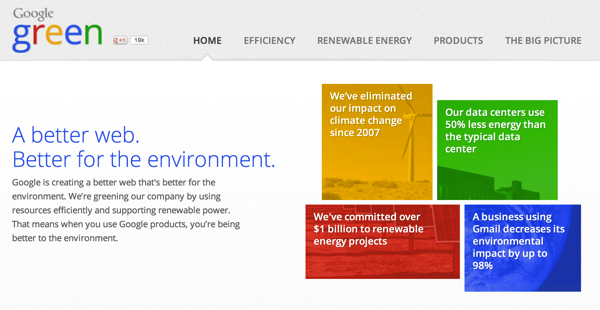
Google Green has their content here.

NewImage

iPhone 5s vs. Galaxy Note 3 comparison, Part 1

I spend at least 10x more time thinking about mobile than desktop solutions.  Mobile is interesting because of what it is going to enable people to do.  Thinking further out and being focused on users two new devices I will have to play with will be the iPhone 5S and the Galaxy Note 3.

Actually, I am going to stick with my iPhone 5 and ordered two 5s's for my family so the 5s will be close at hand, but I won't spend time with it every day.  I am the only Android user in the family, so I will have the Galaxy Note 3, upgrading from the Note 1 I bought 1 1/2 years ago.  I was an early Note 1 users for the stylus and big screen.  Something many don't think are important like the iPhone 5/5s audience.

Here is a comparison of size and resolution.  

NewImage

I'll get the new phones in two weeks and will write more on comparing.  But, forewarned my focus is mainly on the Galaxy Note 3 because the target audience I am focusing on prefers the Galaxy Note 3 vs. the iPhone 5s.  We will address the iPhone market, but first is the Galaxy Note.

It is so much easier to develop really cool solutions when you don't develop across multiple platforms.  Think about it most of the mobile apps out there are cross platform or if they are on one platform, they really don't have to be.

Here is one piece of data iPhone 5/5s = 727,040 pixels on the screen vs. Samsung Galaxy Note 3 = 2,073,600 pixels on the screen. Almost 3X more pixels.  There is a close relationship between the # of pixels you can see and the amount of information you can communicate.