Microsoft makes its first Wind Power Purchase in Texas

GigaOm’s Katie Fehrenbacher reports on Microsoft’s Wind Power Purchase for data centers.

Microsoft to buy Texas wind energy to power its San Antonio data center


6 HOURS AGO

3 Comments

Wind-Powered Politics: Vestas at the DNC
SUMMARY:

Microsoft gets into the game of buying clean power directly from a power company for a data center in Texas.

Microsoft is buying clean energy to help power a data center for the first time. On Monday morning the tech giant announced that it has entered a deal to buy 110 MW of wind energy from a wind farm that will be located just outside of Forth Worth, Texas, and will be connected to the power grid that supplies power to Microsoft’s San Antonio datacenter.

Obama's Obamacare peer reviewed by President Carter, tried your best which is questionable

Peer reviewing is good for the soul if you want to learn from your mistakes and build better systems.  I use peer review all the time to test ideas, software, and research.

How much better would Obamacare be if it had run through a peer review process?  Well, it is going through peer review now to get things fixed.

Here is an interview with President Carter in Parade, and you guessed it Obama comes up.  

On how he would evaluate the Obama presidency so far:
JC: “He’s done the best he could under the circumstances. His major accomplishment was Obamacare, and the implementation of it now is questionable at best.”

Ouch.  Your Democratic President peer with years more experience lays it out to the public.  Sometimes the best way to get people to change is not to tell the person, but to tell the public what you would tell that person.

Oh yeh, BTW I found this article through one of my super smart friends I have known for 25 years.  He has Apple, Adobe, Microsoft, Google on his resume.  I have HP, Apple, Microsoft.  With friends to run peer reviews, we try not to do really stupid things like Obamacare V1.0.

Hey that’s it.  Obamacare will be like Windows, it will be good in version 3.0.  Who was a Windows 1.0 or 2.0 user.  By the time 3.0 came out there were 10X-100X more users.  Oops, that’s not going to help Obamacare now.

HGST ships Helium filled HD with 49% higher performance per watt per TB

As most of you know storage whether it is RAM, SSD, or good old HD has a cost and power impact in the data center.  HGST announced today a new Helium filled HD.

First Hermetically Sealed, Helium HDD Platform Provides Path for Higher Capacity Storage, While Significantly Lowering Power and Cooling, and Improving Storage Density
SANTA CLARA, Calif., Cloud Expo Silicon Valley (Booth #209), November 4, 2013 – HGST, a Western Digital company (NASDAQ: WDC), today announced that it is shipping the 6TB Ultrastar He6 hard disk drive (HDD). Key OEM, cloud and research leaders working closely with HGST to qualify the drive include HP, Netflix, Huawei Unified Storage, CERN, Green Revolution Cooling and Code42, as well as some of the world’s largest social media and search companies. Revealed in September 2012, HGST’s cutting-edge HelioSeal™ platform provides a path for higher capacity storage for decades to come while significantly lowering customer total cost of ownership (TCO). Leveraging the inherent benefits of helium, which is one-seventh the density of air, the new Ultrastar He6 drive features HGST’s innovative 7Stac™ disk design with 6TB, making it the world’s highest capacity HDD with the best TCO for cloud storage, massive scale-out environments, disk-to-disk backup, and replicated or RAID environments.

I first saw this news in ComputerWorld’s post, then found the press release.  Here are some of the stats.

TCOptimized™ - Driving Down Data Center TCO with HeliumThe amount of data that companies need to store is growing exponentially, but IT budgets remain flat. With 6TB, a low 5.3 idle watts, a reduced weight of 640g, and running at 4-5°C cooler, the new Ultrastar He6 lowers data center TCO on virtually every level. Key TCO benefits when compared to a 3.5-inch, five-platter, air-filled 4TB drive include:
Highest Capacity HDD on the Market; 6TB, Seven-disk Design, Providing the Best TCOLowest Power Consumption with Best Watts-per-TB
-23 percent lower idle power per drive -49 percent better watts-per-TBBest Density Footprint in a Standard 3.5-inch Form Factor -50 percent higher capacity
Lighter Weight than a Standard Five-disk 3.5-inch Drive–50g lighter even with two more disks, offering 50 percent more capacity–38 percent lower weight-per-TB- 

One of the companies referenced is Netflix.  Isn’t Netflix all in AWS. NO.

“The Netflix Open Connect delivery platform is a highly optimized video content delivery network. We serve billions of hours of streaming video per quarter to over 40 million subscribers,” said David Fullagar, director of Content Delivery Architecture, Netflix. “As part of our efforts to optimize the delivery ecosystem for Netflix and our Internet Service Provider partners, we strive to build better and better streaming appliances. The high storage density and lower power usage of the Ultrastar He6 hard drives allow us to continue with that goal, and create a great customer experience.” 

Google announces 450 mil euro expansion of Hamina Data Center with 100% renewable power

Remember when data center expansion was a dark secret?  Years ago Google’s Dalles data center had a sign from locals with “Voldemort.”  Thanks to the positive impact of data centers for local economies and data centers that use 100% renewable energy the company PR effect is worth sharing for company’s who have great brands.  Google, Apple, Facebook, and Microsoft are some.  Amazon.com is the one noticably absent from this list.

There were rumors that there would be an announcement from Google in Hamina.  Here are some pictures Google shared.  I chose these two because they show more of the buildings.

NewImage

NewImage

For the full press release here it is.

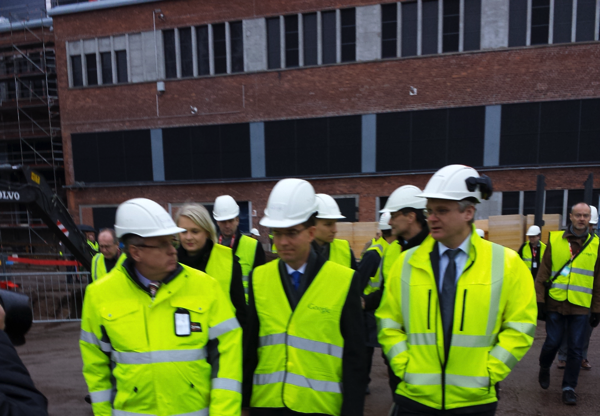
Google welcomes Prime Minister Katainen to Hamina data center, announces EUR450 million expansion


4 November 2013 -- Prime Minister Jyrki Katainen today joined Google at its Hamina data center as the company announced a EUR450 million expansion.


The expansion comes on top of an already announced EUR350 million in investment.


"Finland needs more foreign direct investments in order to enhance our economy, growth and employment. The government accepted the national investment promotion strategy last December,” the Prime Minister said. “In the strategy, the ICT sector, including data centers, has been emphasized as one of the priority sectors. Therefore, Google’s investment decision is important for us and we welcome it warmly."


“We’ve received a wonderful welcome in Finland and are delighted by the country’s strong infrastructure and business-friendly environment,” said Dieter Kern, Google’s Data Center Manager. “That’s why we’re happy to build out our capacity to deliver the lightning fast, easy to use services that people expect from Google.”  


Google purchased the Summa Mill from Finnish paper company Stora Enso in March 2009, with plans to convert the 60 year old paper mill into a modern data center. The first phase of the facility became operational in September 2011 and now serves Google users across Europe and around the world.


Initial construction work converting the paper mill’s first machine hall into a data center lasted just over 18 months. At its peak, the new construction will provide work for approximately 800 engineering and construction workers, most of whom will be Finnish.


The existing Hamina data center already is one of the most advanced and efficient in the global Google fleet. Its high-tech cooling system, which uses seawater from the Bay of Finland, reduces energy usage and keeps our computers running smoothly, and is the first of its kind anywhere in the world.  Starting 2015,the center will be primarily powered by wind energy coming from a new onshore wind park, as announced last June. As the center consumption increases, we'll also conclude additional similar agreements to power the center with 100% renewable energy"


The facility already employs approximately 125 in full time and contractor roles across engineering, technical work, security, food service, and buildings and grounds maintenance.  This does not count new jobs which will open thanks to the present expansion. All of our open positions can be found on Google Jobs page for positions in Finland.  


“As demand grows for our products, from YouTube to Gmail, we’re investing hundreds of millions of euros in expanding our European data centres,” says Anni Rokainen, Google Finland Country Manager.   “This investment underlines our commitment to working to help Finland take advantage of all the economic benefits from the Internet.”


This new investment will support a region hard-hit as its key paper industry retrenches. It comes in addition to a strong community outreach program in the Hamina region.  In the spring of 2013, Google announced a new partnership with Aalto  University and the regional development agency Cursor.  


With Google's financial support, Aalto and Cursor are supporting programs to improve the use of the Internet by local small and medium-sized enterprises. Cursor is strengthening the Venture Gym acceleration program around the growing Playa Game Industry Hub, as well as the region's Kaakko 135 travel and tourism initiative.   Already, some 800 people and dozens of companies in the region have participated in Aalto-Cursor workshops, not only in the region, but also in Helsinki, London and Cambridge.


“Our ambition is nothing less than to jumpstart Internet innovation in Eastern Finland," says Will Cardwell,  Aalto University Senior Advisor, Global Alliances. "The Google data center in Hamina offers Eastern Finland a tremendous opportunity to jump from the industrial to digital age."


“Google’s decision to locate one of Europe’s largest and most modern datacenters into Kotka-Hamina Region sends a strong message,” adds Hannu Karavirta, CEO of Cursor, the regional development agency. “It shows Kotka-Hamina is the place to be for various new ventures; it provides employment opportunities for hundreds of professionals and the ongoing operatio

Will Nuclear Power be a zero carbon option for data centers?

Associated Press has an article that went out this morning appealing to environmentalist to embrace nuclear power.  Here is the ABC version.

Experts Say Nuclear Power Needed to Slow Warming


Some of the world's top climate scientists say wind and solar energy won't be enough to head off extreme global warming, and they're asking environmentalists to support the development of safer nuclear power as one way to cut fossil fuel pollution.

The Full letter from the scientist is here.

Kerry Emanuel originally shared:
 
To those influencing environmental policy but opposed to nuclear power: 

As climate and energy scientists concerned with global climate change, we are writing to urge you to advocate the development and deployment of safer nuclear energy systems. We appreciate your organization’s concern about global warming, and your advocacy of renewable energy. But continued opposition to nuclear power threatens humanity’s ability to avoid dangerous climate change. 

We call on your organization to support the development and deployment of safer nuclear power systems as a practical means of addressing the climate change problem. Global demand for energy is growing rapidly and must continue to grow to provide the needs of developing economies. At the same time, the need to sharply reduce greenhouse gas emissions is becoming ever clearer. We can only increase energy supply while simultaneously reducing greenhouse gas emissions if new power plants turn away from using the atmosphere as a waste dump. 

Renewables like wind and solar and biomass will certainly play roles in a future energy economy, but those energy sources cannot scale up fast enough to deliver cheap and reliable power at the scale the global economy requires. While it may be theoretically possible to stabilize the climate without nuclear power, in the real world there is no credible path to climate stabilization that does not include a substantial role for nuclear power

The four scientist may think their strategy of appealing to the environmentalist will be reasonable and logical.  The problem is most environmental groups survive based on donations, grants, and the efforts of their volunteers.  These people are its users and they predominantly believe nuclear power is evil.

What will be the defining moment is what countries follow the advice of the scientist and are more successfully able to lower its carbon footprint.

Below are a few of the countries with nuclear power.  The most notable anti nuclear is Japan and Germany.

France is pro nuclear with 75% nuclear power.

Nuclear Power in France

(Updated September 2013)

  • France derives over 75% of its electricity from nuclear energy. This is due to a long-standing policy based on energy security.
  • France is the world's largest net exporter of electricity due to its very low cost of generation, and gains over EUR 3 billion per year from this.
  • France has been very active in developing nuclear technology. Reactors and fuel products and services are a major export.
  • It is building its first Generation III reactor.
  • About 17% of France's electricity is from recycled nuclear fuel.

France Nuclear Power Map

Germany is anti nuclear and pro coal with renewables

Nuclear Power in Germany

(updated October 2013)

  • Germany until March 2011 obtained one quarter of its electricity from nuclear energy, using 17 reactors. The figure is now about 18%.
  • A coalition government formed after the 1998 federal elections had the phasing out of nuclear energy as a feature of its policy. With a new government in 2009, the phase-out was cancelled, but then reintroduced in 2011, with eight reactors shut down immediately.
  • The cost of replacing nuclear power with renewables is estimated by the government to amount to some EUR 1000 billion.
  • Public opinion in Germany remains ambivalent and at present does not support building new nuclear plants.
  • More than half of Germany’s electricity was generated from coal in the first half of 2013, compared with 43% in 2010.
  • Germany has some of the lowest wholesale electricity prices in Europe and some of the highest retail prices, due to its energy policies.

Russia and China are pro nuclear. 

Australia has 31% of the world’s uranium, but no nuclear plants.  The majority of power comes from coal.

UK is adding more nuclear and imports Nuclear power from France through a DC power connection.

In the late 1990s, nuclear power plants contributed around 25% of total annual electricity generation in the UK, but this has gradually declined as old plants have been shut down and ageing-related problems affect plant availability.

In 2012, 363 billion kWh (TWh) of electricity was produced in UK. This comprised 70 TWh (19%) nuclear, 100 TWh (27.5%) from gas, 144 TWh (40%) from coal, 19.4 TWh from wind, 8 TWh hydro and 17 TWh from biofuels and wastes. Coal’s share of generation is at its highest level since 1996, with gas’s share at its lowest since 1996.

Net electricity imports from France – mostly nuclear – in 2012 were 12 billion kWh. There is a high-voltage DC connection with France with 2000 MW capacity, and a 1400 MWe link over 700 km with Norway is planned. Per capita UK electricity consumption was 5070 kWh in 2011.

The USA is 30% of the world’s nuclear power generation.

Nuclear Power in the USA

(Updated 30 October 2013)

  • The USA is the world's largest producer of nuclear power, accounting for more than 30% of worldwide nuclear generation of electricity.
  • The country's 104 nuclear reactors produced 821 billion kWh in 2011, over 19% of total electrical output. There are now 100 units operable and three under construction.
  • Following a 30-year period in which few new reactors were built, it is expected that 4-6 new units may come on line by 2020, the first of those resulting from 16 licence applications made since mid-2007 to build 24 new nuclear reactors.
  • However, lower gas prices since 2009 have put the economic viability of some of these projects in doubt.
  • Government policy changes since the late 1990s have helped pave the way for significant growth in nuclear capacity. Government and industry are working closely on expedited approval for construction and new plant designs.

And Japan which is living with the backlash of Fukushima.

Nuclear Power in Japan

(Updated 28 October 2013)

  • Japan needs to import about 84% of its energy requirements.
  • Its first commercial nuclear power reactor began operating in mid-1966, and nuclear energy has been a national strategic priority since 1973. This came under review following the 2011 Fukushima accident.
  • The country's 50 main reactors have provided some 30% of the country's electricity and this was expected to increase to at least 40% by 2017. The prospect now is for about half of this.
  • Japan has a full fuel cycle set-up, including enrichment and reprocessing of used fuel for recycle.
  • The process of regulatory clearance for restarting 50 reactors is slow and will take some years.

Despite being the only country to have suffered the devastating effects of nuclear weapons in wartime, with over 100,000 deaths, Japan embraced the peaceful use of nuclear technology to provide a substantial portion of its electricity. However, following the tsunami which killed 19,000 people and which triggered the Fukushima nuclear accident (which killed no-one), public sentiment shifted markedly so that there were wide public protests calling for nuclear power to be abandoned. The balance between this populist sentiment and the continuation of reliable and affordable electricity supplies is being worked out politically.