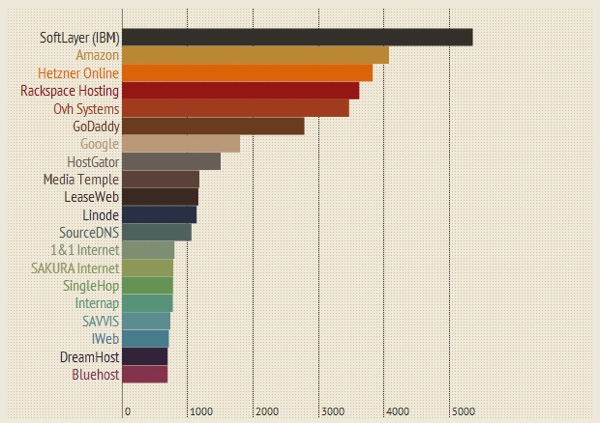
IBM comments on buying Softlayer

GigaOm’s Derrick Harris has a post on IBM and the acquisition of Softlayer.

On buying SoftLayer for $2 billion

“[W]e bought a company. … I’ve bought 120 companies,” Mills said matter of factly, noting that in this case IBM realized it wasn’t capturing certain segments of the cloud market and wasn’t delivering certain capabilities that customers wanted. You can either build those capabilities or buy them, he added, and “at the end of the day you run out of money [to build everything].”

Mills did defend IBM’s cloud legacy, though, going back to then-Google CEO Eric Schmidt calling IBM in 2006 and asking if it would help set up a web-accessible developer cloud “because we had dynamic provisioning and scheduling technology and they did not.”

Too funny, Privacy Int'l thinks the NSA can track phones that are turned off

Battery life is the main thing that defines the user experience.  In the old days, there may have been phones that used power when off, draining the battery.  In the highly competitive world of smartphones who would drain the battery now?

Arstechnica has a post that Privacy int’l is asking manufacturers how the NSA can track their phones when powered off.  This is funny that someone actually thinks the phones are still connected.

Back in July 2013, The Washington Post reported that nearly a decade ago, the National Security Agency developed a new technique that allowed spooks to “find cellphones even when they were turned off. JSOC troops called this ‘The Find,’ and it gave them thousands of new targets, including members of a burgeoning al-Qaeda-sponsored insurgency in Iraq, according to members of the unit.”

Many security researchers scratched their heads trying to figure out how this could be so. The British watchdog group Privacy International took it upon itself to ask eight major mobile phone manufacturers if and how this was possible in August 2013. On Monday, the group published replies from the four firms that have responded thus far: Ericsson, Google, Nokia, and Samsung. (Apple, HTC, Microsoft, and BlackBerry have not yet sent in a response.)

A research officer at the organization, Richard Tynan, wrote that “two themes stood out among the companies that replied: hardware manufacturers claim that they strive to switch off almost all their components while the phone is powered down, and if tracking occurs it is likely due to the installation of malware onto the phone.” Here are a few of the responses:

According to Tynan, Google responded:

When a mobile device running the Android Operating System is powered off, there is no part of the Operating System that remains on or emits a signal. Google has no way to turn on a device remotely.

Samsung Vice President Hyunjoon Kim noted that “without the power source it is not possible to transmit any signal, due to the components being inactive. Thus the powered off devices are not able to be tracked or monitored by any third party.” Meanwhile, Nokia’s Vice President and Chief Ethics and Compliance Officer Chad Fentress said:

Our devices are designed so that when they are switched off, the radio transceivers within the devices should be powered off. We are not aware of any way they could be re-activated until the user switches the device on again. We believe that this means that the device could not be tracked in the manner suggested in the article you referenced.


Open Network Switch is closer to ship, news from Open Compute Project

Open Compute Project’s president Frank Frankovsky posted on the progress of the Open Network Switch.

Just six months ago, we announced our intention to expand the charter of the Open Compute Project to include networking hardware.

At the time, it was our hope that we could build on the momentum we'd established in opening up server, storage, and datacenter designs and collaborate with the broader community on the development of an open, OS-agnostic top-of-rack switch. Such a switch, we believed, would enable a faster pace of innovation in the development of networking hardware; help software-defined networking continue to evolve and flourish; and ultimately provide consumers of these technologies with the freedom they need to build infrastructures that are flexible, scalable, and efficient across the entire stack.

Our progress so far has exceeded even our lofty expectations -- hundreds of people are actively collaborating on the development of more than 30 potential contributions, covering most of the network hardware stack and even some of the network software stack.

 Arstechnica adds in the threat this has to Cisco.

Six months ago, Facebook announced that its Open Compute Project (OCP) would develop a top-of-rack switch that could boot nearly any type of networking software. With the help of Intel, Broadcom, and others, the consortium devoted to open hardware specifications would develop a rival to Cisco's network hardware.

Here is the Cisco response.

In response to today's Facebook announcement, Cisco said in a statement to Ars, "It’s important to acknowledge that the largest web-scale companies driving OCP have the skills, resources, and specialized traffic patterns that justify considering this approach carefully. However, most IT departments won’t relish taking on the additional operational cost, skills and expertise that are required to integrate their own technology.

"We’re finding that the majority of customers are looking for a turnkey solution that gives them the programmability and flexibility they want, with lower operating costs, and that’s exactly what Cisco ACI will deliver, without compromises on scale, performance and security."

9 year old faced with replacing his iPhone 4s or switch to Android Samsung Galaxy Note, he picks the Note - Why?

Less than a week ago my 9 year old son had his iPhone 4S stolen from the bus he rides.  My son spends 45-60 minutes on the bus going to a school that addresses kids with dyslexia.  He has made great progress over the past 2 1/2 years, and we got him a feature phone for the long bus ride.  The family has upgraded to iPhone 5/5S, so we had a 4S we could hand down.  He has been pumped to use the 4S.  Last year we let him have a 3GS.  But he had his phone stolen from the bus and I wrote this post on the 5 steps you can take to protect your iPhone from being stolen.

My son felt bad his phone was lost/stolen, and he was afraid he would be punished.  We have talked about what he can learn from the experience.  All kids go through that painful first experience of having a valuable item lost or stolen.  Two days after the event, he is asking if he can have the other 4S that I was going use for development work.  I told him to wait.  

I decided to charge up my Samsung Galaxy Note 1, wipe it clean, reset it to factory defaults and see if he wanted to play with it.  He wanted to get the move “Remember the Titans,” as he has been getting more into football playing on a well coached flag football team.  He couldn’t figure out how to spell Remember the Titans, so I brought up the mobile browser, hit the microphone button and told him to say “remember the titans.”  Google recognized it, listed the search results.  Next I showed him the pen feature and how he could write with the stylus.  Then the camera app.  He played for hours and was ready to use the Galaxy Note.

There are those of you who may argue that the iPhone 4S can do all this same stuff, minus the stylus.  

Here are a few of the reasons why I am supportive of him using the Galaxy Note with Android on it.

1.  Using multiple devices is like language skills.  It is good to learn another mobile OS. Over twenty years ago I would tell people who knew I worked at Apple and then at Microsoft what computers should their kids should use at home.  They were frustrated their kids had Macs at school and Windows at home.  I told them that kids don’t care most of the time.  It is good to learn different OSs.  Yet with mobile it is quite rare for people to know how to use iOS and Android.  I have an iPhone 5 and a Samsung Galaxy Note 3 which I carry most of the time.

2.  Google’s integration into Android is different than iOS and it creates a different experience which includes more voice features.

3  Samsung’s use of the stylus in the Note series supports hand writing which is good for those who don’t think everything should be from a keyboard.  My son is 9 and he is regularly practicing his hand writing.

4.  My son will learn there are the same and different applications for Android vs. iOS.  It’s not the end of the world switching, yet for some it could be quite traumatic, but not nearly as traumatic as having your phone stolen by kids who you thought would never do such a thing.

5.  The Galaxy Note is bigger and different so it is not a target the way an iPhone 4/5 is.

6.  I am getting an extra battery, so he can swap out the batteries.  Ever notice how many iPhone users are plugged into the wall at conferences?  no spare battery.

7.  He has 48GB of memory, so plenty of room.  16GB internal with 32 GB microSD.

Kids can easily change their minds.  My daughter at first wanted a Windows phone 1 year ago, then within a week said she wanted an iPhone.  I still have a 4S and a nice friend has offered us a Windows Phone.  For now, my son will be on the path to learn Android.  and, he will hopefully comfortably swap between mobile OSs for the rest of his life.

Even though his phone was stolen, he is moving on learning.  Which is part of the challenge of dyslexia.  You hit obstacles.  Adjust.  Try something different.  Keep on going.
Cloud is going to get interesting watching Amazon Web Services compete against IBM

I saw this post that Om Malik reposted.

CIO Magazine: IBM Will Win the War With Amazon

Rob Enderle has been analyst for too long and has mostly been wrong about his favorite target, Apple. And now he has turned his guns on Amazon (Web Services) and points out that IBM is going to win the war with AWS. I think we all have a different definition of winning,  especially considering the troubled cloud effort by IBM. Anyway read the piece, if nothing, for a chuckle!

Talk about two different approaches.  IBM’s business is built on relationships with the CxO to deliver IT services.  Amazon.com is retailer who uses technology the way no other retailer does.  Departments are pulling out their credit cards to use AWS to build IT services that are assumed to be at a lower cost and faster time to market.  In this rush to push out IT services, there are probably many mistakes made from a compliance perspective.  The types of mistakes that can get you fined or in the middle of a lawsuit.

Amazon offsets this by bypassing IT and selling directly to employees. However, IT retains the responsibility for compliance; given enough ammunition, IT generally can block access to any vendor seen as unreliable or unsecure. Expect IBM to start providing IT with the evidence to provide this block and with cost-effective alternatives that IT can use instead.

The CIO article says IBM is ready for a fight.

Don't Bet Against the Old Dog in the Fight

IBM learned early on that fights in any market are often won and lost on perception. The company allocates staff and resource accordingly. In these battles it comes down to who has the most resources and knows the battlefield best. On all vectors, this should be IBM. Amazon may, as the first mover, have the tactical advantage, but IBM has the strategic advantage. At the end of the day, this is IBM's battlefield. It has the best weapons and the appropriate skills.

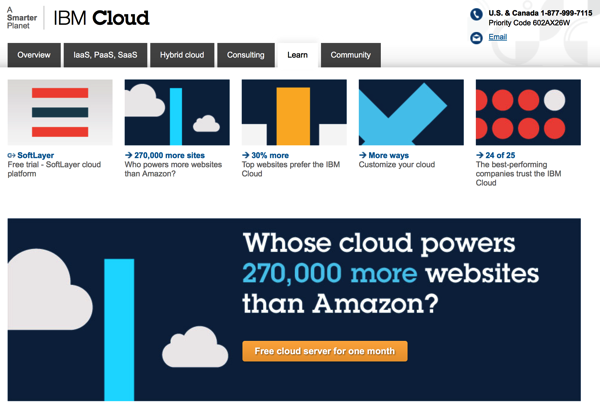
Here is the current state of IBM’s Cloud website. 270,000 more websites than amazon is on IBM’s cloud.

NewImage

NewImage