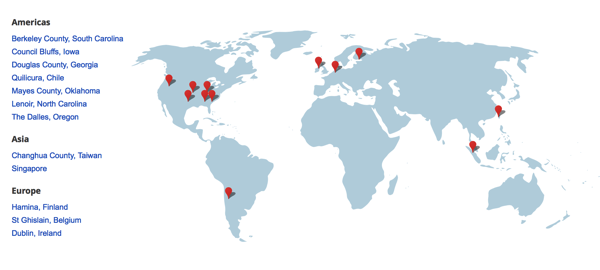
Google Double downs in Taiwan

Google just announced it is expanding in Taiwan.

Google doubles Taiwan data centre investment to $600 million

CHANGHUA, Taiwan Wed Dec 11, 2013 1:03am EST

Dec 11 (Reuters) - Google Inc said on Wednesday it will double its planned investment to $600 million for its data centre in Taiwan to cater to the world's fastest growing technology consumer markets.

"While we've been busy building, the growth in Asia's Internet has been amazing. The number of Internet users in India doubled, from 100 million to 200 million. It took six years to achieve that milestone in the U.S.," Google's vice president of data centres, Joe Kava said in a statement.

The funny thing is I was looking at the Google data center Taiwan website and it said...

In December 2013, we announced the opening of our facility that represents a total long-term investment of USD 600 million.

When.  Oh 24 minutes ago.

A good strategy to go for three data centers in a region, Google folds HK, keeps Singapore and Taiwan

Google announced data centers in HK, Singapore and Taiwan 2 years ago.  Three is a good number when you want to create a high availability service, because sometimes the third has problems.  And in Google’s case they confirmed they will not open up Hong Kong reported in WSJ.

Google Scraps Plan to Build Hong Kong Data Center

Internet giant Google Inc.GOOG +0.60% has scrapped a plan to build its own data center in Hong Kong and will instead expand its facilities in Taiwan and Singapore.

This undated file photo made available by Google shows the campus-network room at a data center in Council Bluffs, Iowa.
 
Associated Press

“While we see tremendous opportunity and potential in Hong Kong…we will not be moving ahead with this project,” Taj Meadows, Asia-Pacific policy communications manager, told The Wall Street Journal on Tuesday

We’ll see if Google chooses another location in Asia Pacific.

Although when you look at a map it looks like Middle East would be a place sometime in the future.

NewImage

IT Automation companies Puppet Labs and Chef invest in new CFOs

Some things  I hear before the press release and hearing something in a bar is not acceptable to write a blog entry.  On Nov 29th I was sitting in a bar and Bill Koefoed said he had a new job and was leaving Microsoft.  Bill’s latest job was CFO at Skype, and he had a new job at a company called Puppet.  Sitting in a bar with a bunch of other ski friends he was used to people saying “Puppet?  What’s that?”  When Bill told me, I said awesome Luke is great.  Scott and Nigel too.  You joined a great team.  It’s a two man race against Chef who just hired another Microsoft CFO.

Now that the news is public I can reference the public disclosures.  AllthingsDigital referenced Bill’s job change.

Top Microsoft Finance Exec Koefoed Departs for Puppet Labs

One of the voices I always enjoyed over the years at the start of Microsoft earnings calls, Bill Koefoed, will be leaving the software giant after eight years to take a job as CFO of Puppet Labs. Most recently, he was working as CFO in the Skype and then in the marketing and business development unit. But Koefoed is perhaps best known, as I called him, as “Microsoft investor relations dude-in-chief.” Puppet Labs develops IT automation software, with almost $46 million in funding from Kleiner Perkins, Google Ventures, True Ventures, VMware and others.

Opscode CFO announcement is here in GigaOm.

Opscode, the company behind the popular Chef configuration management tool set, has a new name (it’s Chef, duh); a new CFO in Microsoft alum Curt Anderson and $32 million in new Series D funding to make the most of that new identity and to promote itself as an IT management “platform.”

Living in Seattle (Chef HQ) and making trips to Portland (Puppet HQ) it is hard not to run into Chef and Puppet employees especially since I write articles on DevOps for GigaOm.

Here is the article I wrote on Continuous Delivery and Devops sponsored by Opscode last year.

Continuous delivery and the world of devops

 Oct. 1, 2012
This report underwritten by: Opscode.
1Executive Summary

The advent of online businesses has created new opportunities and fierce competition. Companies want to get their products and services to market as fast as they can, and releases that occur in periods of months or years are no longer competitive. As a result, the pattern of how to release software is changing from large, infrequent releases of new software to small releases that occur very frequently, as shown in Figure 1. The ultimate goal is the continuous delivery of software updates.

Figure 1. The changing pattern of software releases


This paper explains the world of continuous delivery and its underlying philosophy, devops. Continuous delivery is an automated pipeline constructed with various technologies that allows you to ensure that your code is always ready to be released. It does not mean that you have to release every change you implement: That is a business decision. It does mean that when you choose to release, your code is ready, fully functional, and fully tested.

In conjunction with the technology is the emerging devops methodology, which is an outgrowth of the agile movement. This movement stresses collaboration among groups that have often found themselves at odds, in particular development teams and operations teams. This increased level of collaboration blurs the boundaries between infrastructure and code. Looking at application code and infrastructure holistically rather than as separate disciplines and treating them the same in terms of automated delivery provides compelling benefits in terms of time to market and overall stability.

Bitcoin suffers when it potentially disrupts the China Power and Money System

China is known for so much that has changed and many see China as the land of opportunity.  The latest adventure has been the use of Bitcoin.  It’s rise and fall. One way to look at China is as much as there is new there are some things that don’t change.  In China there are two fundamentals, Power and Money.  And, Money and Power.  To give you an idea of how power and money are different in China read this Economist article on how much richer the politicians are in China vs. the USA.

Power and money

Wealthy politicians

Sep 28th 2013 | From the print edition

Many Americans grumble about the wealth of their politicians, but they are paupers compared with their Chinese counterparts. The 50 richest members of America's Congress are worth $1.6 billion in all. In China, the wealthiest 50 delegates to the National People's Congress, the rubber-stamp parliament, control $94.7 billion. Darrell Issa, a Republican from California, is the richest man in Congress, with $355m. China's richest delegate is Zong Qinghou, boss of Hangzhou Wahaha Group, a drinks-maker, whose wealth is almost $19 billion (including assets distributed to family). Last year Mr Zong was China's richest man, but was overtaken by Wang Jianlin, who is not a member of the NPC. Wealth can bring problems wherever you are. On September 20th, a man, angry at being refused a job, attacked Mr Zong with a knife near his home in Hangzhou. Mr Zong survived, with nasty cuts to his hand.

On 11/24/2013 Forbes discusses how Bitcoin, Baidu, and Beijing are a triangle.

A China Triangle: Bitcoin, Baidu And Beijing

Comment Now

Thinking of buying trinkets in Beijing?  Don’t forget to bring your Bitcoins. China, in the last few weeks, has gone crazy over the cryptocurrency, which is now accepted by Chinese online retailers, a Shanghai real estate developer,and traders in Tiananmen Square.  Perhaps you want a latte in Zhongguancun?  Yes, you can use Bitcoins to pay for caffeine in Beijing’s high-tech zone.

And less than two weeks later Baidu and Beijing shut down the use of Bitcoin.

China Slams Bitcoins: What's Next?

Chinese central bank prohibits the country's financial institutions from touching bitcoins, but plans regulation. Cue further trouble for the crypto-currency?

The value of bitcoins dropped 30% Thursday after the People's Bank of China and five other Chinese government ministries banned the country's financial institutions from handling the currency.

Why the sudden change?  Because Bitcoin changes the Money system in China which effects Power.  Those in power don’t like to see the money system changed in a way that could affect their power.

Windfarms can kill Eagles if they fill out the right paperwork

Generating energy has some form of impact on the environment. It is hard to convert 100s of MW of power from a source to electricity without some part of the environment being hurt.  Windfarms kill bats and birds and probably have other effects.  The killing of eagles has the current attention.  Here is a WSJ article on the topic.


Wind Farms Gain Protections from Bird Kill Prosecutions

U.S. Sets 30-Year Permit for Accidental Eagle, Other Bird Deaths

The U.S. Interior Department on Friday issued a rule that highlights a tension lingering between two key goals of the environmental movement: developing renewable energy sources and protecting wildlife.

The newly finalized rule would grant 30-year permits allowing wind farms and other projects to accidentally kill federally protected eagles, provided they meet certain criteria.

The new rule, which extends an existing five-year window, comes at the same time the government is stepping up its oversight of illegal bird deaths on wind farms.

Here is the press release from the Dept of Interior.

Interior Department Releases Revised Rule to Ensure Long-term Monitoring and Protection of Eagles While Facilitating Renewable Energy Development


Additional Changes to 2009 Eagle Permitting Rule  to be Explored through Public Process


12/06/2013


WASHINGTON, D.C. – The Department of the Interior today announced changes to regulations enabling the U.S. Fish and Wildlife Service to better monitor and address the long-term impacts of renewable energy projects and other activities on federally-protected eagles. In addition to these immediate changes, the Service will continue its comprehensive review of all eagle permitting regulations to determine if other modifications are necessary to increase their efficiency and effectiveness.

“Renewable energy development is vitally important to our nation’s future, but it has to be done in the right way,” said Secretary of the Interior Sally Jewell. “The changes in this permitting program will help the renewable energy industry and others develop projects that can operate in the longer term, while ensuring bald and golden eagles continue to thrive for future generations.”

So if you fill out the right paperwork it is OK to have dead eagle as the base of the wind turbines.

I didn’t realize until now that the charter of the Department of Interior is to protect the outdoors and provide power for the nation.

Our Mission: Protecting America's Great Outdoors and Powering Our Future

The U.S. Department of the Interior protects America’s natural resources and heritage, honors our cultures and tribal communities, and supplies the energy to power our future.