Changing Operations with Proximity Sensors, iBeacon

I am spending more time in operations, and playing with some what if ideas.

Apple announced iBeacon and most are focusing on retail and consumer type of experiences.  Here is a Washington Post article with a  few.

How iBeacons could change the world forever

Retailers are likely to place iBeacons such as this one from Shopkick around their stores, in hopes of better connecting with and serving customers. (Courtesy of Shopkick)

Retailers are likely to place iBeacon sensors such as this one from Shopkick around their stores, in hopes of better connecting with and serving customers. (Courtesy of Shopkick)

Apps such as Google Maps and FourSquare have long used location data to try to improve the average person’s mobile experience. But that could be just the tip of the location iceberg as Bluetooth’s latest technology revolutionizes how people interact with everyday objects and places.

The above is about Radius Networks device.

Here is a GigaOm post by Kevin Tofel on Qualcomm’s Gimbal device.

Step aside iBeacon, Qualcomm has low-cost Gimbal Proximity Beacons

DEC. 9, 2013 - 9:02 AM PST

17 Comments

Project Gimbal
SUMMARY:

Apple’s iBeacon isn’t the only game in town when it comes to Bluetooth Smart proximity devices for retailers. Qualcomm’s Gimbal Proximity Sensor is now available, supporting iOS today and Android in the future. Get ready for a hyper-personal in-store shopping experience.

It is an interesting exercise to think about how operations can be change with proximity sensors.  This is much more interesting than RFID.  Why?  iBeacon is built on Bluetooth 4.0 which is more ubiquitous than RFID readers.  NFC hasn’t really taken off, and with Apple’s iBeacon announcement bluetooth proximity sensors are hot.


Peer 1 Hosting Surveys Canada and UK users, 25% planning on moving out of US

DataCenterKnowledge has a post on a Survey and the impact of the NSA scandal.

Survey: NSA Scandal Prompting Shift Away From U.S. Providers

January 8th, 2014By: Jason Verge


Here is the press release from Peer 1 Hosting announcing the survey.

PEER 1 Hosting Research Confirms NSA Scandal Has Made UK and Canadian Businesses Wary of Storing Data in the U.S.

Wednesday, January 8th, 2014

25% of businesses are moving data outside of the U.S. as a result of privacy scandals; 96% consider security and 82% consider data privacy their top concerns

Vancouver, British Columbia – January 8, 2013 – A new independent survey of 300 UK and Canadian businesses, commissioned by web infrastructure and cloud hosting provider PEER 1 Hosting, reveals that 25 percent will move their company data outside of the U.S. due to NSA-related privacy and security concerns. Canadian companies are even more likely to relocate data than UK companies, with one in three saying they will move away from U.S. datacenters. Despite this trend, the U.S. remains the most popular place for these companies to host data (51 percent) outside of their home countries.

And the survey results are here.

NewImage

With an executive summary.

NewImage

One piece of data that got me to believe Peer 1 was talking to the right people is the fact that 80% of the people weren’t surprised of the NSA spying.

NewImage

And trouble for those who think it is all about latency.  This survey says users are more worried about security than latency.

NewImage

The closing slide has a bunch of quotes.  It is easier to read this if you go to the survey PDF and go to slide 20.

NewImage


Isn't it a bit ironic that Cleantech is a dirty word? Analysis of 60 Minutes piece

It wasn’t too long ago that people would proudly say they worked in Cleantech.  Now Cleantech is a dirty word associated with failure.

60 minutes had a piece on Cleantech which focused on the failure part.  I couldn’t put my finger on what bothered me about the 60 minutes video.

Then GigaOm’s Katie Fehrenbacher wrote her analysis of what 60 minutes got right and wrong in their story. 

What 60 Minutes got right and wrong in its story on the “cleantech crash”


JAN. 5, 2014 - 6:50 PM PST

22 Comments

Dogpatch Biofuels
SUMMARY:

60 Minutes just aired one of the more mainstream looks yet at the Silicon Valley cleantech rise and fall. While they got some things right they also got some wrong. My take here.

Katie had the benefit of months of knowing the 60 minutes broadcast was coming out.

Full disclosure, I spoke with the producers of the 60 Minutes piece on background a few times over the past few months as they were putting it together, just to try to help them go in the right direction.

Katie presents her view of what 60 minutes got right and wrong.

Contrary to the reaction of many of my Twitter friends, I think 60 Minutes got some key things right in the story, but they also got a couple of things wrong in there, too — most importantly they’re overlapping the Valley story with the government funding story. Here’s my take on their piece, which — to their credit — is one of the more comprehensive mainstream media looks at what was the VC cleantech phenomenon:


Do you think of Trust as a Design Pattern? It changes many things

Sitting around thinking about how to be different than the rest I realized focusing on creating a service where Trust is a design priority changes many things.  Trust is one of those things that is valuable yet hard to develop.

GigaOm has a post on the problem of perceiving trust.

Is it safe to buy that new gadget? Why trust is perceptual computing’s biggest problem


4 HOURS AGO

No Comments

Hear_speak_see_no_evil_Toshogu
SUMMARY:

This year’s CES is a frustrating affair — so many cool new context-aware toys to play with, and so little reassurance from the manufacturers that their use will stay secure or private.

Thanks to Eric Snowden the issue of trust is a hot topic.

I am really frustrated right now. I look at the slew of awesome announcements coming in from the Consumer Electronics Show in Las Vegas, and I keep thinking the same thing: “Nope, because surveillance.” Damn you, Snowden!

...

Security and privacy can no longer be afterthoughts or nice-to-haves — difficult as they are to implement in this age of embedded systems. We the consumers now know the dark flipside to these innovations, and that, manufacturers and app providers, is your problem.

So many free services are built on users not thinking about the trust of watch is being done with the events in your life.

Trust is one of those things that is hard to do and with all the latest technology is more and more valuable.

Who do you trust?  Do you focus on developing more trust?

What would change in your data center with more trust?  What changes in your data center with less trust?

AWS first outage of 2014, Jan 3 12:50a

I was disconnected from the internet this weekend and one of my developer friends said AWS was out in the East Coast and I couldn’t find much on the outage.

Here is one post.

Amazon Cloud Services Down, Netflix, Other Sites Unreachable

January 3, 2014 

By Paul Thomson :: 1:16 AM

Update: As of 2:45 AM, it appears that Amazon’s cloud services are coming online again.

With the northeast in the grips of a deep freeze and blizzard, many people are stuck indoors tonight, hunkered down in front of the glowing screens of laptops and televisions. What they’re likely not doing, is watching Netflix and surfing on some parts of the social web, however.

Around 12:30 AM, an outage occurred with Amazon’s cloud storage service, throwing many databases and applications offline. Some of the affected sites include Netflix, Amazon streaming media, Amazon Mechanical Turk, Steam, Tumblr, and various blogs and websites that depend on Amazon’s services to host and deliver their data.

The outage appears to be centered in one of Amazon’s East Coast data centers, according to Tweets from various sources trying to pinpoint the problem, but no official status update has been given from Amazon yet.

Given the amount of outages in East Coast AWS we have chosen to try and use AWS West and our clients are more on the west coast. 

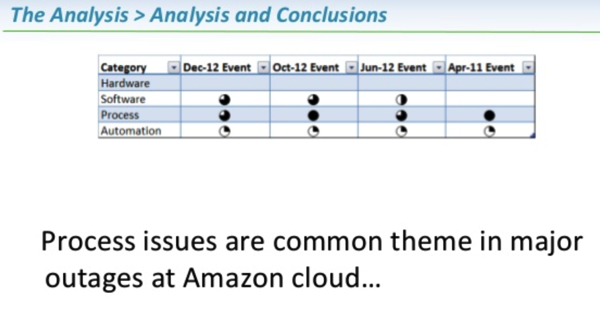
We’ll see what AWS outages look like in 2014 vs. 2013.  Here is an slideshare analyzing past AWS outages.  And the conclusion is most outage are caused by process issues.

NewImage