How Google backs up the Internet

Here is a talk from Oct 2013 on “How Google backs up tho Internet"

If you don’t have the time to watch the video here is a post based on the video.

How Google Backs Up The Internet Along With Exabytes Of Other Data

Raymond Blum leads a team of Site Reliability Engineers charged with keeping Google's data secret and keeping it safe. Of course Google would never say how much data this actually is, but from comments it seems that it is not yet a yottabyte, but is many exabytes in size. GMail alone is approaching low exabytes of data.

Mr. Blum, in the video How Google Backs Up the Internet, explained common backup strategies don’t work for Google for a very googly sounding reason: typically they scale effort with capacity. If backing up twice as much data requires twice as much stuff to do it, where stuff is time, energy, space, etc., it won’t work, it doesn’t scale.  You have to find efficiencies so that capacity can scale faster than the effort needed to support that capacity. A different plan is needed when making the jump from backing up one exabyte to backing up two exabytes. And the talk is largely about how Google makes that happen.

Clouds coming to Carriers Telecom Gear - NFV (Network Functions Virtualization)

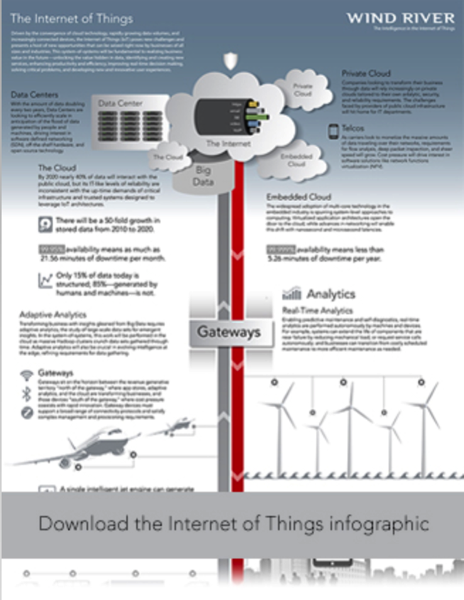
In data centers we take Virtualization for granted.  The software defined data center with software defined network and storage are part of the package.  Another part though is the Network Functions Virtualization (NFV) for Telecom Carriers.

Wind River has their press release announcing HP partnership.

Wind River to Create Carrier Grade NFV-Ready Server Platform with HP
NEWS HIGHLIGHTSWind River products in certification include open source real-time kernel virtualization, a market-leading embedded Linux distribution, and carrier grade software registered with CGL 5.0 specification.Wind River and HP are enabling complete carrier grade servers ready to address an evolving network infrastructure with demanding NFV and IoT needs.Wind River will become a preferred software vendor for HP NFV-ready servers. ALAMEDA, Calif. — Feb. 19, 2014 — Wind River®, a world leader in delivering software for intelligent connected systems, has announced that it is working with HP to certify Wind River networking and communications software on Network Equipment Building System (NEBS)-compliant HP ProLiant servers.-

Both HP and Dell have web pages for NEBS compliant servers.

HP carrier-grade servers

HP carrier-grade platforms—reliable, flexible, scalable, and ready to support your NFV project.

http://h22168.www2.hp.com/us/en/oem/carrier-grade.aspx#tab=TAB2 

Dell’s OEM Solution for telecommunications blends Network Equipment Building System (NEBS)-certified reliability, cost-effective components for high volume, and Dell’s established, high-ranking services and support. These pre-configured servers are based on open standards to help maximize compatibility, scalability and expandability for the highest possible level of stability, when and where you need it most. That way, Dell’s NEBS-compliant solutions can bring you lower operational expenses, better profitability and simplified operations so your technology leaders can focus on what matters: truly innovating to better serve your customers and the world.

http://www.dell.com/learn/us/en/555/oem/telecommunications


You have the traditional equipment with their NFV efforts.  Also today is Alcatel-Lucent.

Alcatel-Lucent delivers suite of virtualized network functions, ushering in the next phase of mobile ultra-broadband for service providers

Alcatel-Lucent's bold NFV roadmap, including virtual EPC, IMS and LTE RAN helps Mobile Network Operators become more efficient, responsive and innovative


PARIS, Feb. 19, 2014 /PRNewswire/ -- Alcatel-Lucent (euronext paris and nyse:ALU) is delivering a portfolio of virtualized mobile network function applications – evolved packet core (EPC), IP Multimedia Subsystem (IMS) and radio access network (RAN) - and extending them to the cloud. Mobile operators will deploy these network applications to drive breakthrough scalability and elasticity, becoming more agile, efficient and responsive as they innovate with new service offerings, speed deployments on a massive scale and expand into new markets.

Last week Ericsson.


Launch: Evolved Packet Core provided in a virtualized mode industrializes NFV
2014-02-12 Categories: Press Releases Download: 
  • Virtualization enables fast time to market of new business solutions such as M2M, enterprise and distributed cloud MBB for fast growing markets 
  • Ericsson's industry-leading Evolved Packet Core solution provided in a virtualized mode with feature compatibility for efficient cloud transformation 
  • End-to-end support provided for operator  transformation to cloud and NFV 

Network Functions Virtualization (NFV) provides important mechanisms to make operator networks more agile and operationally efficient. Ericsson (NASDAQ: ERIC) is now bringing NFV to an industrial scale with a full suite of virtualized network applications, combined with consulting and systems integration services. Based on an open, telecom-grade cloud execution environment, efficient end-to-end solutions and more flexible deployments are enabled.

What you mean the Cloud has Issues? WSJ advises small business users

With all the hype for the Cloud it is easy for people to think the cloud doesn’t have problems.  WSJ has a post on the problems with clouds for small business users.

The Problems With Heading Into the Cloud

When small firms use remote services, they face headaches they never had before

 
February 3, 2014

Ah, the simplicity of the cloud. For small businesses, it means not having to manage big IT setups in their office, turning instead to remote services that let them do everything from storing data to running software online.

Well, maybe not as simple as many entrepreneurs expect. Experts warn that shifting big jobs to the cloud still means business owners need to oversee a host of everyday IT operations around their own office. And it introduces technical considerations they may never have thought of.

Intel Ships Brawny Processors to scale up

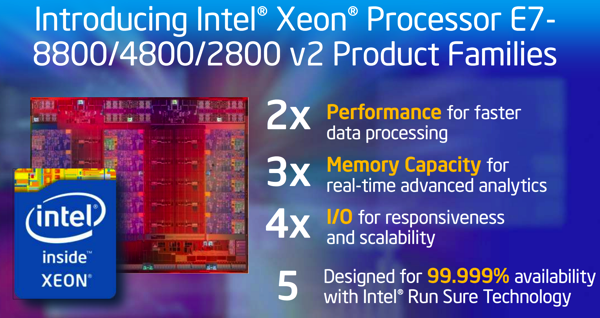
Intel has released the Xeon Processor E7-8800/4800/28000 v2 family.

 NewImage

What comes to mind is Urs Hoelzle’s call to action that not all services can be provided by whimpy energy efficient low clock rate cores.  There is a need for brawny cores.

Brawny cores still beat wimpy cores, most of the time

Urs Hölzle

Google

Slower but energy efficient “wimpy” cores only win for general workloads if

their single-core speed is reasonably close to that of mid-range “brawny”

cores.

At Google, we’ve been long-term proponents of multicore architectures and throughput-oriented

computing. In warehouse-scale systems1 throughput is more important than single-threaded peak

performance, because no single processor can handle the full workload. In addition, maximizing singlethreaded

performance costs power through larger die areas (for example, for larger reorder buffers or

branch predictors) and higher clock frequencies. Multicore architectures are great for warehouse-scale

systems because they provide ample parallelism in the request stream as well as data parallelism for search

or analysis over petabyte data sets.

The Register has a detailed article.

Better late than never: Monster 15-core Xeon chips let loose by Intel

New mission-critical CPUs are mission-critical to Chipzilla's critical money-making mission