Writing about Information Theory, no Information Engineering

I have been thinking it is time to change what I spend time writing about.  The data center is a building to house information.  Information is changing how data centers are built.  Services are changing the information we work with.  It is time to change how Information Technology systems are designed and used.

If you look hard you can see the changes coming through.  It is dividing those who want change and those who see change as a threat to their way of doing things.

I started writing this blog on the idea of a green data center is important.  It is, and will continue to evolve.  The greening of the data center is becoming more than just the building.  It is hardware and the software together is greener, and the information is being used to support sustainable efforts.  

One idea to write about is Information Theory.  No, information theory makes it seems like it is theoretical.  What is more interesting is what is getting done.  The execution.  The trade-offs being made to make changes happen.  Information Engineering seems like a better description.

NewImage

I still plan on writing on data centers especially those ideas that support greener more sustainable ideas.
Be Happy, watch this video

It’s really hard to work on big ideas when you don’t feel good.  Be Happy.  Check out this video.

The innovative part is there is a site for 24 hours of Happy.  http://24hoursofhappy.com

Dubbed the world's first 24-hour video, it features a diverse cast of characters, including the artist and some famous friends, dancing along to the track. The video is presented as an interactive clock-- users can click specific "times," watching a few seconds of each performance or just Pharrell (his bits are indicated by the dots around the clock). Other interactive elements play with the 24-hour concept--comments, for example are time-stamped and linked to corresponding moments in the day-long dance, and they can be viewed in temporal order as an overlay to the video.

The First Graduate Degree for Datacenter Systems Engineering Program is at SMU

I have an engineering degree, and most of my data center friends have engineering degrees too.  But, no one has a degree in datacenter engineering.  SMU announced the first Datacenter Systems Engineering graduate degree.

SMU’s Master of Science in Datacenter Systems engineering is built around five core courses that address the industry broadly, while offering elective specializations in three technical areas:

  • Facilities, infrastructure and subsystems
  • Datasystems engineering and analytics
  • Computer networks, virtualization, security and cloud computing

”SMU’s Master of Science in Datacenter Systems Engineering program addresses a long unfulfilled need in the datacenter industry,” said Chris Crosby, CEO of Compass Datacenters. “Its comprehensive, cross-disciplinary curriculum provides the breadth of knowledge professionals need for success in this complex industry with numerous interdependencies.”

The SMU Datacenter Systems Engineering program is directed toward preparing professionals for a leadership role in this field, whether specifically as a technical contributor or more broadly in management. The program is designed to build a solid foundation for continued professional growth consistent with modern datacenter engineering practices and the changes that lie ahead for this industry.

SMU has a unique opportunity to play a significant role in educating engineering professionals in this field both locally on-campus and nationally via distance education. Approximately 50 datacenters exist within the greater Dallas area.  

There are some so called data center experts out there with no engineering degree so they can’t get their graduate degree in datacenter systems engineering.

In addition to meeting Lyle School admission requirements for a Master of Science degree, applicants are required to satisfy the following requirements:

  • A Bachelor of Science degree in one of the engineering disciplines, computer science, one of the quantitative sciences or mathematics.
  • A minimum of two years of college-level mathematics including one year of college-level calculus.

Part of what is needed in the data center industry is a pool of knowledge and SMU will enable a place to go to look for datacenter knowledge.

Key factors which determine successful competition in today's global environment are: timely and rapid response to customer needs, high product quality, and flexibility of operation. To achieve these objectives, the common element is an effective and knowledgeable organization oriented towed customer needs and requirements.

 We should all buy Chris Crosby a beer to show our appreciation to start something that hopefully will grow over time.

Do you have a High Status Star on your team? Don't feed them Humble Pie

Some think the answer to get performance for the team is to hire a star performer.  Many times that star wants high status.  A common misconception is a high performer has more resources to draw upon during a setback, but according to a study by a couple of Academy of Management professors this isn’t true as often as people think.  One of the things I figured out is the Type A over achiever who has the high status star has some flaws when you dig underneath. You’ll find many times they have many more insecurities than others, and has something they obsessively focus on to show they are better than the rest.  This study explains the situation with some data.

Although "making their prestigious position a central part of their self bolsters high-status individuals' self-worth... it also means that they come to depend more than low-status individuals on their status to maintain their positive self-view," explain the paper's authors Jennifer Carson Marr of Georgia Institute of Technology and Stefan Thau of INSEAD. "Consequently, losing status is likely to be more self-threatening for high- than low-status individuals [and they] will experience a more significant decline in the quality of their performance in the immediate aftermath of status loss."

One of the great observations made by a data center executive is a person who is the “Donald Trump” of the data center industry.  Why? That person is self promoting.  He is a nice guy, but after a while it gets a bit tiring to feed their ego.

The last thing you want to feed a high status individual is a serving of Humble Pie.  Here are three tips to take care of that high status individual who works on your team or may be yourself.

Asked what lessons might be drawn from the paper's findings, Prof Marr names three.


"The first is to acknowledge that even top performers -- in fact, especially top performers -- are prone to make mistakes and suffer poor performance in the aftermath of status loss, which suggests that this is not the time to be taking significant actions or making important decisions. It is prudent to take some time off and restore one's sense of self-worth before returning to work.


"Second, you can reduce the harm from status loss by taking some time to think about a valued relationship and, in general, by recognizing the value of meaningful relationships or aspects of one's life outside of work. These elements can compensate for threats to the self that loss of status can entail. Another way to achieve this may be by looking to change jobs, to find work at another organization where you feel respected.


"Finally, our research investigates the immediate consequences of status loss, but over time individuals find ways to affirm themselves and come back. Steve Jobs was a prime example of that. Maybe we'll see the same thing with A-Rod now that he has a year off courtesy of a Major League Baseball arbitration. He's talking about coming back better than ever, and, who knows, if he's learned a lesson, he just might."

Work Life Balance, BS make your Health #1

Work Life balance is standard HR language to minimize the litigation exposure.  Here is an article that says the USA’s life work balance is amongst the lowest.

To many tired American workers, this won't come as a surprise. The United States has a pretty abysmal ranking on the list of developed countries for creating a balance between work and life away from work.

Americans work longer hours, have fewer vacation days and leisure hours, and spend as much or more time cooking, cleaning and caring for family as their international counterparts.

This is according to the 2013 Better Life Index, compiled by the Organization for Economic Co-operation and Development, a nongovernmental organization in France that tracks economic and social data from its economically developed member countries.

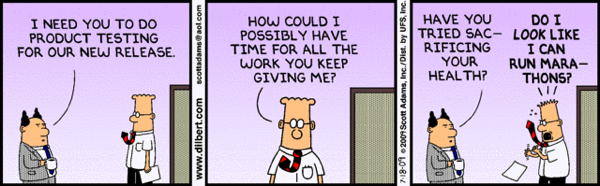
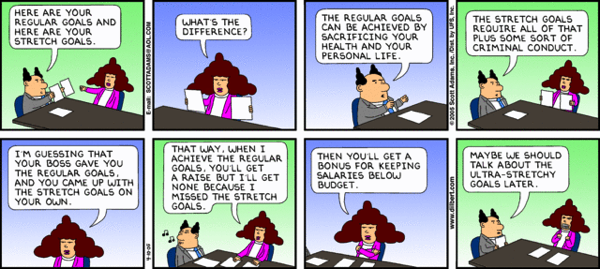
Here are two dlibert cartoons that poke fun at the concept.


NewImage
NewImage

Just went to a funeral service for a friend who had a sudden cardiac arrest at the age of 47.  She didn’t make her health #1, and most likely increased the risk of her cardiac arrest.

If any of my data center friends look like they are losing the health vs. work battle, I try to persuade them that making your health #1 is best for you overall.  

(Note: I tried to embed the Dilbert Cartoons, but the html code didn’t work.