Improvement in Internet Trust, EU Commission VP Neelie Kroes speaks at Cebit, More Regulation Coming

The data center industry is largely unregulated, but with the maturing of any industry comes the eventual regulation as governments are concerned about public safety.

re/code has a post on EU Commission VP Neelie Kroes.

Neelie Kroes Calls Snowden Revelations a Wake-Up Call — “Let’s Not Snooze Through It”

March 10, 2014, 3:19 AM PDT

By Ina Fried


European Commissioner Neelie Kroes said that Edward Snowden’s revelations about NSA spying should serve as a wake-up call that there is a new reality that includes cyber spying and cyber warfare.


Snowden sent the wake up call to the public.  Most of the insiders aren’t surprised by what Snowden has shared.  It just wasn’t public knowledge.

She called on Europe’s political apparatus to create a strong directive around cyber security.

“Snowden gave us a wake up call; let’s not snooze through it,” Kroes said.

Can you see regulations coming?

Joining Kroes in a panel discussion, computer science professor Wendy Hall said that it makes sense that society is struggling to figure out what policies make sense, noting it took centuries to create social norms for the offline world.

“We’ve got to figure out how to live in the digital world in an open society,” Hall said.

If you Have a Disruptive Innovation, do your users Squirm?

Disruptive Innovation is assumed to be a game changer.  

disruptive innovation is an innovation that helps create a new market and value network, and eventually disrupts an existing market and value network (over a few years or decades), displacing an earlier technology. The term is used in business and technology literature to describe innovations that improve a product or service in ways that the market does not expect, typically first by designing for a different set of consumers in a new market and later by lowering prices in the existing market.

This is contrast to Sustaining Innovation where 

In contrast to disruptive innovation, a sustaining innovation does not create new markets or value networks but rather only evolves existing ones with bettervalue, allowing the firms within to compete against each other's sustaining improvements.

You could put Sustaining Innovation on one end of the scale and put Disruptive Innovation on the other end and your new service fits somewhere on the line.  But, where does it fit?  Here is one way to judge where you fit.  When you discuss your service do you find some people squirm?


  1. 1.
    wriggle or twist the body from side to side, esp. as a result of nervousness or discomfort.

Why is squirm an indicator?  Because if you are disrupting things, then some people are going to be uncomfortable with the change.  Seems to be innovative, you are going to make more people squirm.  Sound crazy? I am thinking how to make more people squirm which means the technology we are developing is more disruptive and creating new markets.

Latency impacts Rollout of EA's Titanfall, South Africa orders cancelled

Arstechnica reports on EA’s Titanfall being pulled from the South Africa market due to latency connecting to Microsoft’s Azure Cloud.


EA nixes Titanfall for South Africa after poor network performance

Lack of local Microsoft Azure data centers seems to be feeding latency issues.

"After conducting recent online tests for Titanfall, we found that the performance rates in South Africa were not as high as we need to guarantee a great experience, so we have decided not to releaseTitanfall in South Africa at this time," the post reads. "We understand this is a disappointment for local fans and will keep fans posted on any future plans regarding the release of Titanfall in South Africa."

Australians lucked out even though there is no Azure data center.

Australia is similarly lacking in local Microsoft servers, having to rely on a Microsoft data center in nearby Singapore, but Microsoft has announced plans for two new data centers for New South Wales and Victoria. "We'll have good news soon for Aussies," Zampella tweeted in response to a question about the server situation there.

Facebook figures out the way to bring down Data Center Cost is Lean

The idea of Lean started in Manufacturing and has spread through construction.  Now Facebook has chosen to build its 7th data center with Lean Construction techniques.

Faster, Leaner, Smarter, Better Data Centers

Friday, March 07, 2014 · Posted by  at 1:30 AM

Four years ago, Facebook broke ground on its first greenfield data center project in Prineville, Oregon. In the years since, we’ve deployed six iterations of that design, culminating in the first building currently under construction at our new campus in Altoona, Iowa. With facilities around the world, we constantly challenge ourselves to improve our data center designs to maximize efficiency, reduce material use, and speed up build times.

At this year’s Open Compute Summit, we previewed what we believe will be a step change in those ongoing efficiency efforts: a new “rapid deployment data center” (RDDC) concept that takes modular and lean construction principles and applies them at the scale of a Facebook data center.

We expect this new approach to data center design will enable us to construct and deploy new capacity twice as fast as our previous approach. We also believe it will prove to be much more site-agnostic and will greatly reduce the amount of material used in the construction. And with today’s exciting news from my colleague Joel Kjellgren, we will get to test these theses: Our newly announced second building at our Luleå, Sweden, campus will be the first Facebook data center to be built to our RDDC design.

If you want to watch a video that shows the presentation you can go to this one. http://youtu.be/yu8jin33G64?t=21m50s

I found this information thanks to GigaOm’s Derrick Harris who was at the Open Compute Summit.

The first method Facebook is employing, called the “chassis approach,” is actually more similar to an automobile assembly line, where the chassis is built separately and then built upon from there. In Facebook’s case, the chassis is a 12-foot by 40-foot unit that will sit above rows of racks and house lighting, cable trays, and everything else that typically goes above a row of servers. Facebook data center engineer Marco Magarelli wrote in the blog post detailing the new methods that the company chose the chassis approach over standard containers “to avoid shipping the empty space that will eventually be occupied by the racks.”

How a chassis is built and delivered. Source: Facebook

How a chassis is built and delivered. Source: Facebook

Sample instructions for putting together the pieces in the flat pack. Source: Facebook

Sample instructions for putting together the pieces in the flat pack. Source: Facebook


If AWS is invincible, then why fund a direct competitor? DigitalOcean gets $37.2 mil

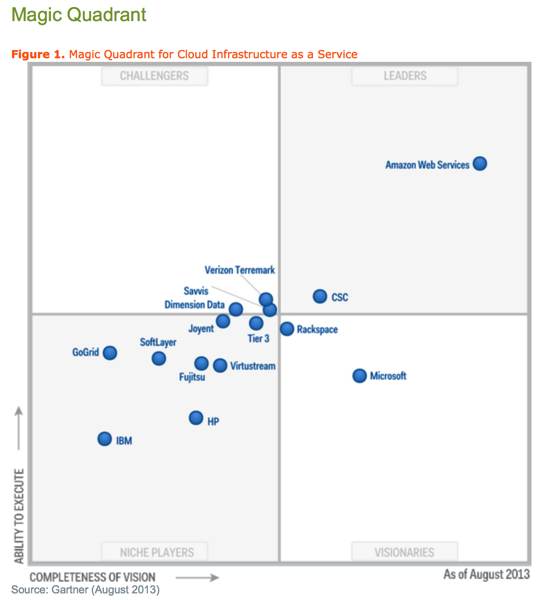
The way some people talk AWS has already won the cloud battle and the spoils are left to the rest.  The beauty of the cloud and their customers is as fast as VMs can be spun up, new businesses can figure out better ways to spin up VMs.  Here is Gartner’s infamous magic quadrant on IaaS.

NewImage

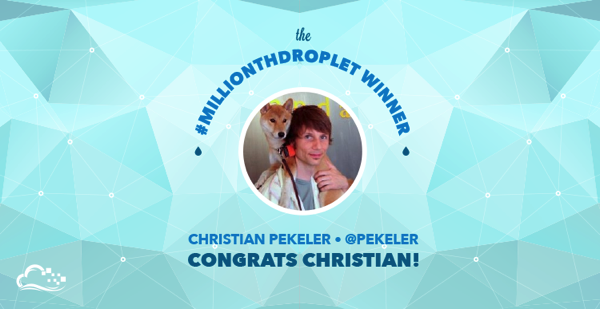
So how’s this for a change.  DigitalOcean doesn’t show up anywhere in this graphic.  Yet has just received $37.2 mil series A funding and has spun up its 1,000,000 VM.

DigitalOcean Growth

In the past 15 months and with only a handful of engineers we’ve been able to hit some amazing milestones. We’ve launched over 1,000,000 virtual servers, processed 18,000,000 events, opened new datacenter regions in San Francisco and Singapore, for over 100,000 customers.

NewImage

DigitalOcean had a simple vision.  Make life easier for the developer.  Vs. Amazon make more money.  Make things stickier, make it hard for people to leave AWS.

We started DigitalOcean in the summer of 2011 with a simple mission: to make developers lives easier. We thought that the other players in the space had made IaaS too complicated. We focused on user experience and simplicity. Guiding ourselves with a single principle, can we build a product that we would love ourselves?

With three engineers we built the first version of our product and with help from the Hacker News community our growth exploded when we announced our SSD powered cloud.

Part of the problem AWS is having in its efforts to make it harder for people to leave it makes it harder to get started as well.