Avison’s Jim Kerrigan is a native Chicago resident and his knowledge of the data center market is among the best. Jim has a newsletter he just shared on the Chicago Data Center market.

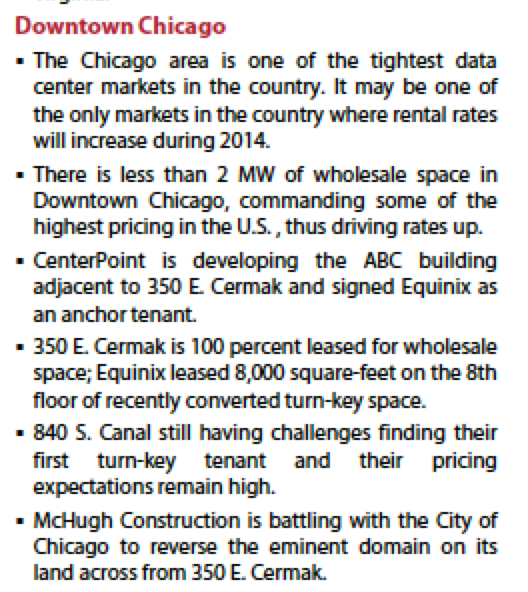
You can see the past newsletter’s Jim has posted here.
Your Custom Text Here
Avison’s Jim Kerrigan is a native Chicago resident and his knowledge of the data center market is among the best. Jim has a newsletter he just shared on the Chicago Data Center market.
You can see the past newsletter’s Jim has posted here.
I’ve been coordinating with some other friends who will be at 7x24 Exchange Boca. So, many of my data center friends are there and we are planning when we’ll have time to chat business and catch up.
FYI, tomorrow is last day for early bird registration.
There are some people out there who believe if they were in charge then all things would be right as they know in their head what are the right things that need to be done. This can occur in design, construction, operations and so many other areas. What is really crazy is when you scale up the ideas in a person’s head the right way and underlings bow down in obedience.
I think this could explain why so many things in the data center world just don’t look right to people who objectively review what others have done.
Check out this Psychology Today article on problems on what your mind sees.
Our perception of the world is like a telegram with every other word missing. We get the gist of things, while our minds fill in the missing pieces. Sometimes our minds get it right; sometimes they are spectacularly wrong.
How many times have you run into this social situation?
For example, have you ever assumed that someone was upset with you because his or her behavior seemed cold or distant, then later discovered that their behavior had nothing to do with you?
We assign personalities to people that help us understand and predict their behavior. Cognitive psychologists call them schemas. When a person's behavior violates our schema, the mind is always at the ready with a quick and easy explanation: Uncle Marty forgot my birthday. Clearly he is angry with me.
From a mind's point of view, the most sensible explanation is the one that ensures our safety. If a mind assumes that Uncle Marty is angry, then we will feel compelled to respond, perhaps by repairing the relationship or distancing ourselves from it. ...Gosh, I better figure out why Uncle Marty is angry. Or, ...Screw Uncle Marty. I never liked him anyway.
The good data center people know they have blind spots and they build a team that reduces the impact. Some data center teams do the opposite and build a team that follows their vision. I think the management consultants have blown up people’s egos too much many times to convince they need vision.
How many managers have failed because their vision had too many blind spots?
Meditation can teach you many things. Here is one technique to ask whether you practice.
Meditation is neither shutting things out nor off. It is seeing things clearly, and deliberately positioning yourself differently in relationship to them.
Kabat-Zinn, Jon (2010-02-06). Wherever You Go, There You Are: Mindfulness Meditation In Everyday Life (p. 30). Hyperion. Kindle Edition.
If you look at the White House Fact Sheet for Climate Change impact and look for “water” it shows up 20 times.
Energy and Water are interconnected. The smart data center people think about the long term water use in their facility as it is going to get scarcer and more expensive
• Energy: “Extreme weather events are affecting energy production and delivery facilities, causing supply disruptions of varying lengths and magnitudes and affecting other infrastructure that depends on energy supply. The frequency and intensity of certain types of extreme weather events are expected to change. Higher summer temperatures will increase electricity use, causing higher summer peak loads, while warmer winters will decrease energy demands for heating. Net electricity use is projected to increase. Changes in water availability, both episodic and long-lasting, will constrain different forms of energy production. In the longer term, sea level rise, extreme storm surge events, and high tides will affect coastal facilities and infrastructure on which many energy systems, markets, and consumers depend. As new investments in energy technologies occur, future energy systems will differ from today’s in uncertain ways. Depending on the character of changes in the energy mix, climate change will introduce new risks as well as new opportunities.” (NCA Highlights: Energy Supply and Use)
• Water: “Climate change affects water demand and the ways water is used within and across regions and economic sectors. The Southwest, Great Plains, and Southeast are particularly vulnerable to changes in water supply and demand. Changes in precipitation and runoff, combined with changes in consumption and withdrawal, have reduced surface and groundwater supplies in many areas. These trends are expected to continue, increasing the likelihood of water shortages for many uses. Increasing flooding risk affects human safety and health, property, infrastructure, economies, and ecology in many basins across the United States… Increasing resilience and enhancing adaptive capacity provide opportunities to strengthen water resources management and plan for climate-change impacts.” (NCA Highlights: Water)