Biggest use of Containers in Data Centers are Dockers, not the slacks, the software container

There were many people and companies who thought Containers would revolutionize the data center industry.  Containers have enabled a choice, but not taken over.  There is a new container that has buzz. It is not a container for hardware, but a container for software.  Called Docker.

What is Docker?

Docker is an open platform for developers and sysadmins to build, ship, and run distributed applications. Consisting of Docker Engine, a portable, lightweight runtime and packaging tool, and Docker Hub, a cloud service for sharing applications and automating workflows, Docker enables apps to be quickly assembled from components and eliminates the friction between development, QA, and production environments. As a result, IT can ship faster and run the same app, unchanged, on laptops, data center VMs, and any cloud.

There is even a post that Docker is in hype cycle.

The Docker container hype cycles into overdrive

June 10, 2014 6:17 AM EDT
Comments


Here comes the 'production-ready' Docker 1.0.

Docker, Inc. announces its eponymous cloud container product. Based on the open-source project of the same name, the company claims it's now ready for prime time.

In addition to Google, Amazon and Microsoft are moving quickly to accept Dockers.
Docker is a particular format for Linux containers that caught on with developers since its inception 15 months ago. Both Amazon Web Services and Microsoft are moving quickly to make Docker containers welcome guests on their respective cloud hosts.
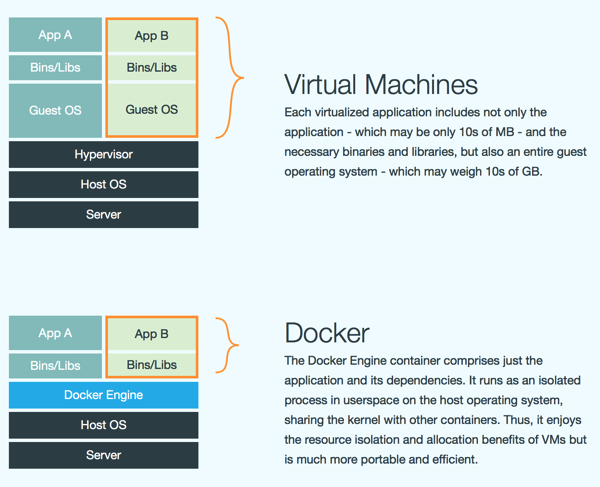
What is the difference between VMs and Docker?  You don’t ship the OS around.  Makes so much sense.
NewImage

Scary Data Center Outage coming in the next year

It has been over 2 years since there has been a serious data center outage.  An outage that takes out major parts of the data center infrastructure and IT equipment for days.  I brought up this point while at 7x24 Exchange chatting with some friends.  And, they all nodded their heads.  For many companies, financially focused people have cut back on maintenance thinking it is a waste of money.  

We discussed who we thought would be hit with a serious outage. And, even one person suggested a betting pool.  The trouble is everyone wanted to bet on the same company being the one who is hit.  A serious outage can hit many of a range of companies who have been compromising on safety and maintenance of their data centers.

Unfortunately, it takes a major outage, a scary one to get financially focused people to understand the impact of not spending on maintenance of facilities.

Many of you know all too well what could happen.

Amazon Web Services is starting to look like Germany in WW2, surrounded by its enemies

Amazon Web Services has a dominant position in the Cloud which leads people to think they are invincible and will win.  But, there are weaknesses in AWS and for those who are fierce competitors, they are taking advantage of those weaknesses.  There are some services when you push them hard, they break.  Some things don’t scale like the way you thought they would.

When you have Microsoft, Google, IBM, and a whole range of other technology companies competing against you it is hard to sustain a dominant position.

Gigaom’s Barb Darrow posts on Microsoft, Google, and IBM vs. Amazon in Gartner’s Magic Quadrant.  You ever wonder what is so magical about the Gartner Quadrants?

Microsoft ranks #2, albeit a distant #2 to AWS

Gartner cited Microsoft’s “brand, existing customer relationships, history of running global-class consumer Internet properties, deep investments in engineering and aggressive road map.” Microsoft is second when it comes to IaaS market share, “albeit a distant second” to Amazon, they wrote. Microsoft is pushing Azure not only to dyed-in-the-wool Windows and .NET shops but as a development platform for mobile apps — not traditionally a strong suit for the company.

...

Google does well on debut; IBM makes strides

Other highlights: Google gets props for its new public cloud, which became broadly available in March, so Google didn’t even show up last year.  IBM Softlayer also showed huge improvement compared to Softlayer-less IBM, which was a laggard in last year’s report.

Also showing strong vision and ability to execute (but below AWS and Microsoft in both categories) were CenturyLink (now with Tier 3 aboard); CSC, which ranked second after AWS last year; and Verizon Terremark, which is building an ambitious public cloud from scratch.

Woodstone Ovens in the home

I just chatted with one of the folks at Woodstone Corp and we had a nice discussion on using the Woodstone oven.  I enjoy cooking and some other chefs who like their woodstone oven at work have one at home too.

Wood Stone is the oven of choice for hundreds of world-class chefs in their restaurants. Of course, they love them so much that they naturally want to have the same oven to play with at home! You too can cook in the same oven favored by the likes of Bobby Flay, Tom Colicchio, Wolfgang Puck, and Michael Mina with Wood Stone Home!

Bobby Flay Tom Colicchio Wolfgang Puck
Michael Mina


I work from my home office so I guess I could say I use my oven at work and home too.

Tonight’s menu is roasted chicken, pizza, and roasted broccoli.

NewImage

Chile Rejects $8Bil dam project in Patagonia based on environmental impact

Al Jazeera has a post on Chile rejecting a $8bil dam project in Patagonia based on environmental impact.

President Michelle Bachelet's government has rejected a huge $8bn hydroelectric project in Chile's Patagonia region, citing its adverse impact on the environment.

The decision by the Chilean cabinet to shelve the controversial seven-year-old scheme was a victory for environmentalist groups which fought the proposal to build five dams in a pristine river basin.

"The Hidroaysen hydroelectric project is hereby rejected," said Pablo Badenier, the environment minister.

Hundreds of people on Tuesday cheered the decision in the streets of Santiago and in the region of Aysen, about 1,300km south of the Chilean capital.

Patricio Rodrigo, executive secretary of the Patagonia Defence Council, called the decision "the greatest triumph of the environmental movement in Chile".

The old way of only using the issue of addressing the power generation requirements have lost.

The project aimed at generating 2,750 megawatts of electricity, boosting Chile's installed capacity of 17,500 megawatts.

Maximo Pacheco, the energy minister, said the Hidroaysen project "suffers from important faults in its execution in not giving due consideration to aspects related to the people who live there".