Can you coerce people to think Mobile, Cloud, and Data First? IBM tries

I made the switch years ago to think about Mobile, Cloud, and Data as the ways to build solutions.  Mobile devices are with people so much more than a laptop or desktop so information is at your fingertips more often.  The Cloud gets you around the monopoly of internal IT organizations and lets you scale faster.  Data has changed from the forms people fill out to be stored in a SQL database which had comfort and control for those who controlled the database schema, to put anything you want in a key value pair approach.

name–value pairkey–value pairfield–value pair or attribute–value pair is a fundamental data representation in computing systems and applications. Designers often desire an open-ended data structure that allows for future extension without modifying existing code or data. In such situations, all or part of the data model may be expressed as a collection of tuples <attribute namevalue>; each element is an attribute–value pair.

The problem is the transition for people who lived in software licenses of applications and the associated hardware can be difficult.

IBM is trying to coerce its staff.

IBM ruffles feathers in push to re-educate veteran employees for cloud, data, mobile


17 HOURS AGO

2 Comments

SUMMARY:

Some IBM Global Technology Services employees have been told they keep their jobs (and 90 percent of their pay) as long as they retrain on hot new technologies.

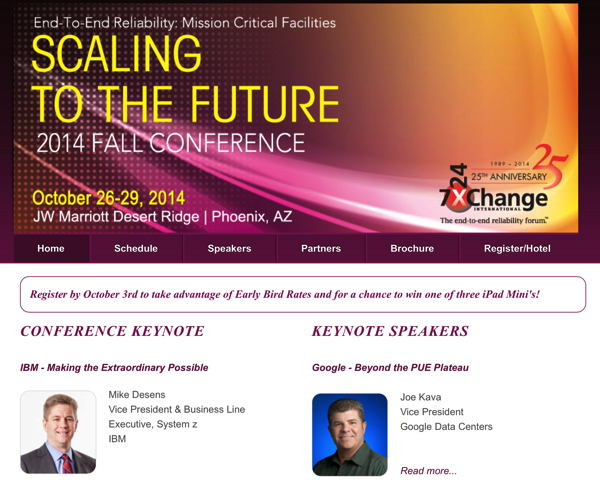
Why I attend 7x24 Exchange? They invited me to give it a try, and I like it

Sometimes it is hard to get someone to change their habits and try something new.  Years ago I was on the regular data center circuit - Uptime Symposium, DatacenterDynamics, Data Center World, Gartner Data Center Conference and a range of others.  Then I had a good friend who is a 7x24 Exchange Board member say you need to come to 7x24 Exchange.  No, I go to enough data center conferences.  Come on give it a try.  I know others who liked the 7x24 events so I decided to give a try.  Like Mikey.

I got another data center exec to give 7x24 Exchange a try and we both have consistently attended twice a year for the past 3 years.  I like 7x24 Exchange.  

Have you tried it?  Mikey would like it.  Oh I could have written this post using Mikey Manos as the subject.  :-)  Unfortunately, now that Mike is CTO of First Data Corp we don’t see him like we used to at data center events.


NewImage

Benefits of 30 minutes of reading regularly, reduces stress & improves concentration, Yes!!!

the WSJ has article on the benefits of spending 30 minutes regularly reading without interruption.

Read Slowly to Benefit Your Brain and Cut Stress

At Least 30 Minutes of Uninterrupted Reading With a Book or E-Book Helps

...

Slow readers list numerous benefits to a regular reading habit, saying it improves their ability to concentrate, reduces stress levels and deepens their ability to think, listen and empathize. The movement echoes a resurgence in other old-fashioned, time-consuming pursuits that offset the ever-faster pace of life, such as cooking the "slow-food" way or knitting by hand.

...

NewImage

I started the habit of reading 30 minutes a day or more by reading on my kindle paperwhite when at the gym last year.  For a while there I took no smartphone, but my spouse complained when I was not responding to text messages.  Uhh, that is the point.  :-)  I had been using my Galaxy Note for a while to read, but found it way to distracting to check e-mail, surf the internet or read other things. The kindle paperwhite is a reading device only.  

It feels good to spend at least 30 minutes aerobic work out and 30 minutes reading.  For a while there I was up to an hour at a time, but I need have lax and fallen off in being a regular to the gym during the summer.  Kids are back in school , so drop them off at the bus stop, then to the gym.  


Do you tell Tech Media when they got a story wrong? Steve Jobs did

This past week I was at Intel Developer Forum in my media roll as a blogger.  I was able to catch up with some good writers who many of your read often.  At a business dinner I was commenting on a story written by one of the writers and their choice of a particular source.  We both agreed that a story’s use of that particular source left a bad taste in our mouth.  We were drinking a nice cabernet from Nickel & Nickel so taste was part of the conversation.

Nickel & Nickel winery, located in Oakville, Napa Valley, is dedicated exclusively to producing 100 percent varietal, single-vineyard wines that best express the distinct personality of each vineyard. Established by the partners of Far Niente in 1997, Nickel & Nickel is focused on producing single-vineyard Napa Valley Cabernet Sauvignon from the appellation's most significant AVAs.

NewImage

Some read what is in the media as if they are facts.  Knowing who the writers are I read as if they are stories which are limited by who the sources are.


2
a :  an account of incidents or events
 
b :  a statement regarding the facts pertinent to a situation in question
 
c :  anecdoteespecially :  an amusing one
3
a :  a fictional narrative shorter than a novel; specifically : short story
 
b :  the intrigue or plot of a narrative or dramatic work
4
:  a widely circulated rumor

NYTimes has a story on how he limits the use of technology in his house, and the story starts on something more insightful.

When Steve Jobs was running Apple, he was known to call journalists to either pat them on the back for a recent article or, more often than not, explain how they got it wrong. I was on the receiving end of a few of those calls.

I’ll regularly reach out to some of the writers I know well to help them research a story, and who I would contact for sources that are credible by peers.

Most people don’t know how to help the media tell better stories.  They have PR companies who manage the media. That is something that is another story, and can be discussed over a nice bottle of wine. :-)  

Equinix Adds Time Service to settle disputes in electronic trades

One of the architectural principles for designing solutions is the concept of time.  I learned this concept from watching friends at OSIsoft and Thetus.  DatacenterDynamics reports on Equinix adding a time stamp service to trades.

EQUINIX PUTS TIME STAMPS ON ELECTRONIC TRADES

Could put an end to disputes amongst finance brokers

11 September 2014 by Nick Booth - 

Equinix puts time stamps on electronic trades

Data center provider Equinix is to offer clients a time-stamping service for electronic trading which can be used in any of the important financial markets across the globe.

The risk compliant service, based on Perseus Telecom’s High Precision Time (HPT) system, will be available in financial service strongholds such as Chicago, Frankfurt, London, New York and Tokyo and should make it cheaper and safer to verify electronic trades.

The finance industry is required to time-stamp all trades to US NIST (National Institute of Standards and Technology) standard timing. The Perseus system works to sub-nanosecond accuracy, giving an objective measure to determine which trades occurred first. It means companies no longer have to connect directly to NIST, and will be safer from disruption and malicious attacks that can occur with a GPS connection.

There are many other ways time can support addressing problems.

2 years Wired reported on Google’s use of GPS for its WW database problems.

This week, as reported by GigaOm and ZDnet, Google published a research paperdetailing the ins and outs of Spanner. According to Google, it’s the first database that can quickly store and retrieve information across a worldwide network of data centers while keeping that information “consistent” — meaning all users see the same collection of information at all times — and it’s been driving the company’s ad system and various other web services for years.

Spanner borrows techniques from some of the other massive software platforms Google built for its data centers, but at its heart is something completely new. Spanner plugs into a network of servers equipped with super-precise atomic clocks or GPS antennas akin to the one in your smartphone, using these time keepers to more accurately synchronize the distribution of data across such a vast network. That’s right, Google attaches GPS antennas and honest-to-goodness atomic clocks to its servers.