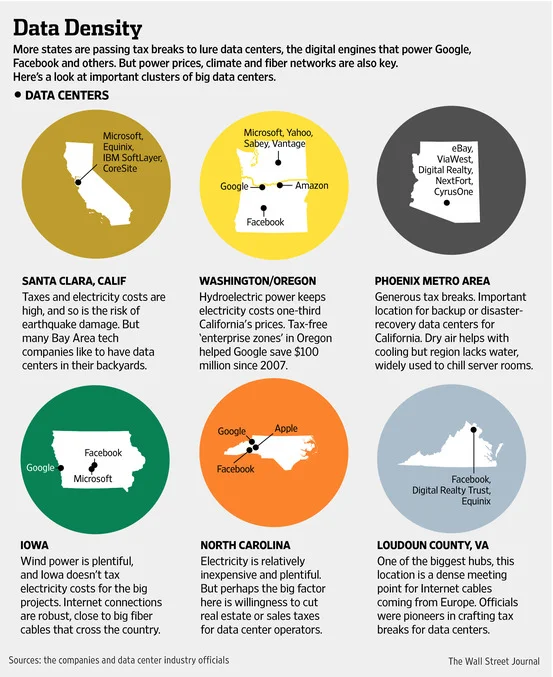
WSJ has nice graphic of Big DC Players in a Range of US States

WSJ has a post on tax incentives for Facebook in Iowa, but the coolest thing is this graphic showing data centers in a range of states which supports the story on state tax incentives.

This quote captures one of the main reasons why states compete for the big players to build.

‘There is a certain ‘wow’ factor when people say you’ve got Google, Microsoft and Facebook.’
—Debi Durham, Iowa Economic Development Authority
— http://www.wsj.com/articles/why-data-centers-collect-big-tax-breaks-1416000057


Where will Spanish Language News grow as Google News shuts down in Spain?

Spain's government has implemented a Google Tax on Google News and Google on Dec 16th will be shutting down its news.google.es site.

But sadly, as a result of a new Spanish law, we’ll shortly have to close Google News in Spain. Let me explain why. This new legislation requires every Spanish publication to charge services like Google News for showing even the smallest snippet from their publications, whether they want to or not. As Google News itself makes no money (we do not show any advertising on the site) this new approach is simply not sustainable. So it’s with real sadness that on 16 December (before the new law comes into effect in January) we’ll remove Spanish publishers from Google News, and close Google News in Spain.
— http://googlepolicyeurope.blogspot.com/2014/12/an-update-on-google-news-in-spain.html

Media like the Washington Post cover the news of Google News shutting down.

Earlier this year, Spain passed a rather egregious amendment to its copyright law (to take effect in the New Year), purportedly as some kind of anti-piracy move, but more aptly called the “Google tax” by some observers. The law gives Internet publishers a right to compensation for the use of “snippets” of their content by news aggregator sites (like Google News). And not just a right to compensation: an inalienable right to compensation, one that publishers cannot waive or bargain away (in return, say, for being included in the new aggregator listings).
— http://www.washingtonpost.com/news/volokh-conspiracy/wp/2014/12/11/google-news-to-move-out-of-spain/

Out of curiosity I looked up what % of the spanish speaking population is in Spain.  11%.  Mexico has over twice the spanish speaking population than Spain and could take up the slack of Spanish news that disappears from Google News.  Columbia and Argentina are close to Spain.

So it is quite possible that Spain disappearing from Google News will be something that will be a non event to most and the biggest impact is in Spain.  Seems like it would be easy for Spain users who want to still use Google News in Spanish to switch from news.google.es to something like Mexico http://news.google.com.mx/


Mexico De facto[3] 120,286,655 Academia Mexicana de la Lengua Mexican Spanish
Spain De jure[4] 47,737,941 Real Academia Española Peninsular Spanish
Colombia De jure[5] 46,245,297 Academia Colombiana de la Lengua Colombian Spanish
Argentina De facto[6] 43,024,374 Academia Argentina de Letras Rioplatense Spanish
Peru De jure[7] 30,147,935 Academia Peruana de la Lengua Peruvian Coast Spanish
Venezuela De jure[8] 28,868,486 Academia Venezolana de la Lengua Venezuelan Spanish
Chile De facto[9] 17,363,894 Academia Chilena de la Lengua Chilean Spanish
Ecuador De jure[10] 15,654,411 Academia Ecuatoriana de la Lengua Ecuadorian Spanish
Guatemala De jure[11] 14,647,083 Academia Guatemalteca de la Lengua Guatemalan Spanish
Cuba De jure[12] 11,047,251 Academia Cubana de la Lengua Cuban Spanish
— http://en.wikipedia.org/wiki/List_of_countries_where_Spanish_is_an_official_language


China DC Growth driven by state - Telco and Finance

DatacenterDynamics reports on the China market with referencing a research study.

The report, Research on the Distribution Features and Development Strategy of China’s Data Centers, was published today by CCID Consulting, a consulting and intelligence service provider under China Electronics Information Industry Development Research Institute of MIIT, according to OFweek.

The report explores the development of China’s data center industry in terms of contextual background, influential factors and major trends. It analyzes the distribution features of data centers across the country.
— http://www.datacenterdynamics.com/focus/archive/2014/12/china’s-data-centers-driven-state

Part of what is covered are the three Telcos and four banks that are behind much of the DC growth.

In the telecommunication industry, three large state-owned telecommunication operators (China Telecom, China Mobile and China Unicom) and large IDC service providers are the major players driving data center constructions.

Among them, China Telecom has up to 375 IDC data centers, 320 of which are used to serve external customers; China Unicom has 196 IDC data centers with a total floor space of 184,000 sqm; and China Mobile has a number of data centers totaling 105,000 sqm.

The ‘Big Four’ banks driving data centers
In the financial industry, the ‘Big Four’ state-owned banks (Bank of China, Agricultural Bank of China, Industrial and Commercial Bank of China and China Construction Bank)

If you are interested in the original research and have Google Chrome you can translate the original document referenced.

REVIEW: CCID Consulting released “Chinese characteristics data center layout and Development Strategy.” In depth analysis of the characteristics of the data center layout and development strategy, from the industrial development environment, influencing factors, and other aspects of the evolution of the trend to explore the development of the data center, and in-depth analysis of the current situation of the layout of the data center.
— http://ee.ofweek.com/2014-12/ART-8420-2817-28908773.html


US Tech vs. European Traditions, Will Data Centers be regulated in the future?

The Data Center industry is young compared to many other industries that make money. WSJ has an article on the challenges that exist between US Technology companies and European Sovereign States.

To give you an idea of the money involved consider this nugget.  5 US Tech firms have a larger market cap than 30 blue-chip companies in the DAX index in Germany.

The U.S. firms loom large. The market valuation of five U.S. tech firms— Apple Inc., Amazon.com Inc., Facebook Inc., Google Inc. and Microsoft Corp. —is $1.8 trillion. That compares to $1.3 trillion for all 30 blue-chip companies in the DAX index in Germany, Europe’s largest economy.
— http://www.wsj.com/articles/europe-vs-u-s-tech-giants-1418085890?mod=WSJ_hps_sections_tech

The article mentions the interest in requiring data to be housed in countries.

This data is the fuel that drives the online advertising and commerce machines that Google, Facebook and Amazon have spent years honing and monetizing. Rising calls for these companies to house such information in local data centers in Europe could make these machines more expensive to run.

There are hints of potential regulation

Europe’s policymakers, accustomed to controlling key sectors of their economies, are struggling to get a handle on the fast-moving newcomers from across the ocean. Growth is weak and government revenues soft, and they see profits that once accrued to European industries from retail to media to taxicabs, being diverted—often lightly taxed—to Silicon Valley. They worry that critical industries such as autos may fall next.

Why worry, because these US tech companies are disrupting existing business models.

“Europeans have got everything to lose” from the rise of U.S. technology firms, said Paul Stoneman, emeritus professor at Warwick Business School and a former U.K. antitrust official.

Don't think this is just the governments.  In a classic move, competitors are supporting actions against others.

And some U.S. firms themselves are exploiting the European tensions to attack rivals. Microsoft has been a driving force behind the antitrust campaign against Google in Brussels, while Oracle Corp. is another member of the Fairsearch alliance that has actively agitated against Google.

Including some of the Telecoms.

For big European companies with clout in Europe’s corridors of power, their traditional business-expansion model is threatened. Europe’s telecom giants, for instance, lobbied regulators for years to ease price caps and competition rules to allow them to grow. But they are now being challenged by so-called over-the-top players such as messaging service WhatsApp, which use the incumbents’ infrastructure to provide lower-cost, high-value alternatives.