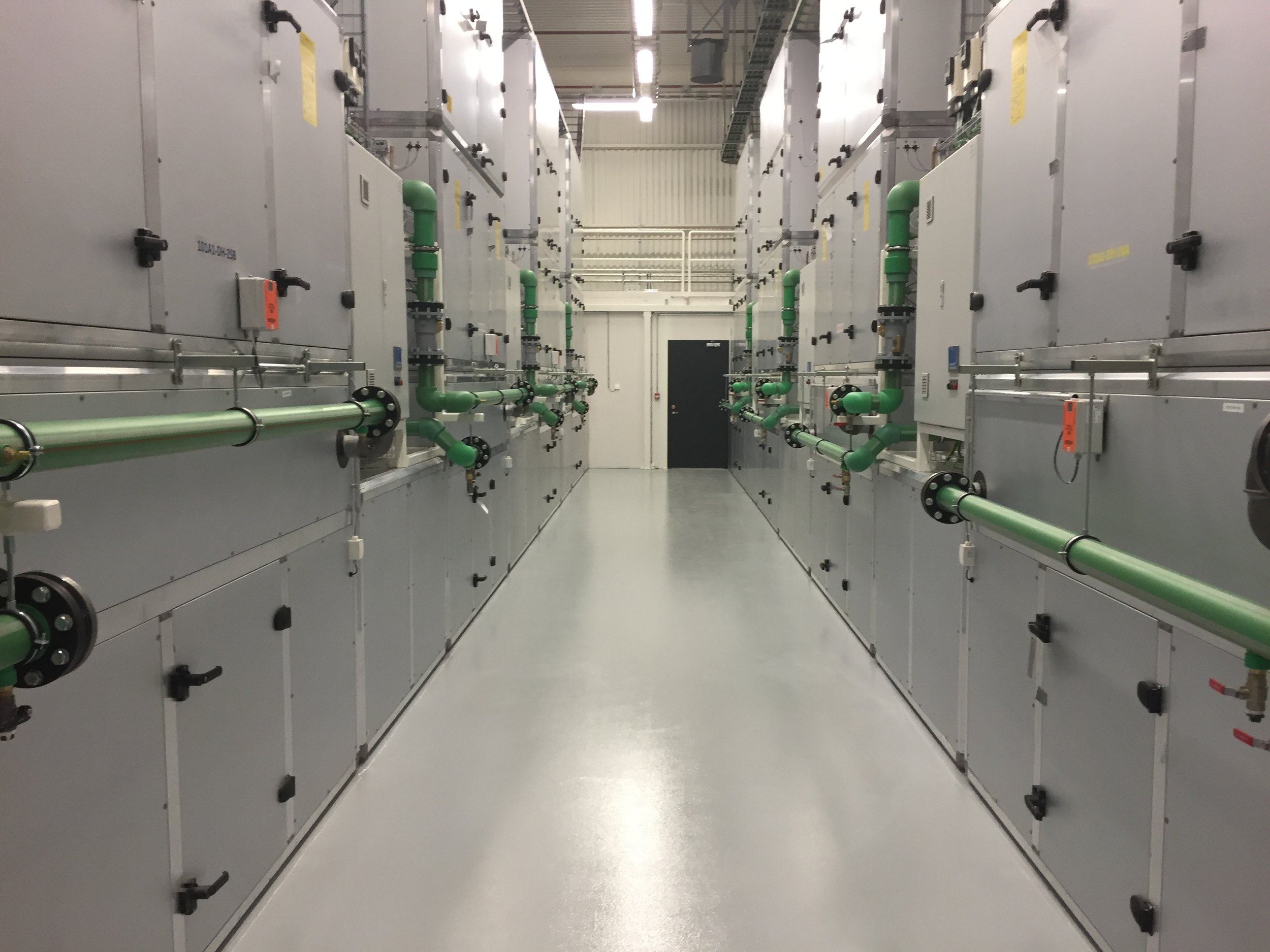
Security or Insecurity - what’s next? 7x24 2017 Fall Keynote Kevin Kealy

A 7x24 Keynote speaker favorite gave the Tuesday Keynote, discussing the current state of Security or Insecurity
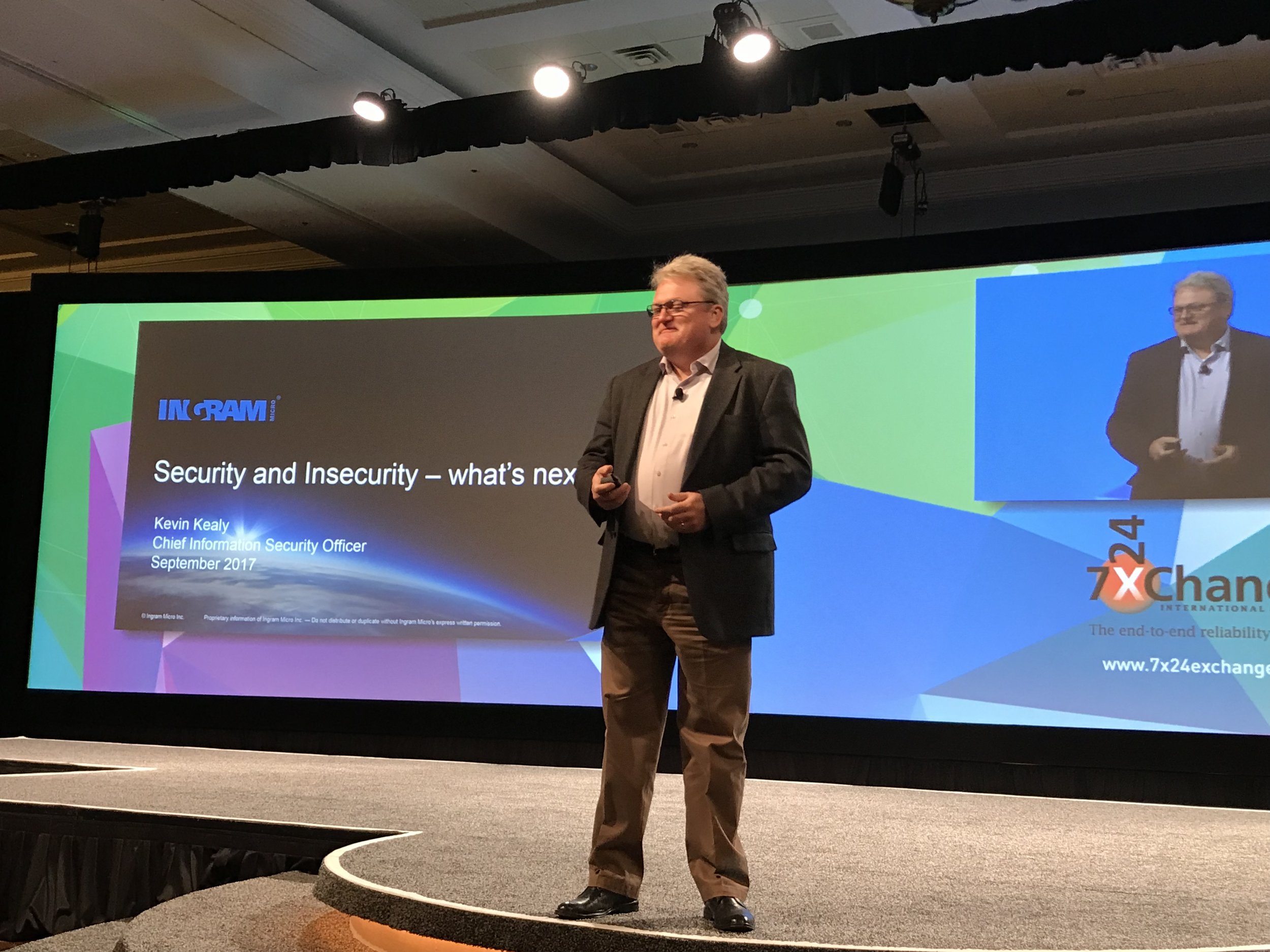
IMAGE.JPG

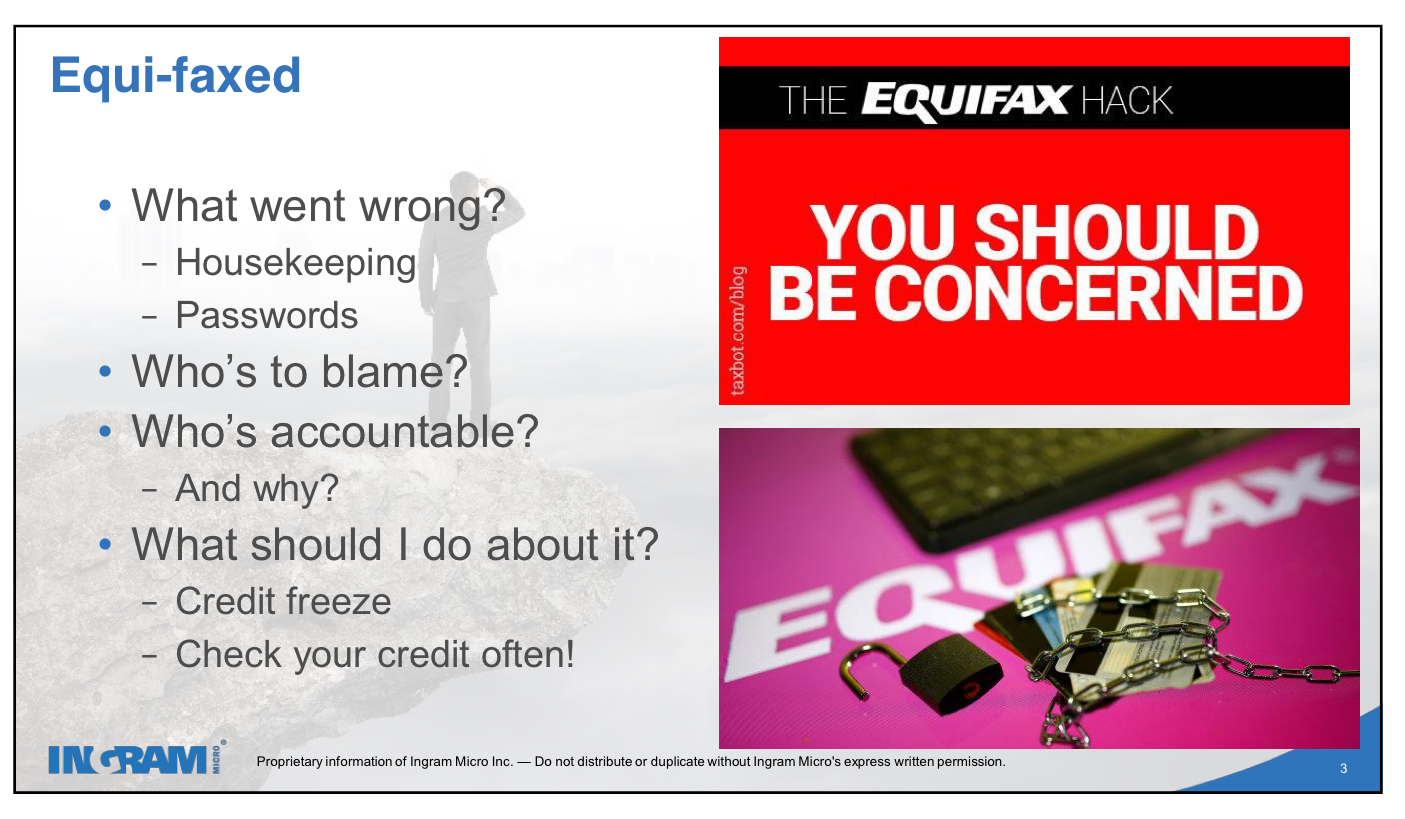
Kevin started out discussing Equifax Hack

Kevin pulls no punches pointing out their stupidity and how they set a new benchmark for mismanagement. Equifax had a single server that needed to be patched and the CIO chosen not to apply a patch, because the service would have gone down. A single server???

Simple free thing to do is to apply the patches. Don’t defer the patching. Even at home. 
FullSizeRender.jpg

Kevin added a new topic that is not on his slides. https://www.krackattacks.com/  Kevin covered the reality and asked a great question on how many of you run LINUX and made the point that any of you who run Android is running LINUX.
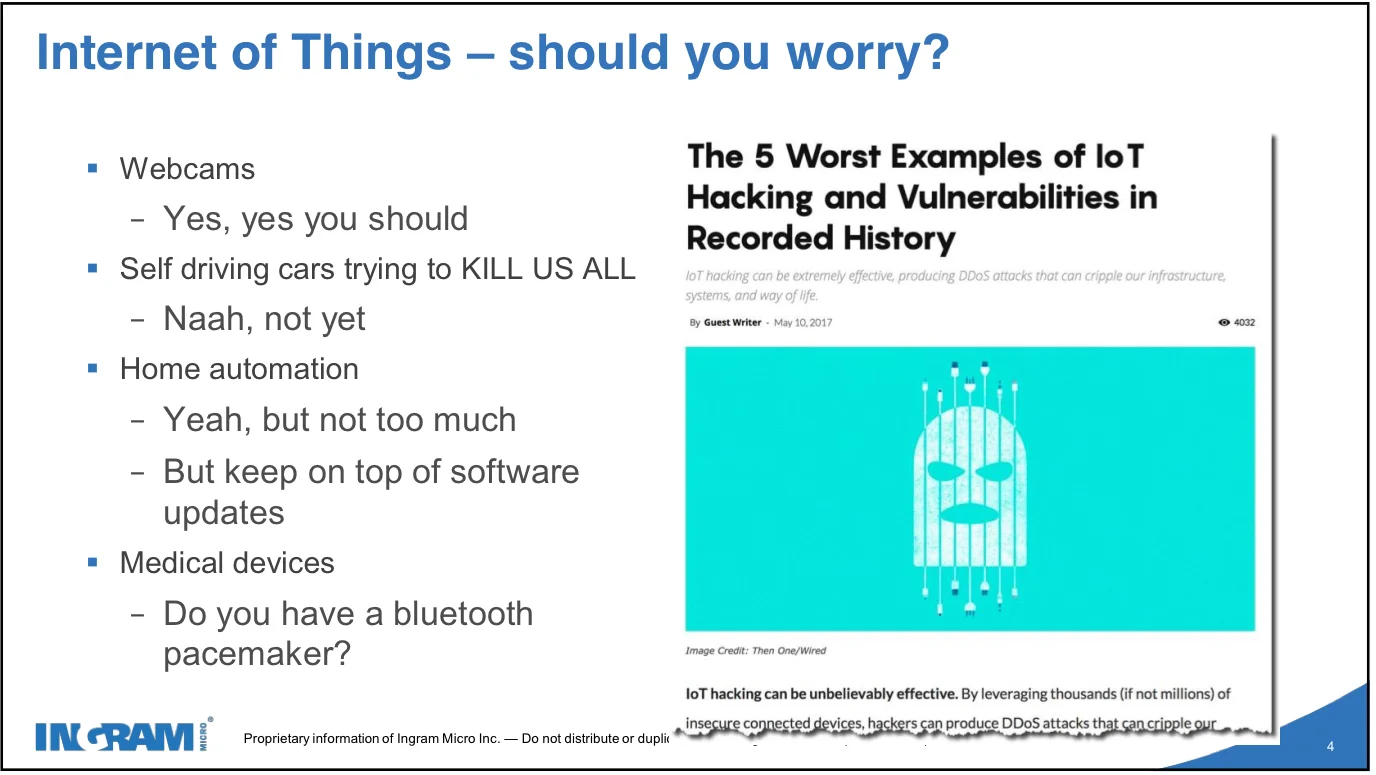
FullSizeRender.jpg

Kevin uses Fortinet firewall and AP

And in the above slide Kevin repeats the need to patch.

Kevin mentioned many ideas that are ones that I live by and part of a good process is regularly review and watching Kevin is one of the most enjoyable ways to self evaluate. 

As usual Kevin is a crowd pleaser. 

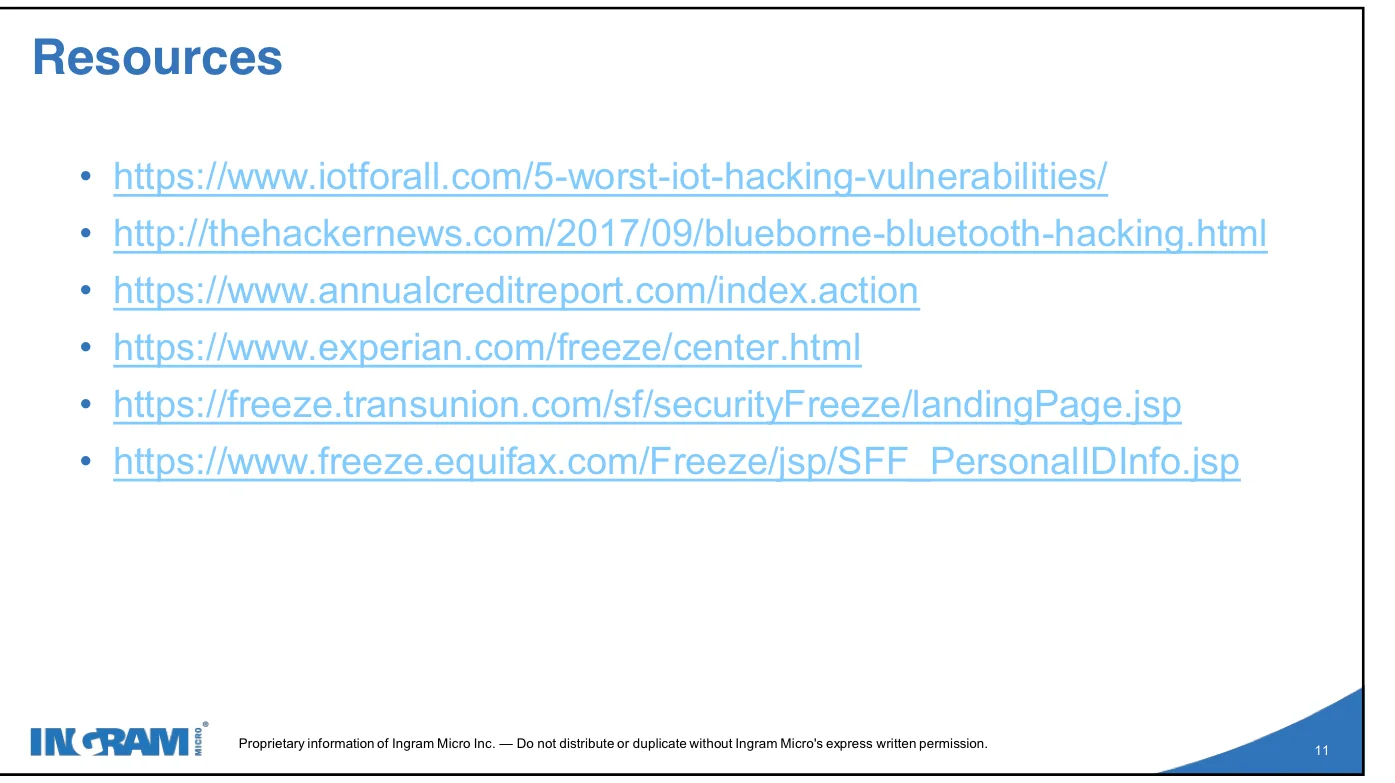
and last here are some resources to help you out. 

Sorry this an image file and not a link clickable HTML. :-( 
FullSizeRender.jpg

Microsoft and AWS AI partnering, some one must have driven the idea

Technology wars are dumb like many other wars. Years and years ago I realized the font war between Microsoft and Adobe was dumb and the users were losing out as the Typographers at Adobe and Microsoft would fight the battle between TrueType and Type 1. I was behind the scenes brokering the deal between Microsoft and Adobe independent of the font teams at each company. It is sometimes what you have to do stop war.  

AWS and Microsoft have press releases on its AI partnership. Gluon

http://phoenix.corporate-ir.net/phoenix.zhtml?c=176060&p=irol-newsArticle&ID=2306307 

https://www.microsoft.com/en-us/cognitive-toolkit/blog/2017/10/microsoft-aws-advance-open-ai-ecosystem-gluon-partnership/ 

“What is Gluon?

Gluon is a concise, dynamic, high-level deep learning library, or interface, for building neural networks. It can be used with either Apache MXNet or Microsoft Cognitive Toolkit, and will be supported in all Azure services, tools and infrastructure. Gluon offers an easy-to-use interface for developers, highly-scalable training, and efficient model evaluation–all without sacrificing flexibility for more experienced researchers. For companies, data scientists and developers Gluon offers simplicity without compromise through  high-level APIs and pre-build/modular building blocks, and more accessible deep learning.”

"The potential of machine learning can only be realized if it is accessible to all developers. Today’s reality is that building and training machine learning models requires a great deal of heavy lifting and specialized expertise,” said Swami Sivasubramanian, VP of Amazon AI. “We created the Gluon interface so building neural networks and training models can be as easy as building an app. We look forward to our collaboration with Microsofton continuing to evolve the Gluon interface for developers interested in making machine learning easier to use.” 

Digging around a bit I was trying to find more behind the scenes information.http://www.firstpost.com/tech/news-analysis/amazon-and-microsoft-team-up-to-launch-deep-learning-interface-called-gluon-4138859.html

”According to a report in the New York Times, the two rival tech firms were reportedly coordinating behind the scenes for the past year to make artificial intelligent assistants Alexa and Cortana communicate with each other.” 

There are lots of ex-Microsoft people in AWS. And there are lots of ex-AWS in Microsoft. With all those people moving back and forth and the companies are less than 10 miles apart it is relatively easy to have discussions like Gluon.  

How many more discussion are AWS and Microsoft having that we don’t hear about? 

Looking forward to another 7x24 Exchange Conference

I admit that I was a late attendee to 7x24 Exchange. I had been attending Uptime Symposium, Data Center Dynamics, Data Center World, Gartner Conferences, IBM, Open Compute, and some other conferences. And thanks to Lee Kirby who suggested I attend 7x24 Exchange I decided to look a bit at the conference. Then I met David Schirmacher who is the President of 7x24 Exchange. Lee Kirby is the President of Uptime Institute. So based on two smart people telling me to attend 7x24 Exchange I started and now I attend both the Fall and Spring event and I always find it is time well spent.

I checked out the attendee list to see who is going who I know and to check out who is attending who I should look to meet. This is part of being an open Conference that supports the interaction of its attendees. 

I am looking forward to see Robbie Bach’s keynote. Being ex-Microsoft and Robbie is too. Will be interesting what words of wisdom he has. 

See many of you at 7x24. I’ll be there. 

Comparing Washington DC vs. Silicon Valley Technology Perspectives

There is a huge gap between how Washington DC views technology and Silicon Valley. If you are interested in the differences check out Stacey Higginbotham's post on her experience visiting a Washington DC conference.

This is a good summary of the difference.

All tech policy seems to boil down into a debate about states rights versus federal control. It’s like the debates over the Affordable Health Care Act with people in the halls and onstage lamenting the patchwork of state laws around privacy, internet taxation, data breach disclosure laws and more. Republican Senator Rand Paul, for example, got onstage to call out the government for imposing social standards on states at the federal level (a problem in his mind). Fellow Republican Senator John Thune apparently wants no government regulatory involvement in tech, including issues such as network neutrality or ensuring that the IP transition leaves people with some form of voice phone access. Whereas in Silicon Valley the axis might be around one company versus another (ie. Google v. Facebook or ISPs v. Netflix ) or legacy equipment versus new infrastructure, the framework in D.C. is decidedly different.

The tool of choice is paper, not a computer. I can scan the rows of people at our Structure conference and see the lids of many a MacBook or the glow of tablets, but here, while there were some folks typing in their notes, more were jotting things down on paper. And in conversations with people, only one ever pulled out a phone; and that was because someone was calling her. FCC Chairman Tom Wheeler even told me after an onstage interview that people are more productive wearing a watch than using their phones to check the time because the phones then distract them. People clearly have smart phones, but they aren’t using them like they are a tether to a more interesting world.

What i would add is Silicon Valley will be much more interested in what the technology does and how it works. Washington DC is more interested in the impact of technology which can be much harder to articulate and fits in their perspective of how to regulate the use of technology.