Solving multiple problems with a picture, Amazon takes pictures of delivery

The verge has an article on Amazon taking pictures of front door deliveries. https://www.theverge.com/2018/3/1/17068480/amazon-photo-on-delivery-new-feature-front-porch 

“Amazon has been quietly rolling out a new program over the past few months where delivery people will use photos to confirm your package has been delivered. The photo of exactly where the package has been placed will be included in the notice of delivery so Amazon users know when it arrived and where it is, as first spotted by USA Today.” 

Most think about here is the proof the package is delivered.  But it is also a quality control event to document package delivery and information about the delivery site. The information can be used for quality control and other ideas to improve the quality of delivery. 

Once I received items where the contents of the box where not what I ordered. Seeing the package could confirm whether it was possible that the label got put on the wrong box.

Is Regulation of Internet Companies around the corner?

NBCnews has a post on the make or break moment. https://www.nbcnews.com/tech/tech-news/silicon-valley-faces-make-or-break-moment-amid-big-tech-n847301

 “

Silicon Valley faces make or break moment amid big tech backlash

Gone are the glory days of glowing praise and good PR for big tech companies.

” 

Any set of companies that get as big as Amazon, Google, and Facebook are targets for government regulation. It happened to Oil companies. Tobacco. Steel. Pharmaceuticals.  The government could understand Oil, cigarettes, and drugs much easier. They could see commodities move and how regulations could be put in place. The Internet companies work by flowing of bits that they can’t see and don’t understand.

What would happen if there was a tech savvy government officials? Would there regulations in place? Most likely yes. 

Washington State publishes Paper why Data Center companies head to other States

Microsoft kicked off the public attention of Washington State as a place to build data centers. The government officials then tried to tax the data center companies as an industry assuming the low power prices were worth it. Finally after 7 years of little activity in Washington the Department of Commerce published a report stating what we all knew, Washington state taxes made it more expensive than neighboring states.

The report is here. The conclusions are here.

Conclusions
 Data center growth in rural Washington is at the lower end of the growth rate experienced by other major competitive markets. The competition among states for data center projects has increased dramatically and, if the state desires to attract more projects, Washington should improve its promotional strategy for this industry segment and reexamine the competitiveness of its overall incentives strategy.
 Urban Washington counties that do not have access to sales and use tax exemptions for data centers are at a competitive disadvantage to other urban data center markets such as Portland that either do not have sales tax or that offer tax incentives that abate the sales tax.

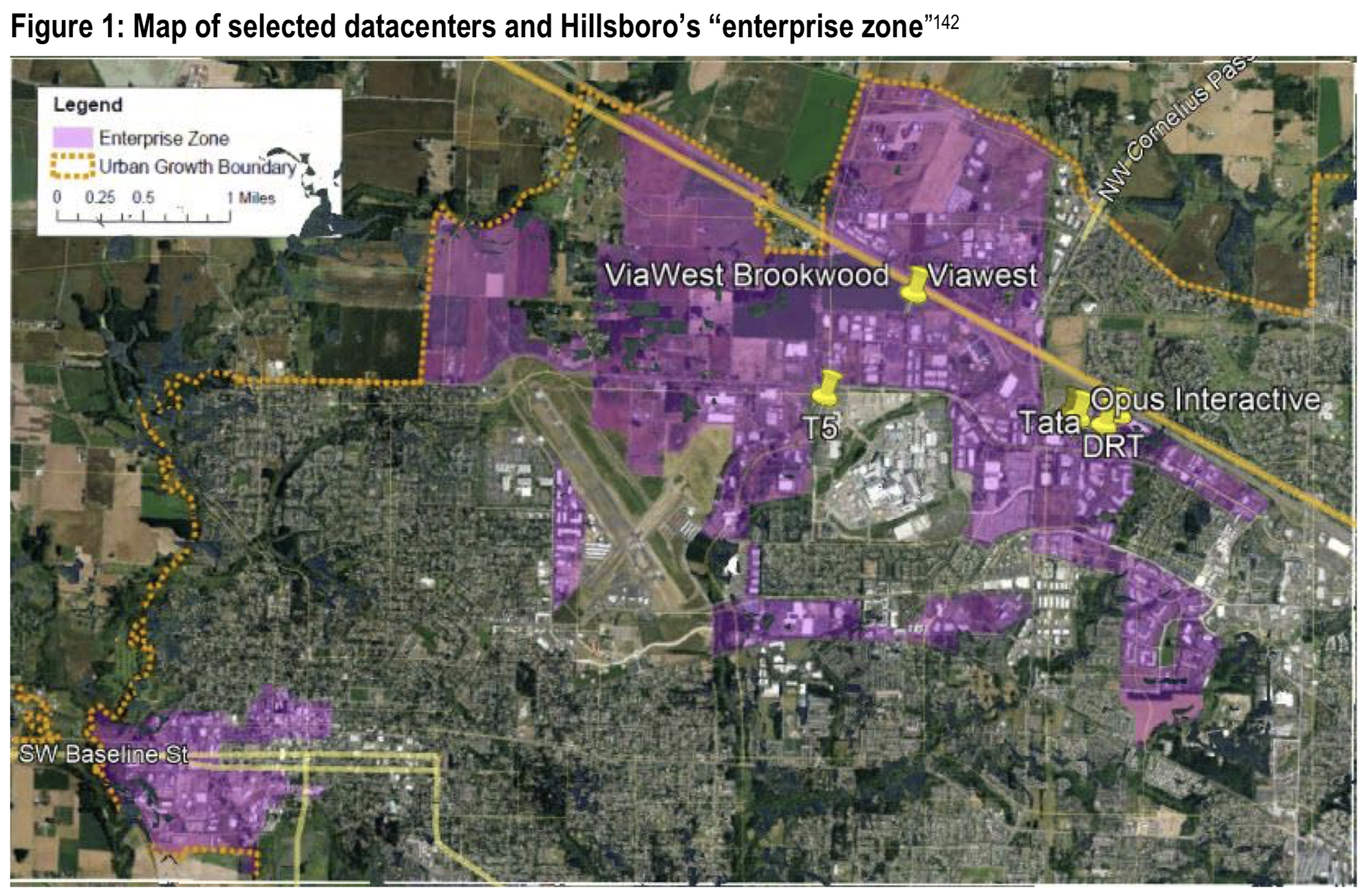
A comparison to Hillsboro is made.

All of Hillsboro’s data centers are located in its “enterprise zone,” which was earmarked by the city to provide property tax abatements to firms that locate there. In addition, Oregon has no sales tax at either the state or local level, and the property tax rate in Hillsboro is currently $16.75 per $1,000 of assessed value. Locating in the enterprise zone caps taxing the property to the pre-development assessed value for nearly five years. These tax benefits draw in big players. Last year, DuPont Fabros bought up 47 acres in Hillsboro for what will be Oregon’s largest urban server farm, a 500,000 ft2 facility that will require 50 MW of power, half of which will be for Microsoft and Facebook’s cloud storage.143
We interviewed Valerie Okada, a Business Development Coordinator at the City of Hillsboro’s Economic Development Department. In pitching Hillsboro to us, she cited the quality of its fiber network, noting there are nine providers and four cable land stations that terminate in Hillsboro. Okada also mentioned the high reliability of its electric substations that do not have the dips and outages other cities have because their infrastructure is up to semiconductor industry standards due to Intel’s long presence since they days when they were just a small town. But it is doubtful these features are significantly better than Seattle.
It is the enterprise zones that really incentivize datacenters to locate to Oregon. Oregon’s largest urban server farm in operation today, an 11.9 MW, 180,000 ft2 facility run by Infomart saves $769,000 a year
Screen Shot 2018-02-21 at 09.24.30.png

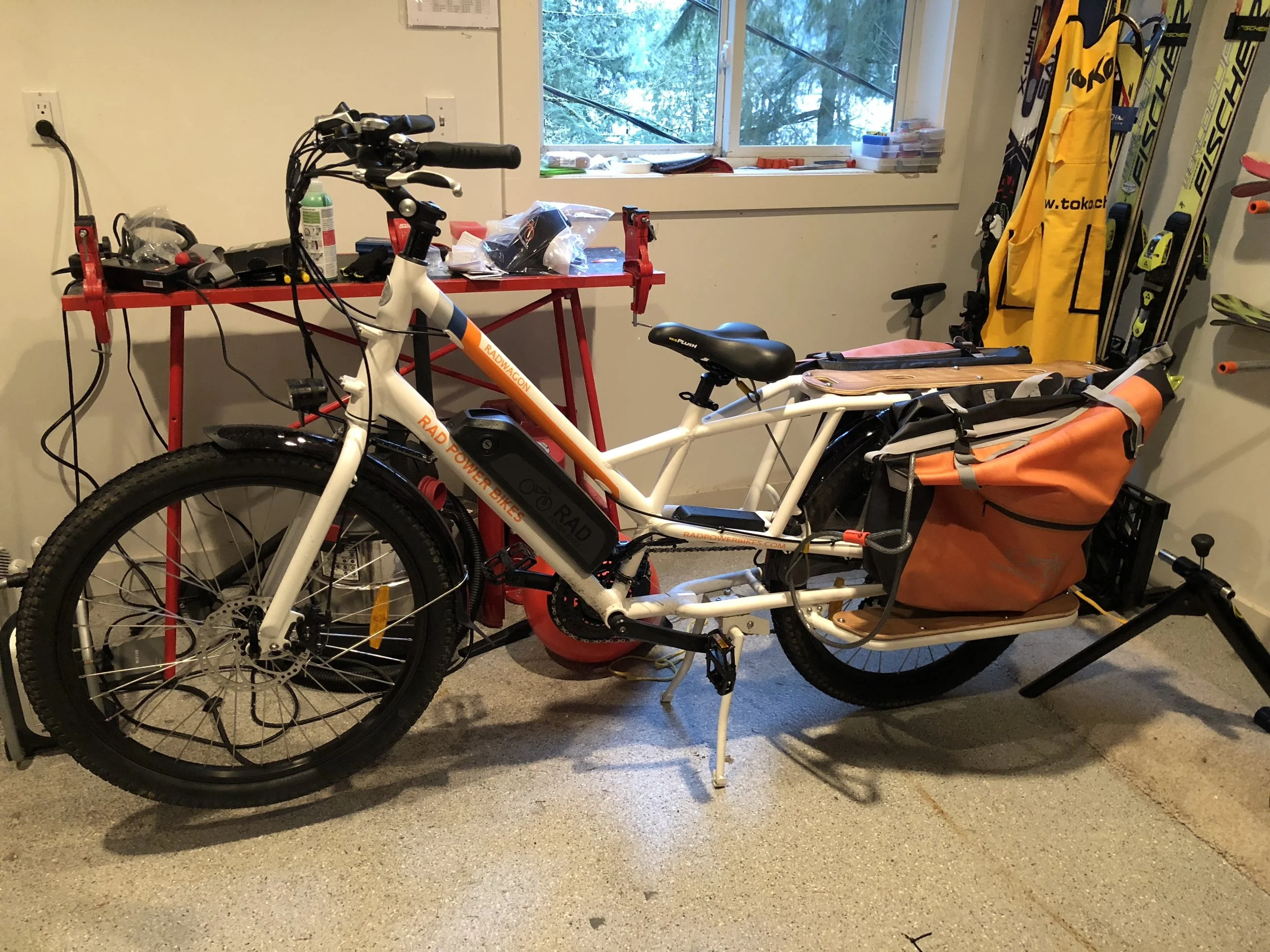
Got an electric bike (RadWagon 2018 Cargo Bike), my dog gives the thumbs up

I live in Redmond which has the tag line "bicycle capital of the northwest."

bicyclecapital.jpg

Part of my criteria for an electric bike is one that i can take dog with me and go to the dog park at Marymoor.

Off-LeashDogArea.jpg

Took my dog, "Bea" today and she had a great time. Rode there at 20 mph, carrying a 50 lb dog and myself.

fHqSgrSPQySZu%1Ix+X7uQ.jpg
+X5ameLkTRODsjlLL%VqCA.jpg

The bike above is a RadWagon from Rad Power Bikes in Seattle. The cargo bags hold plenty of stuff. Have done a Whole foods run and a Trader Joes. Next is a Costco run. No paper towels or toilet paper. :-)

Oh and the other criteria is my son can use electric bike.  It weights 70 lbs has a 750 watt motor. He can use it in electric power mode only and zip around probably 30 miles without peddling given he weighs less than 100 lbs. I have been riding with peddle assist and it looks like I can go about 35-40 miles at 20 mph. Using my Apple Watch my heart rate gets pushed to 145 bpm.