AWS and Azure have edge 5G solutions for Carriers, Market for Edge DC gets smaller

The hottest topic in data centers for many is the edge. Low latency, high bandwidth 5G traffic. Companies have pitched their solutions to be new structures that can house equipment at the edge in metro areas.

Stacey Higginbotham has a post summarizing the current state of where AWS and Azure are at partnering with Telcos for 5G edge solutions.

The AWS deal looks like this.

With the Verizon-Amazon deal, Amazon is putting its hardware inside metro data centers operated by carriers. The goal is to allow developers building latency-sensitive use cases access to networks closer to their end users. It’s part of a new service AWS calls Wavelength. These data centers will act like an Amazon availability zone, although Amazon’s Raj Pai, vice president of EC2 for AWS, explained that Amazon is calling these “Wavelength Zones.” Developers will simply choose Wavelength Zones in cities where they want to deploy their latency-sensitive services, and Amazon will ensure the Wavelength Zones closest to the user field the traffic.

The Azure deal looks like this.

AT&T’s deal with Microsoft Azure is similar, but AT&T is letting Microsoft put gear inside its radio access network. So far, the Microsoft Azure services will only be available in Dallas. Next year, AT&T plans to add Los Angeles and Atlanta.

And as Stacey mentions there is no reason why the Telcos would not have multiple deals for each cloud.

The idea behind both networks is the same, and I expect we’ll see AT&T sign deals with Amazon, and Verizon sign deals with Microsoft Azure.

The other question is what will Google do?

With Amazon, Microsoft, and Google all having 5G edge solutions with strategic partnerships with Telcos what is the Edge DC opportunity? Can’t each of these companies share its own micro data center solution that is an edge container.

Google was first with a container data center. Then Microsoft and eventually AWS. They have all learned the advantages and disadvantages of deploying and running containers. If they think mini container at the edge is a solution they have the no how and they have the Cloud hardware and software.

Seems really hard to be in the edge DC business as the Telcos dedicate resources to work on the integration of AWS and Cloud infratructure.
Why is it so hard for smart people to listen and learn

I have been researching some new ideas as part of the effort of Makai University. One concept I have is Double Loop Learning. The Wikipedia post describes this as

Double-loop learning entails the modification of goals or decision-making rules in the light of experience. The first loop uses the goals or decision-making rules, the second loop enables their modification, hence "double-loop". Double-loop learning recognises that the way a problem is defined and solved can be a source of the problem.[1] This type of learning can be useful in organizational learning since it can drive creativity and innovation, going beyond adapting to change to anticipating or being ahead of change.[2]

But this loses most of you. What I like better is the 1991 Harvard Business Review paper that introduces the double loop learning concept where the author discusses “Teaching Smart People How to Learn.”

First, most people de􏰜ne learning too narrowly as mere ‘‘problem solving,’’ so they focus on identifying and correcting errors in the external environment. Solving problems is important. But if learning is to persist, managers and employees must also look inward. They need to re􏰝ect critically on their own behavior, identify the ways they often inad- vertently contribute to the organization’s problems, and then change how they act. In particular, they must learn how the very way they go about de􏰜 ning and solving problems can be a source of problems in its own right.

I have coined the terms ‘‘single loop’’ and ‘‘double loop’’ learning to capture this crucial distinction. To give a simple analogy: a thermostat that automatically turns on the heat whenever the temperature in a room drops below 68 degrees is a good example of single-loop learning. A thermostat that could ask, ‘‘Why am I set at 68 degrees?’’ and then explore whether or not some other temperature might more economically achieve the goal of heating the room would be engaging in double-loop learning.

One

Professionals embody the learning dilemma: they are enthusiastic about continuous improvement—and often the biggest obstacle to its success.

This paper is over 28 years old, but it still applies well to challenges of why it is so hard for smart people to listen and learn when they are in their professional life.

The weakest link in 5G deployments - Cloud expertise and running fiber to all the antennas

Saying 5G is hyped seems like an understatement. You read and listen companies and they say how great it will be. But here are a few weaknesses that will slow down the deployments.

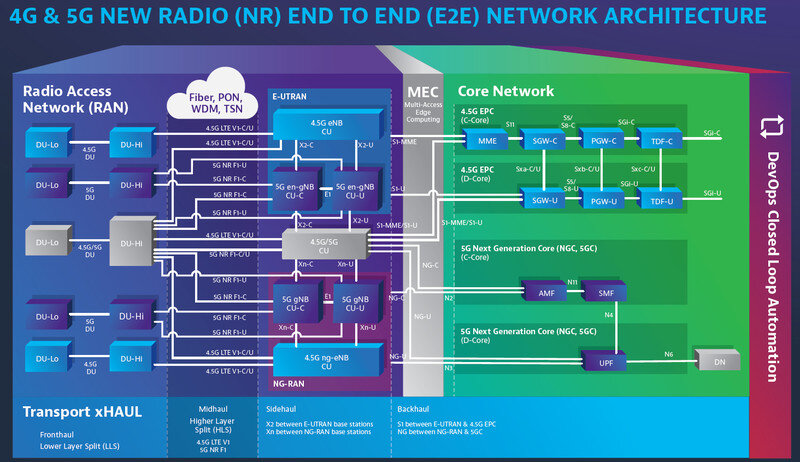
Below is a diagram from https://www.viavisolutions.com/en-us/5g-architecture.

When you get to the physical environment it is a cloud solution. OK makes sense to support the virtualization that permeates many parts of the system. Here is a simple test. How many of the top cloud experts at AWS, Microsoft Azure, and Google Cloud Platform would make the career move to work at a Telco to work on the Cloud environment? Pay enough money and you get a few. Now how many field technicians who deploy and run cloud infrastructure at those same companies want to quit and join a Telco? Are they paid top dollar. Nope. How many of the Telco people who have decades of experience running legacy LTE systems want to throw most of what they know out and learn a new Cloud infrastructure? This number is probably less than the number of people at the Cloud companies who want to move to a Telco.

Getting people to work on Cloud Infrastructure is really really hard.

What could be harder or at least just as hard is running all optical fiber to all the antennas for 5G. It is hard enough to get rights to put LTE antennas up. The number of antennas for 5G is a significant increase. The cost and time to get the easements to run optical fiber is significant. Even the Telcos creating showcase 5G solutions for stadiums do not provide complete coverage of high speed mmWave radios.

5G is a nice hype message. Everyone wants lower latency and higher speed. But the cloud expertise and running fiber are significant obstacles to overcome.

IMG_0014.jpeg

What is future of Peering? Peter Cohen reviews the past to see the future

Telecom Ramblings has a post chatting with Peter Cohen who is VP at QTS. So why would I listen to Peter. Because he has proven invaluable in our past discussions to understand how peering works. Before QTS Peter was at Netflix and before that he was at AWS.

Here is an example of Peter’s review of the past.

This created a reliance on infrastructure in 10 cities or so nationally, and these companies are beholden to those data centers and are subject to cost, power, and space limitations, and to the policies, of those data centers, some of which were never designed with this in mind. This really is putting all your eggs in one basket repeatedly. Having everyone’s peering fail over to another city hundreds of miles away is not a real great plan for long-term growth in the longevity and stability of the internet, but that's kind of where we're at now.

Peter touches on technology changes.

First of all, the lower costs and greater availability of optics has made for larger connections and decreased costs those router-to-router connections. Second, the transport and remote end peering piece, which can be a scaling issue for some companies, has also developed, enabling the connection of hardware to an exchange point or to a data center but actually have the router reside elsewhere.

So what is a better future?

With regards to infrastructure, it’s the thought of metro redundancy. As an operator I would want to be able to be connected to all those destinations in a secondary location as well, and have that traffic resolved within my market, rather than leaving that market and hairpinning it back in order to deliver traffic.

As 5G gets discussed the peering issues will continue and as the bandwidth goes up and the advertised latency becomes expected.

Smart home is dead, eventually someone will think holistically like a system

Stacey Higginbotham posts on the smart home is dead.

The smart home is dead. I'm not sure exactly when the time of death should have been called, but it happened at some point between Google trying to rebrand the smart home as "the helpful home" and the publication of this article, which expresses dismay that at five years of age, Amazon's Alexa offers little more than a new way of interacting with things, without deep functionality or truly new use cases.

This week in New York, at an IoT Consortium event, I listened to executives of dozens of companies associated with the smart home talk around its death but never address the fact directly. Instead, they talked about a lack of compelling use cases, how to move beyond a device-specific mindset, and the ways they are trying to handle consumer demand for interoperability in the smart home without actually providing such interoperability.

If the smart home is dead will the smart building face the same fate? Construction of homes and buildings has not changed to accommodate IOT. The approach has been to bolt on the IOT things. Plug it in or battery operated. Join your home wifi network and now it is on the Internet. My friend Dennis and I have been slow to adopt IOT things and we have chosen the same approach of home network security with enterprise firewall/router running PFsense on Netgate hardware with Unifi APs with a home network and IOT network segmentation. Some IOT devices to be functional need to be on the home network. Many others can exist on the IOT network. With this network configuration we can monitor devices.

When we got together to chat a couple of weeks ago, Dennis told the story of how he found what look like a rogue device on his network that was running a server and he was trying to figure out what the heck it was as everything was secure up to that point. Then he pointed to my Joule sous vide and said that was the culprit he had as well. The Joule device runs a server with a china chipset that looks really suspicious. After that he moved it IOT network. I had already done that. Cameras, LG appliances, Ring Cameras and many others are pushed to IOT SSID and that network is monitored and managed by PFsense.

If this sounds hard. It is. Dennis and I have exchanged many e-mails and have had conversations on how to have a better home network.

One approach I have been studying for a long time and finally been making some good progress is on the use of Christopher Alexander’s Patterns ideas and Wholeness. Unfortunately reading Christopher’s books are not the easiest. One paper that help me understand the concept of Centers and Wholeness is this paper by Bin Jiang on “A Complex-Network Perspective on Alexander’s Wholeness. These ideas applied the smart home/building make so much sense.

Abstract

The wholeness, conceived and developed by Christopher Alexander, is what exists to some degree or other in space and matter, and can be described by precise mathematical language. However, it remains somehow mysterious and elusive, and therefore hard to grasp. This paper develops a complex network perspective on the wholeness to better understand the nature of order or beauty for sustainable design. I bring together a set of complexity-science subjects such as complex networks, fractal geometry, and in particular underlying scaling hierarchy derived by head/tail breaks – a classification scheme and a visualization tool for data with a heavy-tailed distribution, in order to make Alexander’s profound thoughts more accessible to design practitioners and complexity-science researchers. Through several case studies (some of which Alexander studied), I demonstrate that the complex-network perspective helps reduce the mystery of wholeness and brings new insights to Alexander’s thoughts on the concept of wholeness or objective beauty that exists in fine and deep structure. The complex-network perspective enables us to see things in their wholeness, and to better understand how the kind of structural beauty emerges from local actions guided by the 15 fundamental properties, and by differentiation and adaptation processes. The wholeness goes beyond current complex network theory towards design or creation of living structures.

Keywords: Theory of centers, living geometry, Christopher Alexander, head/tail breaks, and beauty