Please stop embedding information in serial numbers, Apple finally is taking this step

MacRumors covers the effort by Apple to switch to random serial numbers and stop embedding manufacturing information in the serial number with a sequence of higher numbers as more are built.

In an internal AppleCare email this week, obtained by MacRumors, Apple said the new serial number format will consist of a randomized alphanumeric string of 8-14 characters that will no longer include manufacturing information or a configuration code. Apple said the serial number format transition is scheduled for "early 2021," and confirmed that IMEI numbers will not be affected by this change.

Some people and organizations are stuck in the old school of a serial number has to be a sequence. It helps them count. They have a bean counter mindset.

a person, typically an accountant or bureaucrat, perceived as placing excessive emphasis on controlling expenditure and budgets.

In Arstechnica some are whining about the change.

Serial numbers are used in online forums, repair shops, and company IT departments to expedite troubleshooting and other tasks by quickly learning more about the machine in question—for example, whether a computer that is exhibiting a problem is part of a certain set of models manufactured in a certain time period that all have that issue. Some of the information will still be accessible after either booting the machine up or taking it apart.

But let’s look at what a random serial number approach does. #1 is u can make the number of characters shorter which has how many hours accumulated across customer support issues. The manufacturing process is much easier to assign a random number, then associate the relevant information required for support and service like manufacturing date, production run, manufacturing location. The current serial number has benefits in case of theft to determine information about the unit without logging into an Apple system to check the serial number information. If you log in, there is now an event at a given from an IP address that could help support recovery of stolen devices.

It is change that makes things easier in the long run, and a minor inconvenience for those who built their processes around the existing numbers.

One of these days serial numbers will be QR codes that can be quickly looked up for product status.

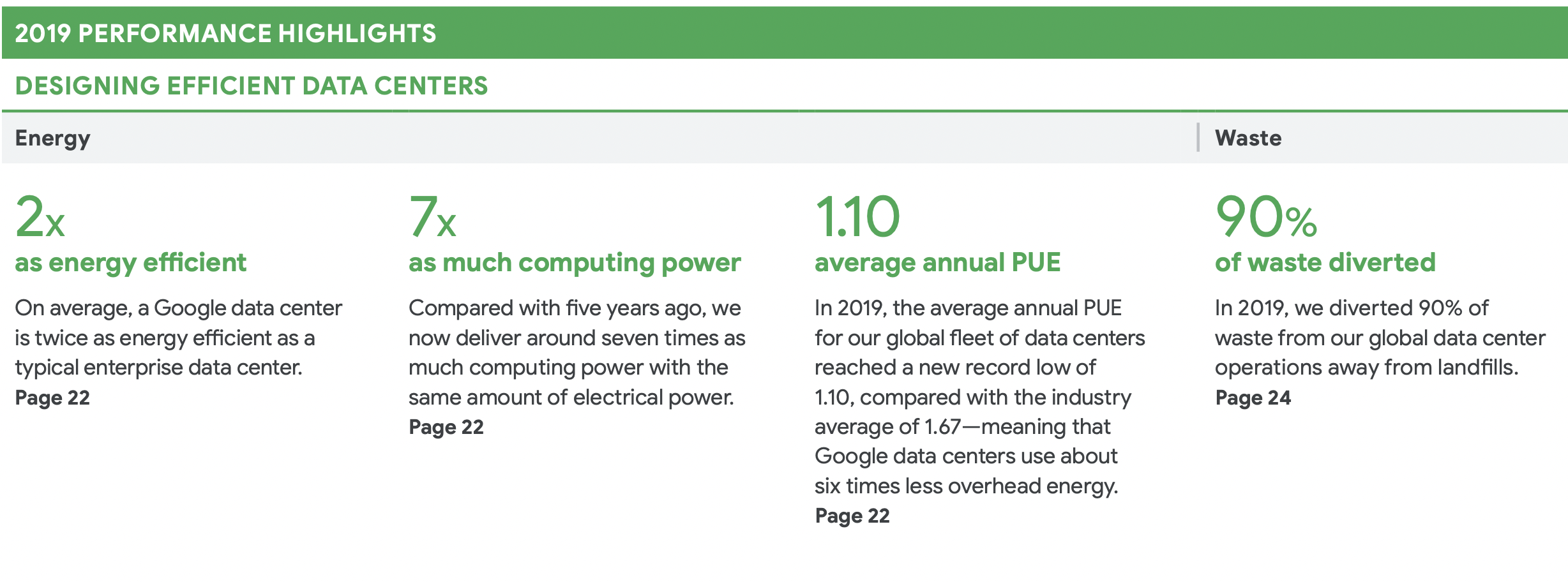
Next 20 years of Google's Environmental Impact after 20 years of effort

Google published its 2020 Environmental Impact report and it is nice.

But reading the report it missed something. I looked at who the Google Executive referenced in the report and it is Ruth Porat Alphabet and Google CFO. Ah. it reads like a financial statement. Well I guess it is a report. Urs Hölzle Senior Vice President of Technical Infrastructure is also a co author.

Google discusses the next decade which is also good. But it was missing something still.

What would I write? Make it more of a challenge. What is it Google could achieve in 20 years. What could it dream. What is it a Gen Z new hire would want to spend working on thet is worth 20 years of their time which il almost is double their life.

The past results are good if you know about PUE, energy efficiency, power per watt, but that is a small fraction of people.

Getting people excited about the future and what could be done is a much bigger audience.

a1.png

Learning what makes a great organization. Ron Westrum's words and reused.

A friend pointed to Andrew Shafer’s post on developer ideas. in one of his slide decks he points to Westrum Typology. When I first saw it I thought it was Western Typology. No Westrum. Westrum who? looking it up Ron Westrum created the Westrum Typology. Has Ron written anything. One book. A book with 5 stars ratings on amazon.com. A book on how the Sidewinder missile was developed.

In the mid-1950s a small group of overworked, underpaid scientists and engineers, working on a remote base in the Mojave Desert, developed a weapon no one had asked for but that everyone was looking for. Sidewinder is the story of how that unorthodox team at China Lake, lead by the visionary Bill McLean, overcame Navy bureaucracy and more heavily funded projects to develop the world’s best air-to-air missile.

Got more curious after buying the book and wrote to Ron and asked him for other things to read. One of the paper’s Ron wrote was on information flow and its impact on safety.

“Not only is information flow vital to the organization’s ‘‘nervous system,’’ but it is also a key indicator of the quality of the organization’s functioning. “

“The important features of good information flow are relevance, timeliness, and clarity.”

“By examining the culture of information flow, we can get an idea of how well people in the organization are cooperating, and also, how effective their work is likely to be in providing a safe operation.”

Ron is 75 and has spent a long time studying organizations. It is interesting that the DevOps community has picked up on his Typology.

A DevOps book Accelerate: The Science of Lean Software and DevOps: Building and Scaling High Performing Technology Organizations has a chapter with much of Ron’s ideas integrated.

What is biggest challenge for Greening Data Center? Cultural change

I have been writing on green data centers for so long and I got bored after a while as it was all the same. People were resistant at first. Greenpeace put pressure on some companies. There were people early on who saw the benefits of greening their data center efforts. Now almost everyone has a green data center effort. but are the data centers really that much greener than 10 years ago? No, most are not. They may have sourced energy from renewable energy sources, but is that all it takes. Is this sustainable?

What is needed is a cultural change.

One of the interesting ways to look at the situation is from this cultural typology by Ron Westrum.

Table 1: The Westrum organizational typology model: How organizations process information (Source: Ron Westrum, "A typology of organisation culture)," BMJ Quality & Safety 13, no. 2 (2004), doi:10.1136/qshc.2003.009522.)

westrum.png