Part 1 — Gary Starkweather: The Laser Printer’s Little-Known, Harder Invention — The Color Coherence System (ColorSync)

Most people know Gary Starkweather as the inventor of the laser printer. That’s the headline. The easy story. What most people don’t realize is that the laser printer wasn’t even his hardest invention.

The harder invention — the one that still gets overlooked — was Gary’s Color Coherence System, which later became known as ColorSync. That’s where his real brilliance lived: not in making another device, but in creating a language of coherence for how colors, scanners, printers, and displays could actually agree on what they were seeing.

Gary was a physicist who specialized in optics, but his deeper gift was understanding that coherence isn’t limited to light — it’s structural. It’s how things align, interact, and hold together. He didn’t just think in components; he thought in compositions. That’s what made the laser printer possible. It wasn’t just light scanning across paper; it was coherence structured into action.

When management at Xerox told him to stop wasting his time, Gary kept going anyway. He built his own lab, working after hours, because he could see what coherence looked like long before anyone else could. Xerox eventually made billions from his invention, yet Gary was never rewarded for what it was truly worth. A single corporate sales commission could exceed what he earned for his entire Xerox portfolio of patents.

But Gary never chased titles or approval. He chased understanding.

When I first met Gary, we were both wrestling with scanners and color. Our conversations went on for hours — about how sensors misread light, how digital systems lose their way, and how to bring color back into alignment with reality. Looking back now, those chats were really about structure: how to restore coherence between what’s real and what’s represented.

In 1992 I left Apple to work on Windows 3.1 technologies for the Far East, and our regular chats became rare. But whenever a color problem came up, I’d pick up the phone and call Gary. He had a way of bringing clarity to chaos. He didn’t argue; he aligned.

Then in 1997 Gary told me he was looking for something new. I suggested Microsoft.

He laughed and said, “It’s too wet there.”

I said, “How do you know if you’ve never gone?”

I made the introductions. He went. And for the first time in a long time, he was rewarded for being exactly who he was — a man who could see coherence where others saw confusion. He finally had the freedom to explore the ideas that had always lived inside him. He retired in 2005 — satisfied, recognized, and finally compensated for his insights.

To me, Gary’s legacy isn’t only the laser printer. It’s the principle behind it — that coherence is the invisible structure that makes things work. That’s what he taught me, even if we never said it out loud. When he built ColorSync, he wasn’t just solving color problems; he was proving that coherence could be engineered.

Reflecting on my own work in color — at Apple and Microsoft — I now see the parallel. My management never knew I was working on color. It wasn’t on a roadmap or a deliverable list. I just did it because it was a good problem to solve — one that, once fixed, would quietly improve everything around it.

Maybe that’s why I was such a difficult employee in systems built on hierarchy, control, and process — I wasn’t built to obey; I was built to align things that didn’t yet make sense. Those structures reward obedience, not curiosity. But invention doesn’t work that way. You can’t schedule discovery or file it through a committee. You have to feel the incoherence in a system and then follow the thread until it resolves.

Gary understood that. He didn’t wait for permission. He followed coherence wherever it led.

And that’s the question every inventor faces:

Do you take Gary’s path — the one that looks foolish to executives until it reshapes the world?

Or the path of those Xerox managers who thought playing with lasers was a complete waste of time?

How Structural Thinkers Use AI

Most people still treat AI as a search engine with better manners.

They type a question, hope for an answer, and measure success by how close the response matches what they already believed.

But that’s not how structural thinkers use AI.

We don’t come to it for answers—we use it as a mirror for coherence.

AI as a Structural Instrument

At its core, AI is a pattern-recognition engine.

It doesn’t “understand” in the human sense, but it can perceive structures—shapes in data, flows in time, and relationships between elements—that our own perception might miss.

In physics, a good sensor doesn’t tell you the truth directly; it measures symmetry.

When symmetry holds, the system is stable.

When symmetry breaks, something has changed—energy shifted, pressure built, flow altered.

AI works the same way.

It notices when patterns fit and when they drift.

And that ability—detecting when something doesn’t fit—is the essence of intelligence.

The Hidden Power of Symmetry

Symmetry isn’t just a visual property; it’s the heartbeat of reality.

In nature, symmetry defines conservation—of energy, momentum, charge, and even time.

In engineering, it defines balance—of loads, flows, and feedback loops.

In organizations, it defines trust—when communication, action, and intent align.

AI’s strength is not just recognizing patterns; it’s recognizing broken symmetry.

It sees the subtle phase errors—the moments when one process drifts slightly out of rhythm with another.

Those small deviations, if detected early, prevent massive failures later.

That’s why I often describe AI as a Phase-Locked Collaborator—a partner that helps us detect and correct drift across systems, projects, and even thinking itself.

AI as a Partner in Structural Thinking

Structural thinkers design through relationships.

We look for how space, energy, and time connect—how a data center’s airflow relates to its electrical harmonics, or how a building’s commissioning schedule reflects its internal logic.

When AI joins that process, it acts like a structural stethoscope.

It listens for coherence.

It points out where feedback loops lose alignment.

It keeps our thinking in phase with reality.

That’s why using AI well doesn’t mean asking it what to do.

It means listening to how it reacts, where it hesitates, and what it mirrors back.

It becomes a kind of dynamic equal sign—helping us see where balance exists and where it doesn’t.

The Human Role

AI can recognize patterns, but only people can decide which patterns matter.

Structural thinking begins where algorithms end—with judgment, ethics, and imagination.

So the role of the human structural thinker is to guide the machine:

• To teach it what coherence looks like in our domain.

• To use it to measure what’s misaligned.

• To let it sharpen our perception of truth, not replace it.

When humans and AI operate together as a feedback pair, the result is deeper clarity—not automation for its own sake, but structural intelligence in action.

Steve Fairfax 7x24 Exchange Keynote - realities of Small Modular Nuclear reactors

Steve Fairfax presenting the Tuesday Oct 21 ,2025 keynote at 7x24 Exchange Fall Conference. Steve presented an abundant amount of information from a 45 page slide deck with lots to read.

As usual Steve goes a great job of making it easier to understand a complex topic.

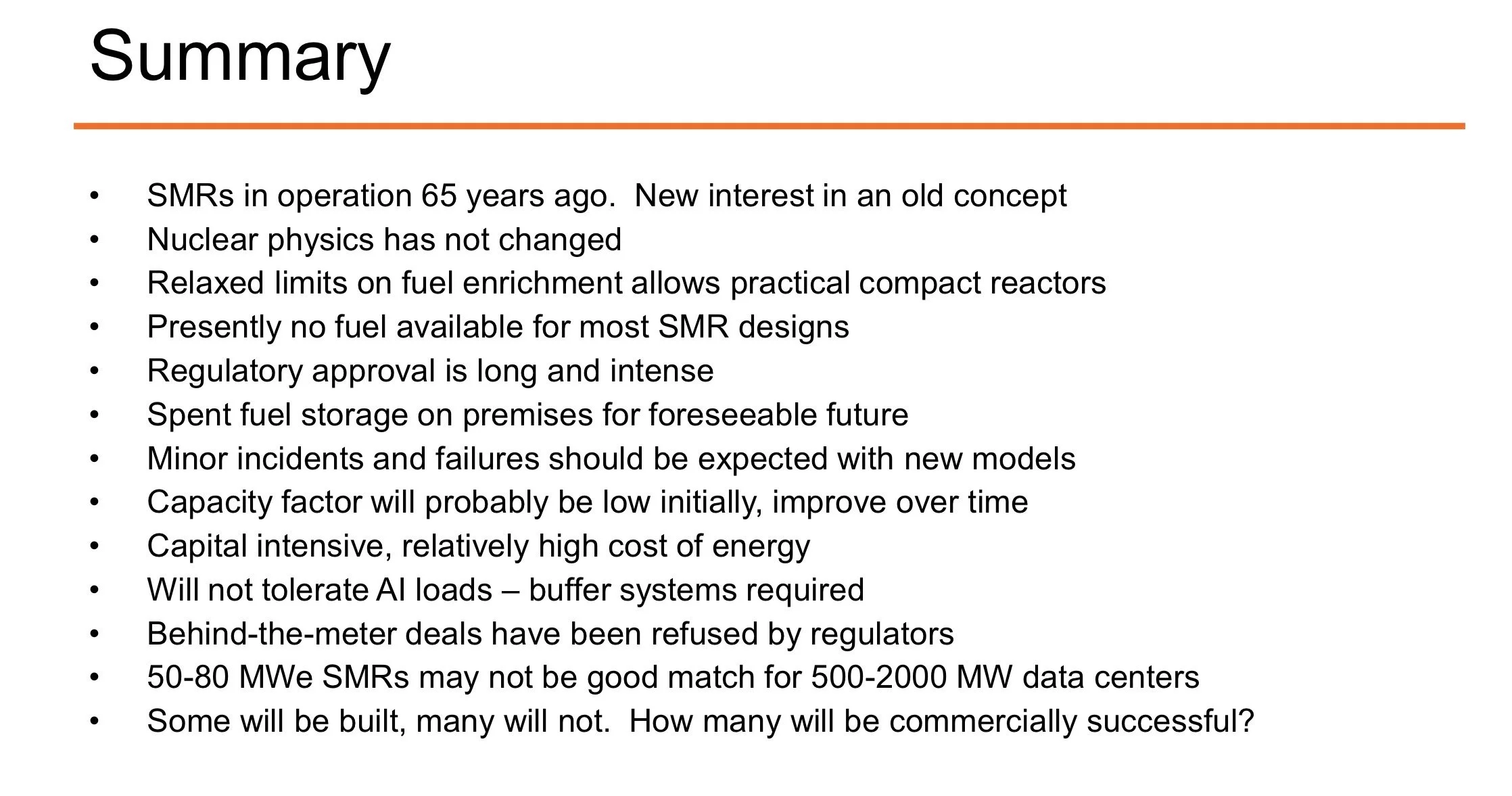
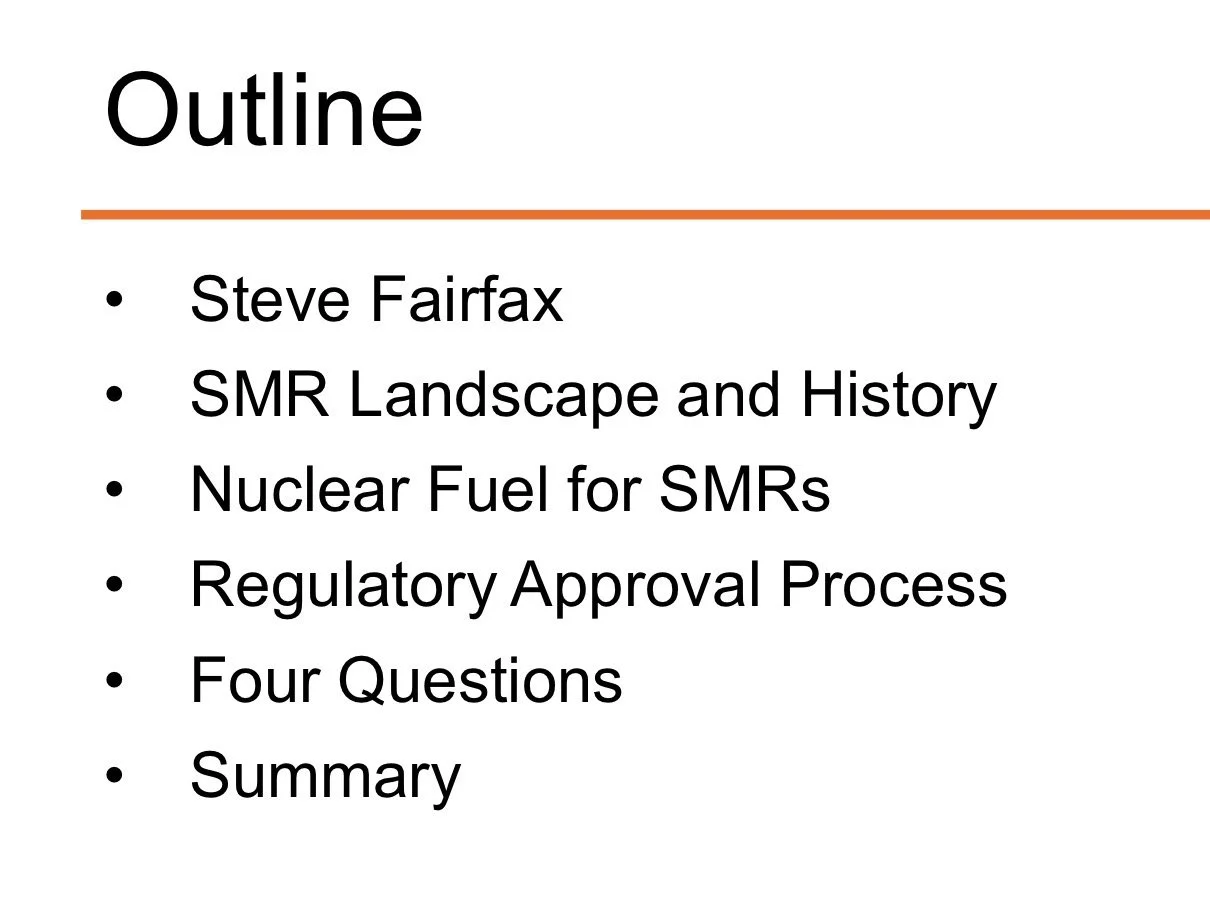
The reality of small modular reactors (SMR) are in this slide. Steve covers these four questions.

The summary of Steve’s talk gives you an idea of how much he covered.

Fall 2025 7x24 Exchange Keynote - Cassie Kozyrkov - AI First

Cassie Kozyrkov, https://www.kozyr.com was the opening Keynote for the 7x24 Exchange 2025 Conference.

She discussed the perceptions that exist of AI - Theory, Data, GenAI, Agents

Cassie took the audience through a journey of to think about AI. She interacted with the audience to engage the audience in how to think about AI.

Control vs. Complexity is one of the points that Cassie arrived at how people’s focus on control creates an over simplistic approach when the hardest problems require an embrace of complexity and data. Data enables a super human memory.

Here are some nuggets of what Cassie covered

The #1 Rule of Complexity. Expect the unexpected!

How do you test complexity? Test to trust.

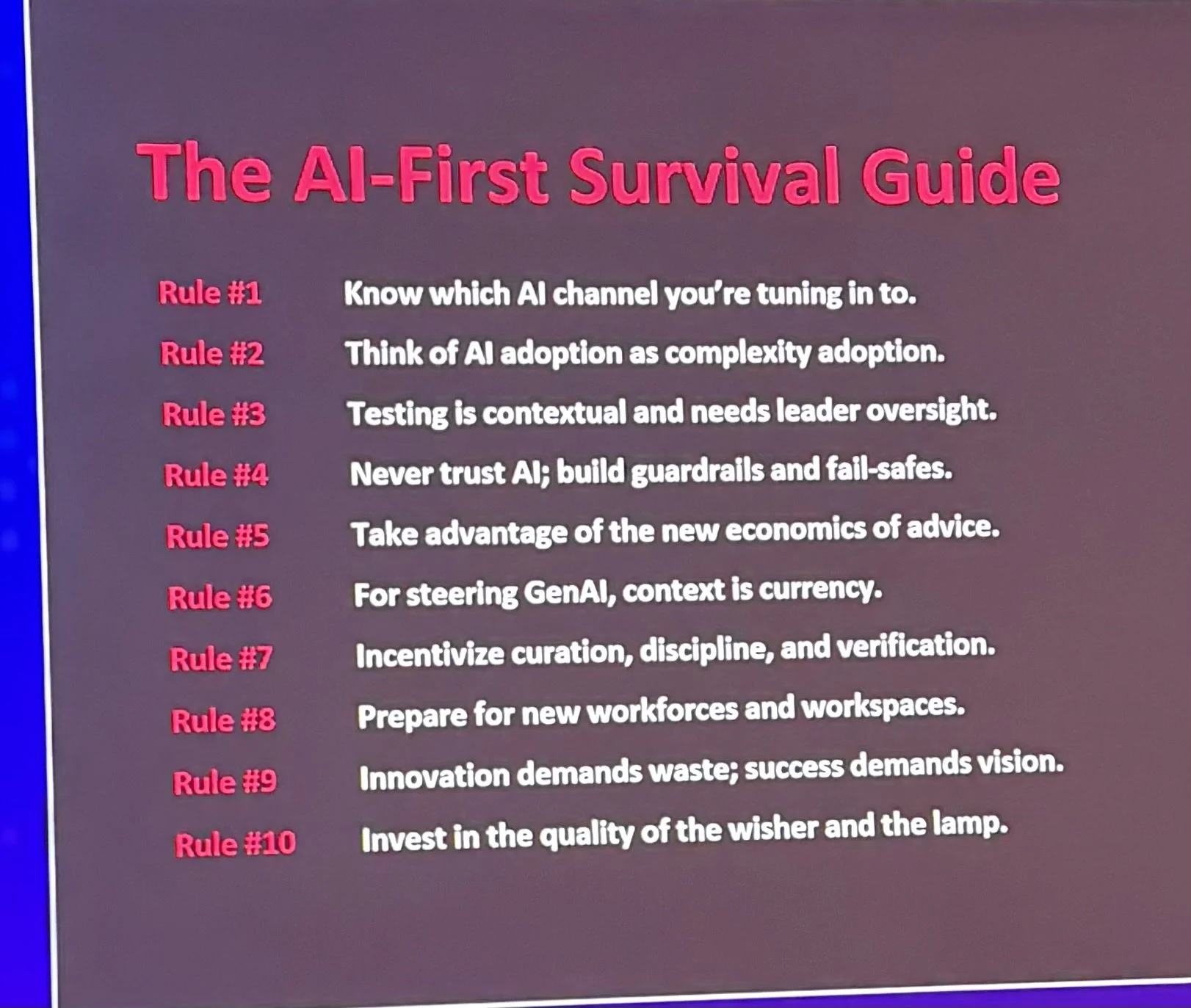
Rule #3 Testing is contextual and needs leader oversight.

AI Reliability Paradox.

Language is the basis of collaboration. literacy is key

Context is Currency

in the end Cassie completed the journey of discussing Theory -> Data -> GenAI -> Agents as a way to think about AI and the range of issues

Remembering Pat Kennedy, The Start of My Green Data Center journey

I just returned from a visit with a BMS integrator where we spent time discussing PLC controllers and monitoring systems. Unsurprisingly, OSIsoft PI came up frequently—it was a chance for me to geek out over how monitoring systems function, and how OSIsoft PI has long been the default historian software in many industrial and infrastructure settings.

That discussion brought back a memory of Pat Kennedy, the founder of OSIsoft. When I looked him up, I discovered that he had sadly passed away. At the end of this note, I’ve included a beautiful tribute his daughter Kathy wrote about him.

Why am I writing about Pat Kennedy?

Because Pat once asked a simple question that changed the trajectory of my career:

“What is the power consumption of an application in a data center?”

No one knew.

At the time, I had spent more than half of my career working on operating systems—first at Apple, focusing on hardware, analog power supplies, and software integration; then at Microsoft, from Windows 3.1 through to XP and Windows Server. I had enough technical grounding to know what questions to ask—and more importantly, what I didn’t yet know.

That question from Pat led me to discover Power Usage Effectiveness (PUE), and more importantly, the startling realization that the industry lacked meaningful instrumentation for app-level power monitoring. Monitoring power consumption at the application layer simply wasn’t part of standard operating procedure.

Then, while talking to a friend about what I was uncovering—how this lack of visibility directly affected the environmental performance of data centers—he said: “That’s a great topic. You should start blogging about it.”

And that’s how my Green Data Center journey began:

With Pat Kennedy asking a smart question that no one could answer.

Here’s what his daughter Kathy wrote about him:

Here is what his daughter Kathy wrote about her dad.

  • Dr. J. Patrick Kennedy of San Leandro, CA | 1943 – 2023 | Obituary

    J. Patrick Kennedy, 79, of San Leandro, CA passed away on April 9, 2023. Pat lost his fight with interstitial lung disease after ten months. 

    He was born on June 4, 1943, in Portland, Oregon, to Ted and Grace Kennedy and was raised in Lawrence, Kansas, where his parents met and married. Pat was raised on a farm south of Lawrence along with his brothers Ted and David.

    Pat had a strong sense of right and wrong and stood up for what he believed in. Although this attitude had a positive effect on his life, there were moments that it caused problems. Pat actually failed to get a high school diploma. A friend of his was suspended for wearing shorts and in protest, Pat came to school the next day in shorts and was kicked out. This setback was minor, as he was already a sophomore at the University of Kansas at the time. Pat went on to earn a BS and PhD in chemical engineering, and was a Jayhawks fan for life.

    Along the way, he met and married the love of his life, Patricia. They met in Tulsa, Oklahoma, when Patty was working as a nurse. 

    Over the next nine years, Pat and Patty had three children and their small family moved several times.. They finally landed in San Leandro, CA. At age 37, he started Oil Systems Inc. (later known as OSIsoft). The firm evolved into a software company that developed monitoring products for heavy industry. He ran the business for 40 years. 

    He was a dedicated husband, father and grandfather and continually extended himself for those that he loved. Pat enjoyed a life of family events and activities and playing the ukulele. In the last few years, Pat focused his philanthropy on food insecurity in Alameda County.
     
    Pat was a giant in his industry. His life’s work will continue to grow, and among other things, we will miss his unique sense of humor. Pat is survived by his wife of 56 years, Patty, three children, their spouses, grandchildren and his brother in San Diego.