Over the last several weeks, I’ve settled into a workflow that looks unusual on the surface but has proven extremely effective in practice:
ChatGPT for structural exploration and review
Claude Code for deterministic compilation and execution
No overlap between their responsibilities
The key is not which models I use—it’s how I separate their roles.
The Capability Asymmetry That Matters
Here is the practical difference that forced this separation:
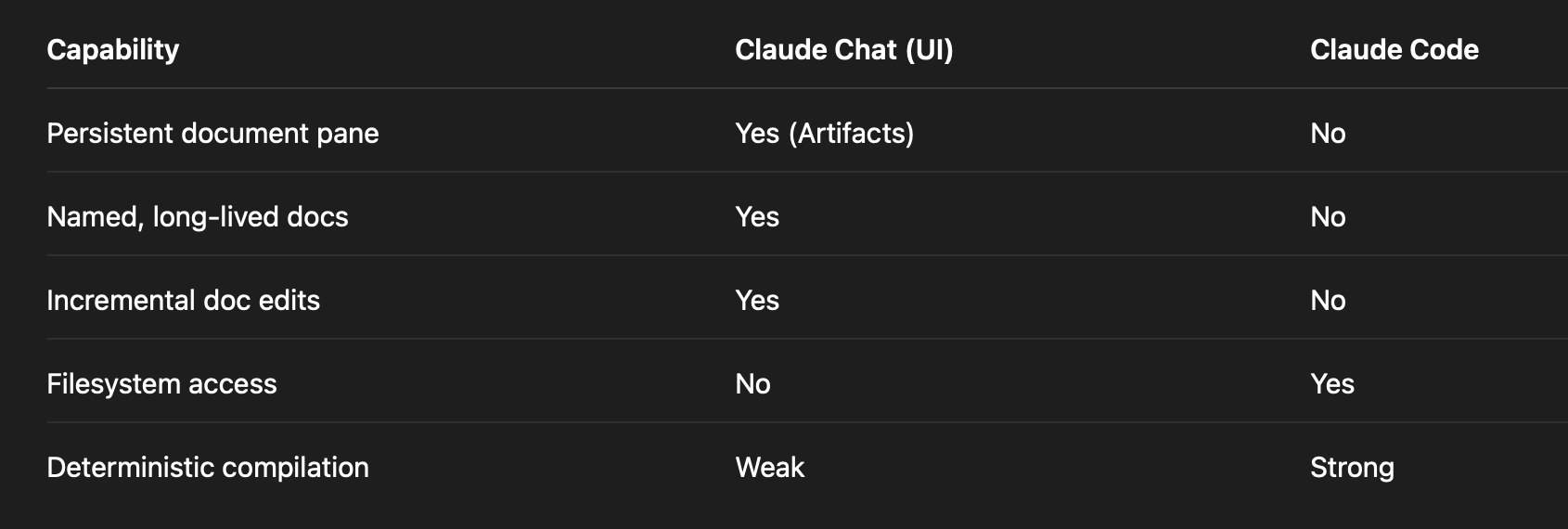
That tells you how each tool wants to be used.
ChatGPT = Structural Workspace
I use ChatGPT for:
Long-lived thinking
Naming and structure
Clarifying intent
Reviewing results after execution
I do not use it to touch the filesystem or “prove” code works.
Claude Code = Compiler
Claude Code is treated as a deterministic machine:
It edits real files
It runs real commands
It fails concretely
It enforces correctness through execution
No long-term reasoning. No design debates.
The Critical Rule
I never use ChatGPT to review Claude Chat.
Instead, the loop is always:
Structure → Compile → Review
ChatGPT defines structure
Claude Code executes it
ChatGPT reviews what actually happened
This avoids language-only feedback loops and keeps everything grounded in reality.
Why This Works
Exploration stays fast
Execution stays correct
Code becomes expendable
Structure becomes durable
I’m now applying this workflow to OS-level services for electrical and mechanical systems in AI data centers, where ambiguity is expensive and determinism matters.
Final Thought
Most AI frustration comes from asking one tool to do two incompatible jobs.
Once you separate exploration, compilation, and review, AI starts behaving like a real engineering toolchain—not a chatbot.
