Coherence and focus
Published: 2026-04-28
Gary Starkweather was solving an information transfer problem.
The original problem was straightforward: Xerox wanted to send a copy from one copier to another. Transfer the image across a wire. Starkweather worked on it and ran into the same wall anyone would hit: white light is incoherent. Every photon is at a different phase, a different frequency, going a different direction. You cannot preserve precise spatial information on an incoherent carrier without the signal degrading. The image degrades. The signal falls apart before it arrives.
A laser is different. Its photons are coherent: same phase, same frequency, same direction. The source is coherent. And once you have a coherent source, you can use optics to focus it — direct it exactly where it needs to go, pixel by pixel, without loss. The laser solved the coherence problem that white light could not.
Then Starkweather saw the deeper thing. If you are sending a coherent signal anyway, why carry the entire image? A fax sends the complete picture — every pixel, whether it matters or not. But a coherent digital signal can carry structure: the information that describes the image, not the image itself. Send the structure. Render it on the receiving end. The result is more precise, faster, and far more efficient than copying the whole surface and transmitting it. That insight is the laser printer. Not a better copier. A new class of machine: one that transfers structured information and renders it onto a physical surface.
GreenM3DC is solving the same class of problem.
A construction project generates structural information continuously — material locations, RFI status, delivery provenance, thermal boundary conditions at mechanical interfaces. That information exists. The problem is that it is incoherent: scattered across systems, held by different teams, expressed in different formats, and never compiled into a single structured transfer that a decision-maker can act on. The owner does not lack data. The owner lacks a focused surface. Without that surface, the project cannot distinguish noise from structural signal.
GreenM3DC is the transfer mechanism. Each framework in the stack is a coherent lens — calibrated to one layer of the physical system, aimed at one class of structural claim. The spatial compiler is the optics. It takes those coherent inputs and focuses them onto a surface at the scale where a human can see what needs attention. The compile result is not trying to be a complete model of the building. It is a focused transfer of the building's own admitted signals, structured through a coherent grammar, rendered at the resolution where an owner can make a decision.
The Structural MRI Scanner is one tool in that transfer chain.
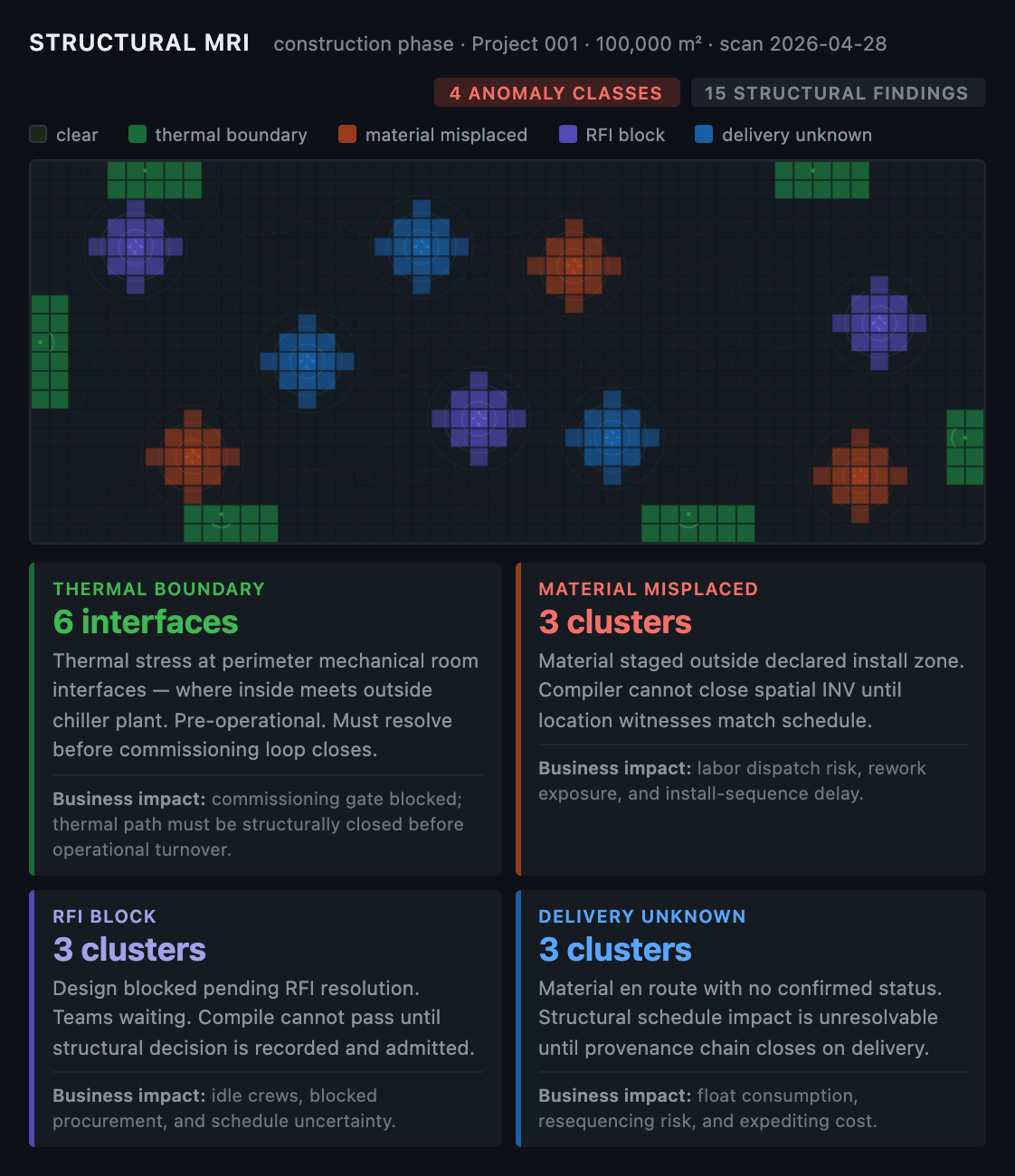
Just as an MRI in healthcare produces a diagnostic scan — not a treatment, not a care plan, but a precise localization of where the body is incoherent — the Structural MRI Scanner produces a structural scan of the project field. Four anomaly classes. Fifteen findings. Thermal boundary stress at the perimeter interfaces where mechanical rooms connect to outside chiller infrastructure. Material staged in the wrong location. Design blocked waiting on RFI resolution. Delivery status unknown. The scanner does not find generic issues. It transfers typed, localized incoherence onto a surface the project team can read.
The value is not that it finds problems. Project teams already know problems exist. The value is that it separates problem types by structural cause, localizes them in the field, and identifies which gate cannot truthfully close until the incoherence is resolved.
Once a boundary is identified, resolution can be compiled.
Each corrective action runs through the GreenM3DC compiler against the specific gate it is meant to close. A gate passes when its conditions are structurally met — not when someone marks it resolved. This is not a 100% project approval. It is a gate-by-gate compile: the gates that have been identified, tracked, and run. Some pass. Some do not. The ones that do not tell you exactly what still needs to close.
That is Starkweather's principle applied to infrastructure. He did not make printing faster. He built a mechanism that could transfer structured information from a coherent digital source onto a prepared physical surface. GreenM3DC does not make project reporting faster. It builds a mechanism that transfers structural information from a coherent compile stack onto a decision surface an owner can act on.
Structural MRI turns project uncertainty into typed, localized, business-actionable incoherence. The blur is where you point next.
GreenM3DC is a structural analysis project applying compile-time verification to green data center design. The sensor bridge is admitted. The spatial compiler is running. Phase 2a — EFC identification, the feedback-control lens — is next in the stack.
