The right information, at the right place and time, for the energy you have, to get the build done.
In the early 1990s the problem was that text on low-resolution screens was unreadable. Print fonts existed, but they were designed for print. They did not fit the medium.
The solution was named simply: fonts for the screen. Verdana solved that. The name made the problem and the answer obvious at the same time.
MakaiWay is trying to make the same move for a different problem.
Builds today — software builds, construction builds, commissioning steps, data center bring-ups — fail not for lack of data. Data is everywhere. They fail because the right information is not in the right place at the right time for the energy and context available. The person who needs to know something cannot act on what they are given, because what they are given is not shaped for them.
The answer to that is named the same way Verdana was named: Bits for the Build.
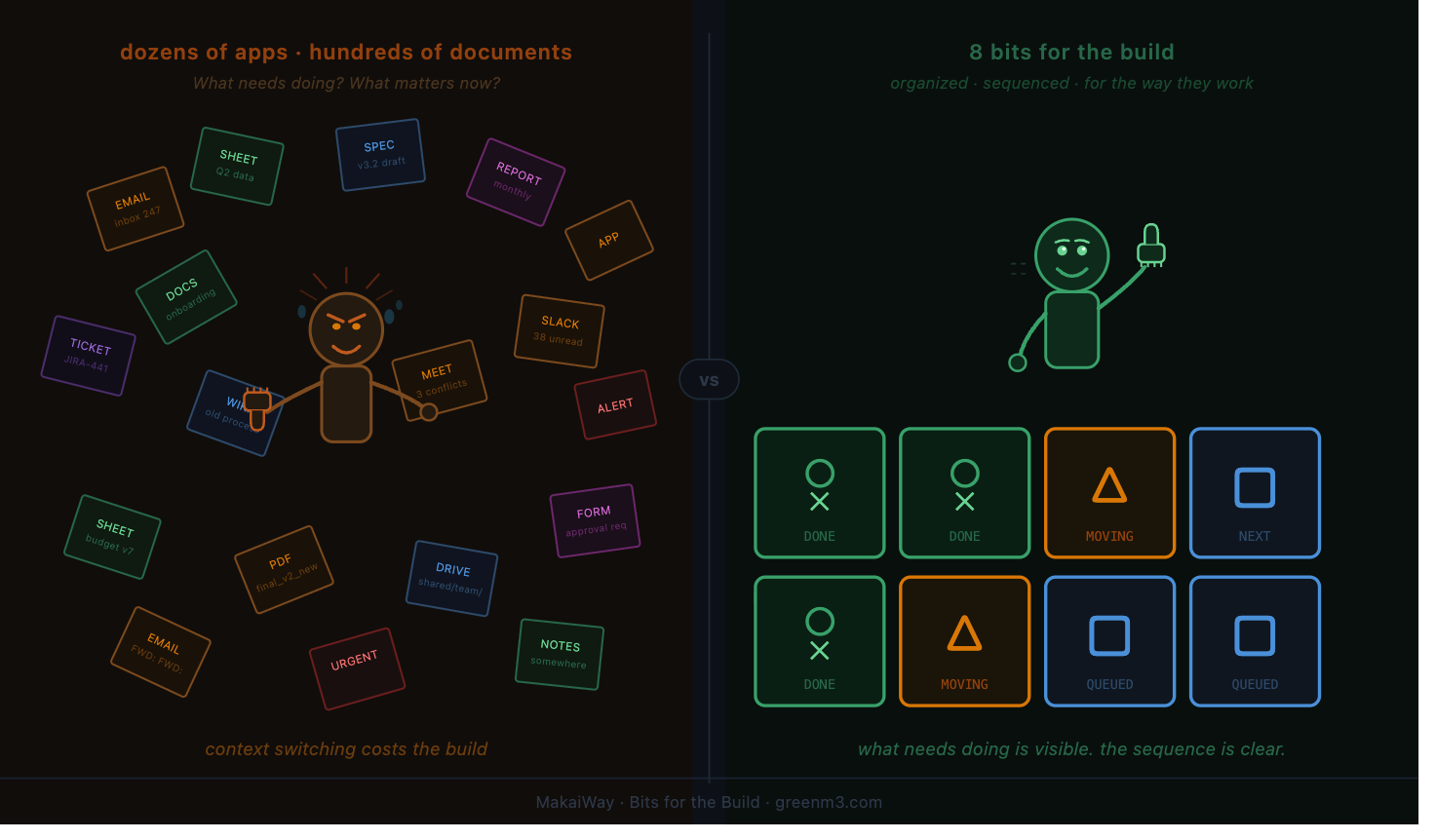
What is a Bit?
A Bit is a scoped, addressable unit of essential information needed to support a build. It is not a file. It is not a doc. It is not a database row. It is the smallest unit that advances the build.
Four properties define it.
Identity. Every Bit has an address. That address makes it verifiable — you can confirm it is what it says it is — and composable — it can link to other Bits. Without an address, information cannot be secured or connected. It can only be copied.
Fluid. The architect, the inspector, and the bricklayer asking the same question receive different Bits, because their build context is different. A Bit that answers the right question for the wrong person is noise.
Energy-aware. The right Bit accounts for what the receiver can actually do with it given current constraints — time, attention, available tooling. Information delivered outside the window where it can be used is not useful information. It is overhead.
Compile-ready. Bits combine. Linked Bits compile into the build. The ID makes relationships explicit instead of implicit. The build is what the Bits compile into.
The lifecycle
Every Bit moves through a visible state.
□ FIELD — the Bit has arrived. Available, scoped, addressable. Pending work.
△ MORPHISM — action is being applied. The build is moving.
○✕ CLOSURE + WITNESS — the Bit's contribution is complete and proven.
Squares are pending. Triangles are in motion. The circle-X is done and witnessed. Anyone looking at a wall of Bits can read the build state at a glance — not from a status dashboard, not from a standup, from the symbol set.
That last part matters. Most information systems deliver. Few witness. The X inside the closure is proof that the work happened — not that someone reported it happened.
Why this framing holds up
It names a problem nobody else has named. "Information delivery" is too generic. "Documents" is too static. "Bits for the Build" points at the gap.
It carries the verification model in the symbol set. You do not need to read the spec to understand that ○✕ means closed and proven. The proof is in the shape.
It scales. A Bit's ID and links are the same whether the build is a meeting, a data center commissioning step, or a code change. The model does not depend on the size of the build.
It respects energy. The same fact, delivered as the wrong Bit at the wrong time, is noise. Energy is a first-class input, not an afterthought.
Verdana solved legibility on screens. MakaiWay solves delivery and verification for the build. People grab "Bits for the Build." Everything else unfolds from there.
— Dave / greenm3
