1,000 + AWS hiring, How big is the AWS team? Are you paying for features you don't need?

AWS does a great job of promoting how lean it is and continuously drops the price of AWS.  Yet, there are companies who find it is lower cost to move out of AWS and run their own cloud.  How can that be?

Here is a thought experiment.  There are currently over 1,000 job openings in AWS.  Amazon overall has over 100,000 employees.  Let’s just say that the AWS team is 5,000 employees and they are have 20% job openings.  Do you need 5,000 employees to run the AWS services you are using no.  Many of those people are developing new services and new customers.  So part of your payments are the costs to fund the growth of AWS.

We're hiring!

Since early 2006, Amazon Web Services has provided companies of all sizes with an infrastructure platform in the cloud. 
We're looking for talented new members of the AWS team in the following locations:

When you are small this cost is not significant amount and the value of what you get from not having to have infrastructure people is worth it.  As you grow and start  paying $10k a month, $40K a month, then maybe $75K a month, what % of your payments are now going to fund AWS’s growth?

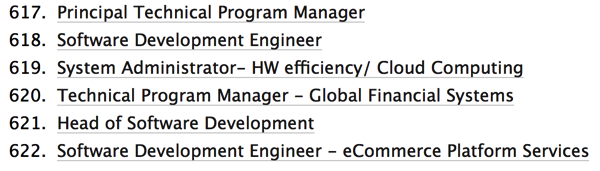
Take a look again at the 1,000 people AWS is trying to hire. Are those people and features you need?  There are 622 job openings just in Seattle.
NewImage

I think part of the reason why companies choose to move out is the features they need are clear and they just need a handful to run their services.


Early days of AWS - Fireside chat Andy Jassy

Here is a Youtube video with 

Published on Oct 21, 2013

As a follow up to his presentation, Andy Jassy, senior vice president of Amazon Web Services, sits down with Michael Skok to discuss the evolution of AWS and its road to success.

Here is a blog post for those of you would like to read vs. watch a 45 minute video.

Revealed: The 4 Reasons Amazon Web Services Got Approved

Screen Shot 2013-12-19 at 9.19.42 AM

In the summer of 2003 Amazon was a fast-growing online bookstore.  Nine years old, it had pioneered many innovative components of e-commerce that we take for granted today: customer reviews, a personalized shopping experience, relevant product recommendations, and frictionless buying.

Jeff Bezos had founded the company in 1994 and began selling books online.  His advantage, he thought, was that he could sell a bigger selection of books than any traditional book store (or chain).  And right from the start he committed to outstanding customer service. Amazon’s mission is “to be Earth’s most customer-centric company, where customers can find and discover anything they might want to buy online, and endeavors to offer its customers the lowest possible prices.”

Which is why it wasn’t an easy decision in the summer of 2003 to hire a team of 50 or so engineers, and set them upon the task of build “the operating system of the internet,” as Andy Jassy, Sr Vice President of Amazon Web Services, likes to call it.

The Leadership team took an assessment of its assets:

“We were doing an assessment ourselves, as a senior leadership team, about what Amazon was really good at.  And initially you can imagine what we were talking about: we were good at retail, we were good at detail pages on our retail site website – all the things that were the primary business at the time.  But as we dug deeper we realized we were really good at running these infrastructure services deep in the stack, and then we were also good at running these reliable, scalable, cost-effective data-centers.  So the first realization we had was that we had a real core competence running infrastructure.”

A view of working in Amazon's IT group vs. Google

We have all seen when people have sent an e-mail that copied the whole company.  Thanks to social networking, you can now make same mistake magnitudes worse by sharing to the public vs. your company.

Here is a post by a Google engineer that has been published on another google plus site on his comparison of amazon vs. google.

Shared publicly  -  Oct 12, 2011
The best article I've ever read about architecture and the management of IT.

***UPDATE***

This post was intended to be shared privately and was accidentally made public. Thanks to +Steve Yegge for allowing us to keep it out there. It's the sort of writing people do when they think nobody is watching: honest, clear, and frank.

The world would be a better place if more people wrote this sort of internal memoranda, and even better if they were allowed to write it for the outside world.

Hopefully Steve will not experience any negative repercussions from Google about this. On the contrary, he deserves a promotion.

***UPDATE #2***

This post has received a lot of attention. For anyone here who arrived from The Greater Internet - I stand ready to remove this post if asked. As I mentioned before, I was given permission to keep it up.

Google's openness to allow us to keep this message posted on its own social network is, in my opinion, a far greater asset than any SaS platform. In the end, a company's greatest asset is its culture, and here, Google is one of the strongest companies on the planet.
Steve Yegge originally shared:
Stevey's Google Platforms Rant

I was at Amazon for about six and a half years, and now I've been at Google for that long. One thing that struck me immediately about the two companies -- an impression that has been reinforced almost daily -- is that Amazon does everything wrong, and Google does everything right. Sure, it's a sweeping generalization, but a surprisingly accurate one. It's pretty crazy. There are probably a hundred or even two hundred different ways you can compare the two companies, and Google is superior in all but three of them, if I recall correctly. I actually did a spreadsheet at one point but Legal wouldn't let me show it to anyone, even though recruiting loved it.
 
Steve responds well and adds another point on how wicked smart Jeff Bezos is.

Bezos is so goddamned smart that you have to turn it into a game for him or he’ll be bored and annoyed with you. That was my first realization about him. Who knows how smart he was before he became a billionaire -- let’s just assume it was “really frigging smart”, since he did build Amazon from scratch. But for years he’s had armies of people taking care of everything for him. He doesn’t have to do anything at all except dress himself in the morning and read presentations all day long. So he’s really, REALLY good at reading presentations. He’s like the Franz Liszt of sight-reading presentations.

So you have to start tearing out whole paragraphs, or even pages, to make it interesting for him. He will fill in the gaps himself without missing a beat. And his brain will have less time to get annoyed with the slow pace of your brain.

I mean, imagine what it would be like to start off as an incredibly smart person, arguably a first-class genius, and then somehow wind up in a situation where you have a general’s view of the industry battlefield for ten years. Not only do you have more time than anyone else, and access to more information than anyone else, you also have this long-term eagle-eye perspective that only a handful of people in the world enjoy.

In some sense you wouldn’t even be human anymore. People like Jeff are better regarded as hyper-intelligent aliens with a tangential interest in human affairs.

Amazon's Shipping opportunity for Private Delivery looks like what could be done with Hybrid Cloud

Much has been discussed on Hybrid Clouds.  One way to think about the problem of what should be in Public vs. Private cloud is what would Amazon do moving from Public Shipping companies to add capacity with a private delivery fleet.  Why?  Because sometimes thinking how to solve a problem from a different perspective can show you a different way to think about the problem.

If you were going to move some of your Cloud Compute out of AWS what should you move?  The easiest or the most valuable?  Another way to think is what could you move to your Private Cloud that would give you the most savings, leaving the rest to run in AWS.

Let me use local shipping as an example.  Here in Seattle UPS, Fedex and other local contract companies deliver packages for Amazon.  If Amazon was going to add private delivery to the mix what should they add?  Those thing that are the easiest?  Those things that are the most valuable?  You could, but that doesn’t necessarily get the maximum value out of a local private delivery service.  If Amazon has 10 trucks for routes and knows the shipments coming through, why not pick those shipments that can have the most savings vs. shipping with the Public carriers?  The complexity is a good problem for compute algorithms to calculate those shipments that can be handled in a day with the at the lowest cost and the most amount of freight saved.  This difference is what ends up in Amazon’s pocket at the end of the day, and provides future negotiating leverage with the Public Carriers.

Sometimes what people are thinking goes into a public cloud vs. private is not a clear financial reason.  If you cannot run it cheaper in house, then move it back to Public, and put something else in the private cloud. 

Just something that hit me after reading the Everything Store book.

The Everything Store: Jeff Bezos and the Age of Amazon [Kindle Edition]

Brad Stone 
4.3 out of 5 stars  See all reviews (308 customer reviews)

Print List Price: $28.00
Kindle Price: $10.99
You Save: $17.01 (61%)
Sold by: Hachette Book Group
NewImage