Can A True Analysis be Written of Amazon.com? Everything Store book makes the point

I am reading the Everything Store: Jeff Bezos and the Age of Amazon for the 2nd time.  The first read I found interesting to see what the author had collected as the facts to write his book.  The nice thing is I know some folks who have been at Amazon and talked with them first hand on what the company is like.  One friend I found was in the book.  Were they quoted in an interview?  no they just appear in this picture included in the book.

NewImage

A point made in the book is the challenge of telling story in words.

The narrative fallacy, Bezos explained, was a term coined by Nassim Nicholas Taleb in his 2007 book The Black Swan to describe how humans are biologically inclined to turn complex realities into soothing but oversimplified stories. Taleb argued that the limitations of the human brain resulted in our species’ tendency to squeeze unrelated facts and events into cause-and-effect equations and then convert them into easily understandable narratives. These stories, Taleb wrote, shield humanity from the true randomness of the world, the chaos of human experience, and, to some extent, the unnerving element of luck that plays into all successes and failures.

Bezos was suggesting that Amazon’s rise might be that sort of impossibly complex story. There was no easy explanation for how certain products were invented, such as Amazon Web Services, its pioneering cloud business that so many other Internet companies now use to run their operations. “When a company comes up with an idea, it’s a messy process. There’s no aha moment,” Bezos said. Reducing Amazon’s history to a simple narrative, he worried, could give the impression of clarity rather than the real thing.

Stone, Brad (2013-10-15). The Everything Store: Jeff Bezos and the Age of Amazon (pp. 12-13). Little, Brown and Company. Kindle Edition.

If you agree with the point made by Bezos and Taleb which the author Brad Stone would appear given he puts it in the book, then how should you interpret what Brad Stone has written?  The image above tells a story that is not manipulated in photoshop to align with the goals of a sales team.  The words written by Brad Stone are written in a way that fulfill his objectives and his publisher.

This idea is going through my head as I read the book for the 2nd time.

Here are some words from my friend who is in the above picture.

in my time he was just a very enthusiastic, very smart startup CEO with a mission beyond what any of us ever imagined. I'm still crazy proud of the place and my time there

This point is going through my head though more as I study Amazon.

Wow AWS is 8 years old

GigaOm’s Barb Darrow posted on AWS turning 8.


Amazon’s ginormous public cloud turns 8 today


3 HOURS AGO

No Comments

birthday cake
photo: wfabry
SUMMARY:

When Amazon launched S3 in March, 2006, no one with the possible exception of Jeff Bezos et al, thought that Amazon Web Services would become an IT juggernaut. Well, guess what?

Eight years ago Amazon, the online book seller, announced a storage service for the internet. That S3 service was the first of a slew of cloud-based products that Amazon launched and which, it can be safely said, shook the IT world to its roots.

I can remember this time well as I left Microsoft in Apr 2006 and a friend left Microsoft to join the AWS team, and he is still there.

Web Services Evangelism

Amazon Web Services

May 2006 – February 2010 (3 years 10 months)

Amazon Web Services provides developers with direct access to Amazon's robust technology platform on a true on-demand basis. For example, what used to require an upfront investment in servers is now an on-demand utility, accessible for only $0.085/hour, with no upfront costs, no monthly minimums, and no catches.

There is nothing more exciting than telling the world about the amazing things that they can do with Amazon Web Services. So it was easy to travel the world, telling anyone who would listen, about this new thing known as "the cloud". Isn't it incredible? In 2006 S3 and EC2 were born -- and we were amazed that 185 million "objects" were stored in Amazon S3.

If AWS is invincible, then why fund a direct competitor? DigitalOcean gets $37.2 mil

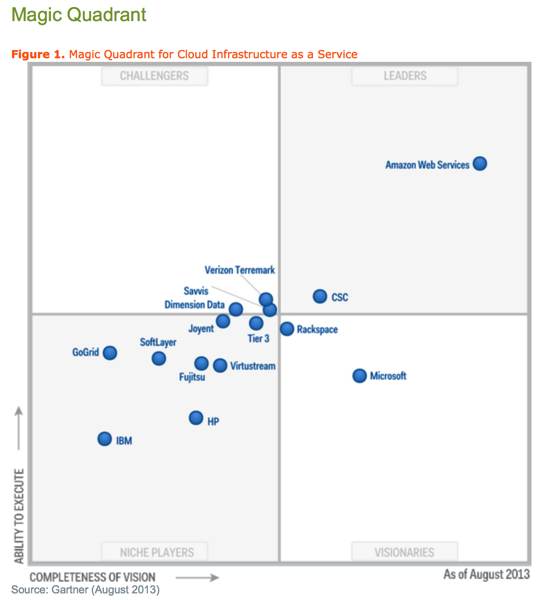
The way some people talk AWS has already won the cloud battle and the spoils are left to the rest.  The beauty of the cloud and their customers is as fast as VMs can be spun up, new businesses can figure out better ways to spin up VMs.  Here is Gartner’s infamous magic quadrant on IaaS.

NewImage

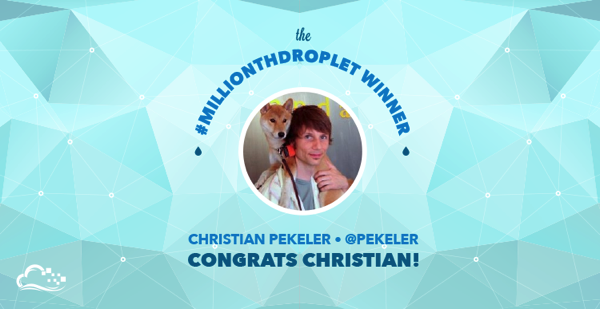
So how’s this for a change.  DigitalOcean doesn’t show up anywhere in this graphic.  Yet has just received $37.2 mil series A funding and has spun up its 1,000,000 VM.

DigitalOcean Growth

In the past 15 months and with only a handful of engineers we’ve been able to hit some amazing milestones. We’ve launched over 1,000,000 virtual servers, processed 18,000,000 events, opened new datacenter regions in San Francisco and Singapore, for over 100,000 customers.

NewImage

DigitalOcean had a simple vision.  Make life easier for the developer.  Vs. Amazon make more money.  Make things stickier, make it hard for people to leave AWS.

We started DigitalOcean in the summer of 2011 with a simple mission: to make developers lives easier. We thought that the other players in the space had made IaaS too complicated. We focused on user experience and simplicity. Guiding ourselves with a single principle, can we build a product that we would love ourselves?

With three engineers we built the first version of our product and with help from the Hacker News community our growth exploded when we announced our SSD powered cloud.

Part of the problem AWS is having in its efforts to make it harder for people to leave it makes it harder to get started as well.

A peak into Amazon's approach to servers comes from LSI

here is a blog post by Silicon Angle with Robert Ober.  In this post Robert discusses some of Amazon’s approached to IT hardware.

“The evolutionary direction we’re going in the data center, you can call it many things – you can call it pooling, you can call it disaggregation – but at a large scale, at a rack or multiple racks or a hyperscale data center, you wanna start pulling apart the parts,” he remarks.

Optimizing infrastructure down to the component level has many benefits, both architectural and operational, but Ober considers the improvements in thermal management to be the most notable. The reason, he details, is that processors, DRAM, flash and mechanical disk all have different temperature thresholds that have to be sub-optimally balanced in traditional configurations.

Here is a video you can watch with Robert discussing some of the ideas.  This interview was done at the OCP Summit V.

Netflix made 11 presentations at AWS Re:Invent

AWS Re:Invent had many sessions and the folks at Netflix created a post so you could find the Netflix one, two, three, four, five, six, seven, eight, nine, ten, eleven.

Yes there are eleven Netflix presentations made at AWS Re:Invent.  Here are two.  You can go to this link to see all.

Netflix Presentation Videos from AWS Re:Invent 2013


AWS recorded all the talks, there are hundreds of videos, so to make it easier to find the Netflix related ones, here are links to the videos.

DMG206 - Development Patterns for Iteration, Scale, Performance and Availability
Neil Hunt - Chief Product Officer


ENT203 What Enterprises Can Learn From Netflix
Yury Israilevsky - VP Cloud and Platform Engineering