Smart Grid Issues for Electric Vehicles looks like Data Center Power Monitoring Complexity

Like fractals, complex system can be self-similar.

Fractal

From Wikipedia, the free encyclopedia

For the 2009 recording by Skyfire, see Fractal (EP).

The Mandelbrot set is a famous example of a fractal

A fractal is generally "a rough or fragmented geometric shape that can be split into parts, each of which is (at least approximately) a reduced-size copy of the whole,"[1] a property called self-similarity. Roots of mathematical interest on fractals can be traced back to the late 19th Century; however, the term "fractal" was coined by Benoît Mandelbrot in 1975 and was derived from the Latin fractus meaning "broken" or "fractured." A mathematical fractal is based on an equation that undergoes iteration, a form of feedback based on recursion.[2]

A fractal often has the following features:[3]

Because they appear similar at all levels of magnification, fractals are often considered to be infinitely complex (in informal terms). Natural objects that approximate fractals to a degree include clouds, mountain ranges, lightning bolts, coastlines, snow flakes, various vegetables (cauliflower and broccoli), and animal coloration patterns. However, not all self-similar objects are fractals—for example, the real line (a straight Euclidean line) is formally self-similar but fails to have other fractal characteristics; for instance, it is regular enough to be described in Euclidean terms.

Gigaom has an article about the complexity of a smart grid electric vehicle system.

Report: IT and Networking Issues for the Electric Vehicle Market This content requires a paid GigaOM Pro subscription

Summary:

This Pike Research report focuses on the IT and networking requirements associated with technology support systems for the emerging Electric Vehicle (EV) market. Key areas covered include vehicle connection and identification, energy transfer and vehicle-to-grid systems, communications platforms, pricing and billing systems and implementation issues.

The new generation of mass-produced EVs (including both plug-in and all-electrics) that will start arriving in 2010 will be able to charge at the owner’s residence, place of business, or any number of public and private charging stations. Keeping track of the ability of these vehicles and the grid to transfer energy will require transmitting data over old and new communications pathways using a series of developing and yet-to-be-written standards.

Industries that previously had little to no interaction with each other are now collaborating, determining new technologies and standard protocols and formats for sharing data. Formerly isolated networks must be able to handshake and seamlessly share volumes of financial and performance data. EV charging transactions will, for the first time, bring together platforms including vehicle operating systems and power management systems, utility billing systems, grid performance data, charging equipment applications, fixed and wireless communications networks, and web services.

When you look at the complexity of the system, it looks amazingly like the issues to put in a real-time energy monitoring system in the data center.

  1. Executive Summary
  2. Vehicle Connection and Identification
    1. Building Codes
    2. Battery Status
    3. Managing Vehicle-Grid Interaction
    4. Power Transfer
      1. Timed Power Transfer
  3. Communications Between Charging Locations and the Grid
    1. Home Area Networks
      1. Smart Meters
    2. Communications Channels
      1. Broadband
      2. ZigBee
      3. Powerline Networking
      4. Cellular Networks
  4. Utility Interaction with Customers
    1. Real-time Energy Pricing
    2. Enabling Vehicles to Respond to Grid Conditions
    3. Renewable Energy
    4. Future Vehicle to Grid (V2G) Applications
  5. Implementation Issues
    1. Cost
    2. Standards in Flux
    3. Clash of Multiple Industries
      1. Control
    4. Privacy
Read more

Best Possible Conditions for a Green Data Center, Intel & T-Systems launch DataCenter2020

Intel and T-systems have launched DataCenter2020.

Bavaria's Silicon Valley: DataCenter 2020

Sep 18, 2009

  • T-Systems and Intel join in researching the efficient data center of the future

Opening in Munich: At DataCenter 2020, T-Systems and Intel are working on the industrial implementation and automation of ICT services. Their goal: bringing them to market with maximum energy and cost savings. In an initial phase at Euroindustriepark, the two companies are researching how to create the best possible conditions for a green data center. Initial findings will be published this year. They will serve as the basis for ecological improvements to new and existing data centers.

Some of the technical details for the below pictures are:

Highlights of DataCenter 2020 include a ceiling height that can be adjusted from 2.50 meters to 3.70 meters and a smoke generator that makes air flows visible. The test environment, roughly 70 meters square, and an equipment room of the same size are located in the T-Systems data center. Intel is providing about 180 servers for the project, while the corporate customer arm of Deutsche Telekom is supplying the infrastructure necessary to operate them.

20090918_DataCenter2020_008

20090918_DataCenter2020_002 

20090918_DataCenter2020_005

Read more

Adobe Greens Content Publishing, Closes Loop with Omniture Acquisition

Adobe announced its acquisition of Omniture to measure the effectiveness of published content.

Adobe acquires Omniture

On Sept. 15, 2009, Adobe Systems Incorporated (Nasdaq:ADBE) and Omniture, Inc. (Nasdaq:OMTR) announced the two companies have entered into a definitive agreement for Adobe to acquire Omniture in a transaction valued at approximately $1.8 billion on a fully diluted equity-value basis. Under the terms of the agreement, Adobe will commence a tender offer to acquire all of the outstanding common stock of Omniture for $21.50 per share in cash.

Adobe’s acquisition of Omniture furthers its mission to revolutionize the way the world engages with ideas and information.

Adobe and Omniture

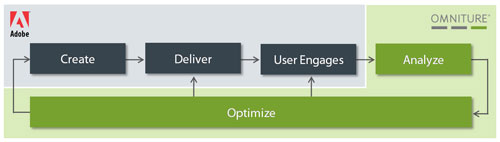
For the data center the significance is in closing the loop in published content.

By combining Adobe’s content creation tools and ubiquitous clients with Omniture’s Web analytics, measurement and optimization technologies, Adobe will be well positioned to deliver solutions that can transform the future of engaging experiences and e-commerce across all digital content, platforms and devices.

This is an important part of a strategy to understand the value of information in the data center.

Greening the data center is easier if you can understand what information systems are high value and which are low value.

The more advanced companies are thinking of a strategy for greening the data center accounting for the business value of the systems.  You can save more by segmenting the IT loads than by treating them all the same.

Read more

Conversation Between Facilities and IT, Lost in Translation

After listening to Mike Manos’s chiller side chat and writing a short blog post.  It got me thinking about  the passionate conversations I’ve listened to between data center facilities and IT, and part of the problem is captured in understanding “Lost in Translation

If you haven’t seen the movie, here is an explanation of a reoccurring theme.

The concept of "lost in translation" occurs throughout the film with a number of meanings.[1] Bob (Bill Murray), a Japanese director (Yutaka Tadokoro), and an interpreter (Takeshita) are on a set, filming the whiskey commercial. In several exchanges, the director speaks several long sentences with passion, followed by a brief, inadequate translation from the interpreter. The scene (like all the film's Japanese dialogue) is played without subtitles.

Director [in Japanese, to the interpreter]: The translation is very important, O.K.? The translation.
Interpreter [in Japanese, to the director]: Yes, of course. I understand.
Director [in Japanese, to Bob]: Mr. Bob. You are sitting quietly in your study. And then there is a bottle of Suntory whiskey on top of the table. You understand, right? With wholehearted feeling, slowly, look at the camera, tenderly, and as if you are meeting old friends, say the words. As if you are Bogie in Casablanca, saying, "Here's looking at you, kid," -- Suntory time!
Interpreter [In English, to Bob]: He wants you to turn, look in camera. O.K.?
Bob: Is that all he said?[2]

Now imagine you had an IT guy as the Director, going on and on about the needs for hosting new applications and hardware in the data center.  A facilities team listening to the IT guy, and the outside data center design team translating the needs of IT to data center specification.

Do you think something is lost in translation?

This is all kind of funny as I am Japanese American, have taken twenty trips to Tokyo working on multiple products with many Japanese companies.  And, other friends who have gone through the pain recognize the patterns and mistakes that cause a lost in translation.

Watching IT folks and data center folks communicate is entertaining as they don’t understand each other even though they are both speaking English.

There is a way to solve the problem, but it requires people who can think about knowledge modeling to continuously assess cross system opportunities for improvement and optimization based on the changing requirements and system capabilities.

There are some people who can do this and they’ll laugh at the connection between “Lost in Translation” and data center conversations between facilities and IT.

Read more

Data Centers as Cities, and Servers as Buildings – IT ecosystem

I just had an hour discussion with data center construction company and another hour discussion with Intel on the 5500 chip and data centers. Thanks to these two conversations and some good input from Intel’s Allyson Klein, Director of Server Technology Leadership Marketing, I came up with the following metaphor.

You could think of data centers as cities and buildings as servers.  Allyson was quick to point how Portland which is in Intel’s backyard of Beaverton where she is based, has taken a sustainable approach to the city.

Welcome to the new Bureau of Planning and Sustainability

In January 2009, Portland City Council merged the Bureau of Planning with the Office of Sustainable Development to create the new Bureau of Planning and Sustainability. The Bureau of Planning has had an exceptional record of guiding Portland's growth and development toward the thriving, livable city that it is today. The Office of Sustainable Development pioneered policies and programs that integrate environmental, economic, and social benefits.

This new bureau will ensure that sustainability principles are integrated into the core of Portland's planning, urban design and government operations, strengthening Portland’s position as the global epicenter of sustainable practices and commerce.

If you have a Sustainable City plan, then green buildings fit as well.

Green Jobs High performance green buildings Healthy environment


City of Portland Proposed High Performance Green Building Policy


High performance green building presents one of the best solutions to improve environmental performance while strengthening the local economy and keeping buildings affordable in the long term. Recognizing the many benefits of green building, in 2007, Portland City Council directed the Office of Sustainable Development to develop policy options to improve the environmental performance of commercial and residential buildings community-wide. The resulting proposed High Performance Green Building Policy also addresses City Council's goal to identify steps to reduce greenhouse gas emissions 80 percent from 1990 levels by 2050.

The proposed High Performance Green Building Policy seeks to accomplish the following goals for buildings and the sites they occupy in the City of Portland:

  • Reduce greenhouse gas emissions that cause climate change.
  • Maximize energy efficiency and cost savings.
  • Keep housing and commercial buildings affordable over time.
  • Decrease consumption of potable water, especially during summer months.
  • Increase on-site stormwater management.
  • Reduce waste during construction and operation.
  • Improve indoor environmental quality, occupant health and productivity.
  • Increase the number of local living-wage jobs.

Take these ideas and apply the metaphor to a green data center plan with the right kind of servers (performance per watt and power management).

After talking to Allyson more it became clear how Intel could fund its data center innovation efforts like Data Center Efficiency Challenge, as Intel has encountered situations where customers want to buy and deploy Intel’s latest products, but power and cooling capacities were the limiting factor. In 40% of the scenarios when customers postponed purchasing, data center power and cooling capacity was a limiting factor. Helping customers improve the energy efficiency of their data centers frees up power and cooling for more equipment. 

Intel is amongst a crowded data center services market, but they have a unique position as where others can buy or build buildings (server OEMs), Intel can make servers be more productive and more efficient with processors and support chips.  The Intel 5500 chip has some new power management features, and added instrumentation and controls to allow higher levels of power management.  Intel’s Data Center Manager is Intel’s latest effort.

Flexible data center hierarchy support

  • Supports management simultaneously at all levels of data center hierarchy

Power and thermal data aggregation
and trending

  • Monitor node power and inlet temperature data in real time
  • Aggregate power and inlet temperature data
  • Stores trend data for up to 1 year

Intelligent group power capping

  • Supports multiple policies depending on user power threshold target or goal to minimize power consumption
  • Maintains group power capping while dynamically adapting to changing server loads
  • Accepts SLA priority as policy directive
  • Automatically manage rack and group power consumption and safeguard from sudden power spikes

If you follow the data center/city and server/building metaphor, then DCM creates neighborhoods to control power use.

I like the city, neighborhood, building metaphor for data centers.  It seems like a good way to think about the problems in greening a data center and the interdependencies.

Read more