Fiercely Independent Guy/Gadfly, Innovator's DNA, and Chaos Monkey

I was telling one of my good friends who will tell me when I am wrong the story about how one of my other good friends described me as a Fiercely Independent Guy.  She says, "remember, I am the one who said you are a gadfly.  So, you can still be use the FIG acronym - Fiercely Independent Gadfly, instead of Fiercely Independent Guy.  Now it was one thing to describe myself as the Fiercely Independent Guy, it is another to say I am Fiercely Independent Gadfly.

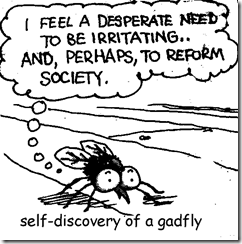
What is a Gadfly?  Merriam's definition.

Definition of GADFLY

1 : any of various flies (as a horsefly, botfly, or warble fly) that bite or annoy livestock

2 : a person who stimulates or annoys especially by persistent criticism

It can hurt to be called a Gadfly.

image

These two people who categorized me as a gadfly could not be more different - one a Prince of the institutional church, almost 70 years old; the other a model for the Jesus follower of the future, recognized by many for his genius with people that the church routinely does not welcome.  What they have in common is (a) they are 2 of the most powerful men in churchianity I know personally and (b) they took the time and effort to call me a gadfly.  When both of them said this term, in very different settings,  it was meant as a slur, a term of disparagement - and trust me, it hurt.

...

There is a funny thing about this slur - inside many institutions, it is a term to shut down new ideas, criticism or even challenges to power or sacred cow.   Outside some of the most fallow institutions, these very characteristics are not a negative category or a way to stifle new life - they are, in fact, the core ethos the organizations strives to achieve.  As is so often the case, a word meant to demean is actually a word of holiness, redeemed as part of our essence as beloved creatures made in God's image.
Do you know who is one of the most famous Gadfly is?  Socrates.

The term "gadfly" (Ancient Greek: μυω̃ψ, myops)[1] was used by Plato in the Apology[2] to describe Socrates' relationship of uncomfortable goad to the Athenian political scene, which he compared to a slow and dimwitted horse. During his defense when on trial for his life, Socrates, according to Plato's writings, pointed out that dissent, like the gadfly, was easy to swat, but the cost to society of silencing individuals who were irritating could be very high. "If you kill a man like me, you will injure yourselves more than you will injure me," because his role was that of a gadfly, "to sting people and whip them into a fury, all in the service of truth." This may have been one of the earliest descriptions of pragmatic ethics.

The nice thing is with 30 years in the industry I've developed more patience and you can achieve results without being overzealous.

The Innovator's DNA is an example of a more tactful way to be a gadfly.

  • Associating—drawing connections between questions, problems, or ideas from unrelated fields
  • Questioning—posing queries that challenge common wisdom
  • Observing—scrutinizing the behavior of customers, suppliers, and competitors to identify new ways of doing things
  • Networking—meeting people with different ideas and perspectives
  • Experimenting—constructing interactive experiences and provoking unorthodox responses to see what insights emerge

When engaged in consistently, these actions—questioning, observing,networking, and experimenting—triggered associational thinking to deliver new businesses, products, services, and/or processes. Most of us think creativity is an entirely cognitive skill; it all happens in the brain. A critical insight from our research is that one’s ability to generate innovative ideas is not merely a function of the mind, but also a function of behaviors. This is good news for us all because it means that if we change our behaviors, we can improve our creative impact. By completing an Innovator’s DNA assessment, you can better understand your personal innovation skill strengths and learn how to make them even better.

Was Socrates an Innovator, labeled as a Gadfly with critics hoping he would go away?

Socrates was in all things an innovator, in religion, in as much as he sought to eliminate from the theology of his contemporaries “those lies which poets tell “; in politics, in as much as he distrusted several institutions dear to Athenian democracy; in education, in as much as he waged war against authority, and in a certain sense made each man the measure of his own actions.

It is because Socrates was an innovator that we, who see in him the founder of philosophical inquiry, regard him as a great man; it was because Socrates was an innovator that old -fashioned Athenians, who saw’ in the new fangled culture the origin of all their recent distresses and disasters, regarded him as a great criminal.

The Gadfly label is applied as Socrates was a gadfly to a horse.

The term "gadfly" (Ancient Greek: μυω̃ψ, myops)[1] was used by Plato in the Apology[2] to describe Socrates' relationship of uncomfortable goad to the Athenian political scene, which he compared to a slow and dimwitted horse.

Isn't this the same as Mike Manos's talk on Chaos Monkeys, Donkeys and Innovation of Action?

In my talk I tried to focus on what I felt to be emerging camps at the conference.    To the first, I placed a slide prominently featuring Eeyore (from Winnie the Pooh fame) and captured many of the quotes I had heard at the conference referring to how the Cloud, and new technologies were something to be mistrusted rather than an opportunity to help drive the conversation.     I then stated that we as an industry were an industry of donkeys.  That fact seems to be backed up by data.   I have to admit, I was a bit nervous calling a room full of perhaps the most dedicated professionals in our industry a bunch of donkeys – but I always call it like I see it.

I contrasted this with those willing to evolve their thought forward, embrace that Innovation of Action by highlighting the Cloud example of Netflix.   When Netflix moved heavily into the cloud they clearly wanted to evolve past the normal IT environment and build real resiliency into their product.   They did so by creating a rogue process (on purpose) call the Chaos Monkey which randomly shut down processes and wreaked havoc in their environment.   At first the Chaos Monkey was painful, but as they architected around those impacts their environments got stronger.   This was no ordinary IT environment.  This was something similar, but new.  The Chaos Monkey creates Action, results in Action and on the whole moves the ball forward.

Interestingly after my talk I literally have dozens of people come up and admit they had been donkeys and offered to reconnect next year to demonstrate what they had done to evolve their operations.

So, if you are called a Gadfly, maybe the person is a Horse or a Donkey, and you are a Chaos Monkey, an Innovator.

" Criticism may not be agreeable, but it is necessary. 
It fulfills the same function as pain in the human body. It calls attention to an unhealthy state of things."
- Winston Churchill

"A society that gets rid of all its troublemakers goes downhill."
Robert A. Heinlein

One way to look at Green Data Center Start-ups are they founded by engineers and scientists or VCs

Two of my cloud computing engineering friends and I are having a blast working on a technology solution that can be used in data centers as well as many other areas. I ran across Steve Blank's post on

How Scientists and Engineers Got It Right, and VC’s Got It Wrong

There are many parts of Steve's post that resonate with our team.

Startups are not smaller versions of large companies. Large companies execute known business models. In the real world a startup is about the search for a business model or more accurately, startups are a temporary organization designed to search for a scalable and repeatable business model.

...

Scientists and engineers as founders and startup CEOs is one of the least celebrated contributions of Silicon Valley.

It might be its most important.

We all worked in Silicon Valley, so we have a bunch of methods ingrained our thinking.

Why It’s “Silicon” Valley
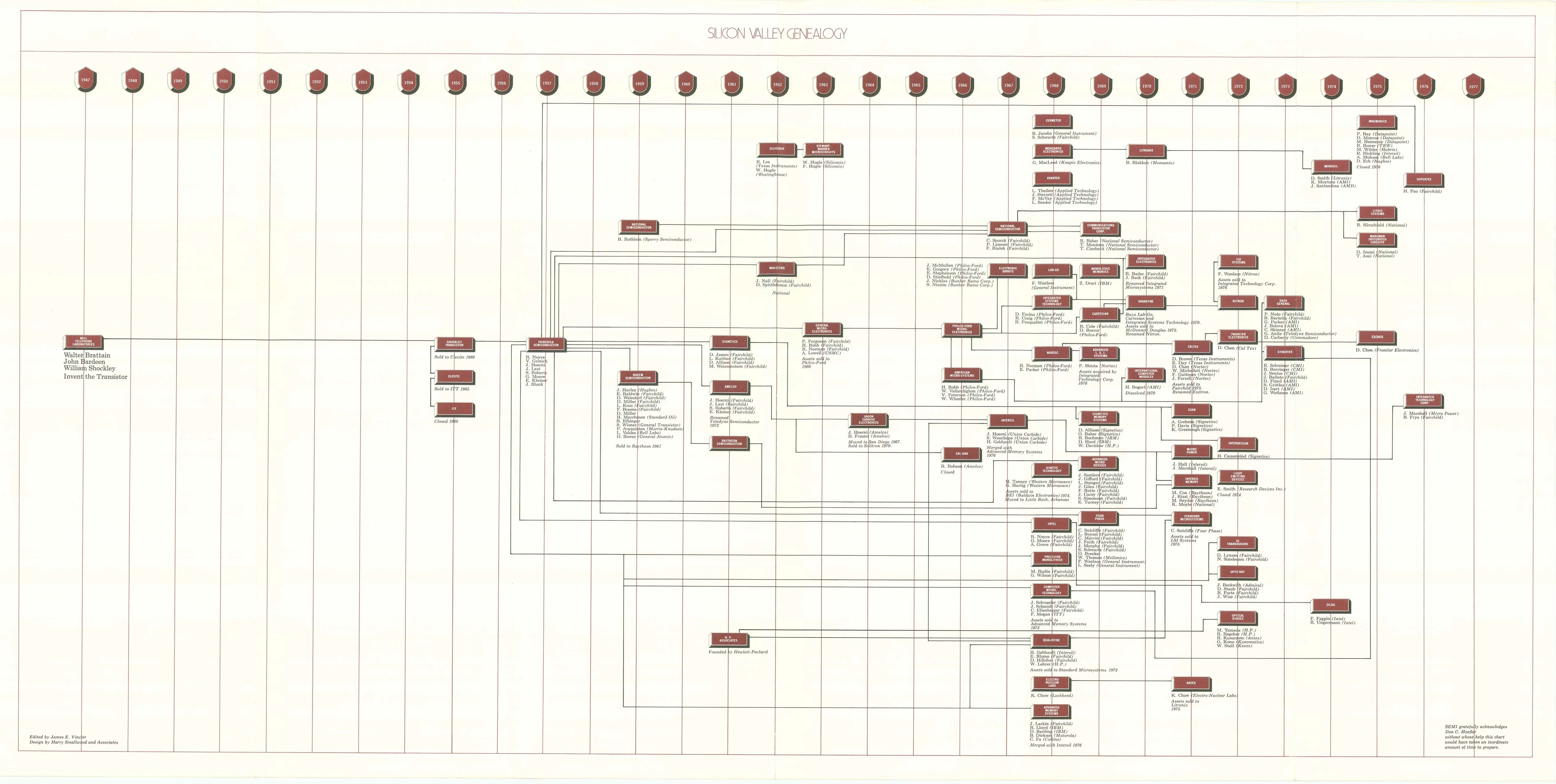
In 1956 entrepreneurship as we know it would change forever.  At the time it didn’t appear earthshaking or momentous. Shockley Semiconductor Laboratory, the first semiconductor company in the valley, set up shop in Mountain View. Fifteen months later eight of Shockley’s employees (three physicists, an electrical engineer, an industrial engineer, a mechanical engineer, a metallurgist and a physical chemist) founded Fairchild Semiconductor.  (Every chip company in Silicon Valley can trace their lineage from Fairchild.)

The history of Fairchild was one of applied experimentation. It wasn’t pure research, but rather a culture of taking sufficient risks to get to market. It was learning, discovery, iteration and execution.  The goal was commercial products, but as scientists and engineers the company’s founders realized that at times the cost of experimentationwas failure. And just as they don’t punish failure in a research lab, they didn’t fire scientists whose experiments didn’t work. Instead the company built a culture where when you hit a wall, you backed up and tried a different path. (In 21st century parlance we say that innovation in the early semiconductor business was all about “pivoting” while aiming for salable products.)

The Fairchild approach would shape Silicon Valley’s entrepreneurial ethos: In startups, failure was treated as experience (until you ran out of money.)

Conveniently, our idea does not need VC money or MBAs.

Scientists and Engineers = Innovation and Entrepreneurship
Yet when venture capital got involved they brought all the processes to administer existing companies they learned in business school – how to write a business plan, accounting, organizational behavior, managerial skills, marketing, operations, etc. This set up a conflict with the learning, discovery and experimentation style of the original valley founders.

Yet because of the Golden Rule, the VC’s got to set how startups were built and managed (those who have the gold set the rules.)

I have been reading Steve Blank and some of his ideas as he experiments with business models.

Earlier this year we developed a class in the Stanford Technology Ventures Program, (the entrepreneurship center at Stanford’s School of Engineering), to provide scientists and engineers just those tools – how to think about all the parts of building a business, not just the product. The Stanford class introduced the first management tools for entrepreneurs built around the business model / customer development / agile development solution stack. (You can read about the class here.)

Some of the best data center conversations I have are on new business models not technology. Give it a try sometime.  It is much more fun.

Another way to green the data center, changing the flow of the bits

I've been spending a lot of time researching some ideas that green the data center, but not in the facilities side which has seen great achievements over the past 5 years as PUE has helped create a focus on energy efficiency of the mechanical systems in the data center.   In what area? Consider this Intel statement regarding their acquisition of Fulcrum Microsystems.

"Our customers are looking to purchase compute, networking and storage as one unit," said Steve Schultz, director of marketing at Intel.

When talking to some senior SW architects,  I test the idea that the next big operating system will not be on a server, but run across servers, network, and storage devices.

To green the data center from a server OS level is frustrating as you can't see the bits move into the server and off the server through the network and access devices like storage.  If you want to green the data center you want to use the least amount of energy to process bits into higher value bits.

To support better communication for the OS, there are things that can be done at the chip device level.

The key to these types of initiatives is to make servers and network components aware of each other so they can work more closely together, said Yankee Group analyst Zeus Kerravala. As applications on dedicated servers give way to virtual machines that can be moved around for greater efficiency, it's harder for IT administrators to keep network policies up to date manually, he said. Such an effort is both time-consuming and prone to human errors, which are the leading cause of network downtime, according to Kerravala.

No other vendor yet has all the pieces for the kind of tight integration Cisco has achieved, Kerravala said. If Intel makes server and switch chips that can talk to each other at that level, smaller manufacturers will be able to offer coordination with products from other vendors that also use Intel.

HP and Dell have converged infrastructure initiatives.

  • DRIVE BUSINESS GROWTH - by accelerating IT innovation and responsiveness
  • MANAGE RISKS - by accelerating security and disaster recovery
  • LOWER COSTS - by accelerating ROI and sustainability

...

Intelligent Infrastructure: Redefining Efficiency in the Virtual Era

Imagine a truly efficient data center: What if you could break down your silos of isolated IT resources? What if you could manage your entire data center as a single pool of servers, storage and networking?

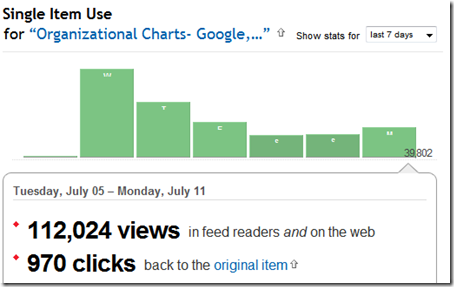
An example Humor is viral, Organizational Chart post traffic 112,024 views in 6 days

One of my loyal followers sent me the post about a bunch of high tech companies and their org charts.  A bunch of other people reposted this blog post. My friend sent me the post on June 29, but it took me a few days, 6, to get around to thinking how I wanted to post.  Below is a Google search on "organizational chart microsoft google apple."  You can see the posts are all dated June 29 or 30, except mine which is Google #7, posted on July 5.

  1. Funny Organizational Chart for Apple, Facebook, Google, Amazon ...

    usingapple.com/.../funny-organizational-chart-for-apple-facebook-g... - Cached

    Jun 30, 2011 – Organizational Chart for Apple Amazon Facebook Google Microsoft and Oracle Funny Organizational Chart for Apple, ...

  2. Organizational Chart for Apple Amazon Facebook Google Microsoft

    usingapple.com/...organizational-chart...apple...google...microsoft... - Cached

    Organizational Chart for Apple, Amazon, Facebook, Google, Microsoft and ...

    Show more results from usingapple.com

  3. Amazon, Google, Facebook, Microsoft, Apple, and Oracle Org Chart

    www.cloudave.com/.../amazon-google-facebook-microsoft-apple-a... - Cached

    Amazon, Google, Facebook, Microsoft, Apple, and Oracle Org Chart. By Adron Hall on June 29, 2011. AMZN, MSFT, GOOG, and other org Charts (Click for full ...

  4. Apple, MS, Google Etc. Imagined As Fun Org Charts | Cult of Mac

    www.cultofmac.com/apple-ms-google-etc...as...org-charts/102917 - Cached

    Jun 29, 2011 – Posted in Mac, News | Tagged: Apple, google, microsoft, Org chart, tech company org charts | Comment on this article ...

  5. Apple, Google, Facebook, and Microsoft Org Chart | Obama Pacman

    obamapacman.com › Apple - Cached

    Jun 29, 2011 – Funny interpretation of Amazon, Apple, Google, Facebook, Microsoft, and Oracle organization charts. Org Chart of Apple, Google, & Microsoft ...

  6. Amazon, Google, Facebook, Microsoft, Apple, and Oracle Org Chart ...

    compositecode.com/2011/06/29/3169/ - Cached

    Jun 29, 2011 – Amazon, Google, Facebook, Microsoft, Apple, and Oracle Org Chart. June 29th, 2011 § Leave a Comment. AMZN, MSFT, GOOG, and other org Charts ...

  7. Organizational Charts- Google, Amazon, Apple, Facebook, Oracle ...

    www.greenm3.com/.../organizational-charts-google-amazon-apple-f... - Cached

    Organizational Charts- Google, Amazon, Apple, Facebook, Oracle, and Microsoft. Date Tuesday, July 5, 2011 at 1:48PM. Here is a post a a friend shared on ...

So, how much volume did I get to move to position to #7?  Here is a Feedburner report.

image

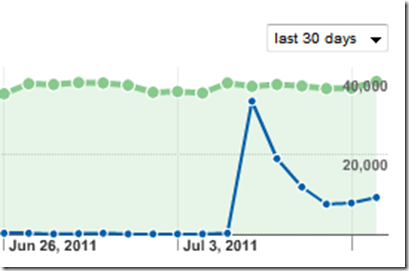
This blog post distorts now my normal traffic as you can how the traffic blows away my normal view volume.

image