Don't make the mistake Lotus did, betting against the adoption of new technology, Win3.1

A long time ago, almost 20 years ago, Microsoft was launching Win3.1 while the dominant installed base was MS-DOS.   Win3.0 had done OK, but much of the installed base of apps were DOS apps.  Microsoft was trying to get developers to write Windows apps.  One of those companies who dragged their heals to create Windows app was Lotus 123.  So, when Windows 3.1 shipped you could run Lotus 123 in DOS mode or you could run another spreadsheet not as popular, but had been ported from the Mac to Windows, called Microsoft Excel.  Microsoft Excel became the spreadsheet app to use on Win3.1.  And, Lotus 123 never recovered its #1 spreadsheet market on the PC.

Amazon has launched Kindle Fire and there are companies like Netflix that will drag their heals to port their applications to the Amazon Kindle Fire.  Just because an app is dominant on Android marketplace or Apple app store doesn't mean the Kindle Fire users will wait for the port to eventually show up.

Just like when the PC was having the battle between CP/M, DOS, and Windows operating system frustrating developers.  The battle is between Google, Apple, and Amazon.

We'll see who wins and loses if Amazon Kindle Fire is a winner.

How much do you want to follow Netflix’s data center strategy given CEO says "I messed up"?

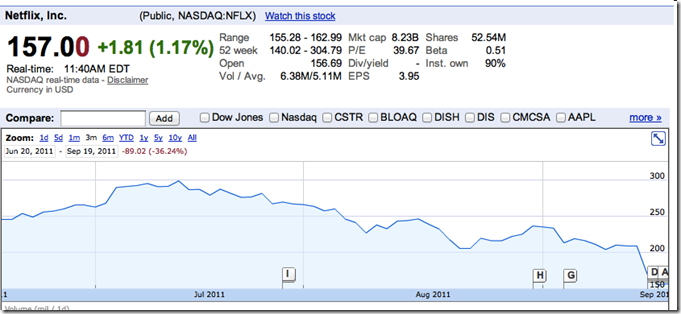
I’ve always wondered whether Netflix’s strategy of getting out of the data center business and moving to Amazon Web Services would make sense long term.  Netflix 2 months ago was considered invincible before they announced their price increase and separation of DVD and streaming business.

2 months ago Netflix stock was approaching 300, now it is close to 150.

image

One interesting perspective on why Netflix made this move is

So why is the company raising its rates?

Mr. DANIEL ERNST (Research Analyst, Hudson Square Research): The simple reason is because they can.

GREGORY: That's Daniel Ernst. He's an analyst at Hudson Square Research.

Mr. ERNST: They don't really have competition. They have some competition at the margin but the reality is, there is no one offering a full slate of movies and television shows that's digital and in DVD.

If you assume you have no competition what is the big deal where your data center is and whether you have one?

Netflix is offering an apology, but is adding more confusion by substituting the Qwikster brand for Netflix DVD.

An Explanation and Some Reflections

I messed up. I owe everyone an explanation.

It is clear from the feedback over the past two months that many members felt we lacked respect and humility in the way we announced the separation of DVD and streaming, and the price changes. That was certainly not our intent, and I offer my sincere apology. I’ll try to explain how this happened.

So we realized that streaming and DVD by mail are becoming two quite different businesses, with very different cost structures, different benefits that need to be marketed differently, and we need to let each grow and operate independently. It’s hard for me to write this after over 10 years of mailing DVDs with pride, but we think it is necessary and best: In a few weeks, we will rename our DVD by mail service to “Qwikster”.

We chose the name Qwikster because it refers to quick delivery. We will keep the name “Netflix” for streaming.

One of the things I have learned working at big brand companies – HP, Apple, and Microsoft is managing your brand is not something that should be taken lightly.  Netflix’s moves to introduce a new brand “Qwikster” seems really expensive and confusing.  Out of the millions of Netflix users how do you think will easily understand “Netflix DVD” = “Qwikster”

Amazon, Vudu, Hulu, and Redbox must be doing high fives as the watch Netflix decrease the value of their brand.

When you watch all of this does it make you question whether Netflix’s logic for getting out of the data center business and moving to Amazon Web Services may later be a mistake “I messed up.”


Blogging vs. Editorial Process, speed & quantity vs. quality

i have spent a bunch of time in the Publishing Industry, and remember in 1986 using Aldus Pagemaker 1.0 on a Mac.  Companies that were in my regular discussions were Altsys, Macromedia, Quark, Adobe, and a bunch of other high end publishing & printing technologies.  In 1994 I was a renegade and developed Verdana as the first TrueType font where screen readability was the priority, not print.  Leaving behind print changes what you can do.  Being a blogger is different than print as you focus on speed & quantity vs. quality.

What happens when you leave behind the Print Editorial Process?  Businessweek has a good post on Blogs vs. Magazine processes.

We're proud here of the work we do as a team to lift the level of each story. But what a slog. It's unthinkable for the blog world. Consider the path of a story as it winds its way through our system.

I looked at a draft of the story over the weekend, suggested changes, and spent nine hours editing it yesterday. (Usually two people share this job, but this week we're short-handed.) Then I sent it to the copy desk. There, people who are new to the story read it to see if it makes sense, if the thinking is logical, the context clear, the grammar and spelling ok, the names and titles correct. Meantime, some facts, such as names and Web addresses, are checked by a researcher. The copy desk sends the story, with questions, back to the writer and me. At the same time, the top editors of the magazine have a chance to read the story and suggest changes of their own. Potentially contentious or delicate stories are often sent upstairs to a McGraw-Hill lawyer, who might suggest further adjustments.

Today we work answering the questions, clearing up doubts, filling in holes, and cutting the story to fit on the page.

Then, wouldn't you know, the story goes back to the desk. They edit again--mostly proofreading, making sure questions have been answered, and writing display language this time around--and put it on a literal sheet of paper. Then that paper is circulated back to us. We read it and make fixes, and then carry it to the close desk, where editors make the final changes and push the button to send it to the printing press.

Much of this process is a good idea when you are thinking sending content to a printer.  But, what about a blog post?  Note this post was written in 2005, and describes a blog process.

The editorial process of blogging is far simpler. We write, we publish. This takes our journalism into a new sphere, but carries inherent risks. How do we handle them? First, we reduce risk by avoiding the sorts of stories that require heavy editing. We don't blog investigative pieces, for example, or heavy financial analysis. Second, we consult our gut. If it looks risky, we'll push it toward the more edited BW Online or the magazine. Finally, when we make mistakes--which we do--we aim to correct them quickly and ask for your understanding. We're into something new, and all of us, you and I, are only coming to understand it as we create it.

Much of the editorial process was constrained by the print process.  Blogging is constrained by speed of internet and data center software.  Quality is important, but do end users care about the intangible qualities.

Much of what gets the traffic is the fastest most relevant, and it is hard to beat that with better quality that is later, and shows up days later.


Intelligence community transformed from "need to know" to "responsibility to share," shouldn't data centers follow?

9/11 had many affects on people and organizations.  One of those who has had to change the most is the Intelligence Community as they bear blame for not stopping the 9/11 terrorist attacks. WSJ has an article written by James R. Clapper, Director of National Intelligence.  The part that caught my attention was:

How 9/11 Transformed the Intelligence Community


It's no longer about 'need to know.'


Our guiding principle is 'responsibility to share.'

...

We no longer operate largely on the principle of compartmentalization, that is, sharing information based on "need to know." We now start from the imperative of "responsibility to share," in order to collaborate with and better support our intelligence consumers—from the White House to the foxhole.

How many problems are caused in data centers where the standard operating procedure is "need to know."  If the US intelligence community has shifted to "responsibility to share" to solve their integration problems, maybe others should try the same approach.

Prior to the 9/11 attacks, the community had recognized that reorganization, integration of intelligence activities, and a shift in intelligence culture was necessary to adapt to evolving threats. But progress on these initiatives came slowly—too slowly to impact the events of 9/11.

The intelligence community got the message.

...

We can't know with absolute certainty if any of these changes would have led to a different outcome on 9/11, but the tangible benefits of vertical and horizontal integration are indisputable. Today we are unquestionably better positioned to provide the kind of full-scope information that leaders need to make informed decisions about how to protect our nation.


Wall to remember a bad 1st experiment, Japanese American Internment logistics, shipping 276 to prison

Both of my parents were in Internment Camps during WWII, along with many of my Aunts and Uncles when they were all children.

"Most of the 110,000 persons removed for reasons of 'national security' were school-age children, infants and young adults not yet of voting age."
- "Years of Infamy", Michi Weglyn

...

These Japanese Americans, half of whom were children, were incarcerated for up to 4 years, without due process of law or any factual basis, in bleak, remote camps surrounded by barbed wire and armed guards.

...

Rather, the causes for this unprecedented action in American history, according to the Commission on Wartime Relocation and Internment of Civilians, "were motivated largely by racial prejudice, wartime hysteria, and a failure of political leadership."

On Aug 6, 2011 The NYTimes writes about a new Wall was dedicated on Bainbridge Island.

A Wall to Remember an Era’s First Exiles

Matthew Ryan Williams for The New York Times

Holly Wilson visited a newly completed memorial on Bainbridge Island, a cedar and stone wall dedicated to its residents' World War II experience. More Photos »

By KATHARINE Q. SEELYE
Published: August 5, 2011

BAINBRIDGE ISLAND, Wash. — Frank Kitamoto was only 2 when he and his family — and more than 270 others of Japanese ancestry — were forcibly removed from this forested island and sent to an internment camp after Japan bombed Pearl Harbor in World War II. Mr. Kitamoto, now 72, said he spent many of his younger years in a severe identity crisis, ashamed of his Japanese heritage and wishing he were white. Other young men went so far as to have plastic surgery to disguise their Japanese features. Some committed suicide.

Bainbridge Island was the 1st experiment to figure out the logistics of shipping hundreds of people, 2/3 US citizens to prison for having Japanese ancestry as a crime.

Associated Press

Japanese-American residents of Bainbridge Island, Washington, boarded a ferry to Seattle. From there, they were transferred to a camp in California. The government chose Bainbridge Island as its test run for mass evacuations. More Photos »

“As a kid, I thought this was the land of equality and freedom, and so this couldn’t be happening because of discrimination,” Mr. Kitamoto, who became a dentist, said the other day in his office, where one wall is covered with photos from that era. “So I thought it was because there was something wrong with me, that I was a bad person.”

One of the most famous photographs from this experiment is a mother with her 13 month old daughter taken by the SeattleTimes.

Everywhere she went, Kayo Natalie Hayashida Ong, now 70, was greeted over and again with delight and recognition as "the baby!"

An iconic photograph of her at age 1, asleep in her mother's arms as her family was forcibly removed from their Bainbridge Island home during World War II, became one of the best-known symbols of a dark period in American history.

MUSEUM OF HISTORY AND INDUSTRY /

Fumiko Hayashida, then 31, carries her daughter Natalie, 1, to the Bainbridge ferry and exile.

If my daughter had been born 70 years ago, she would be amongst the other 1 year olds who were a threat to US security.

At the time, Executive Order 9066 was justified as a "military necessity" to protect against domestic espionage and sabotage. However, it was later documented that "our government had in its possession proof that not one Japanese American, citizen or not, had engaged in espionage, not one had committed any act of sabotage." (Michi Weglyn, 1976).

There was one loan voice in the USA who spoke through the media, a Bainbridge publication.

_TIM4636 - Milly and Walt Woodward at the Review -1945

Two months before Pearl Harbor, Walt and Milly Woodward pledged in a front page editorial to "always strive to speak the truth, unafraid, whether it be on a national issue or something purely local." In 1940, the young couple–barely thirty–had purchased the weekly Bainbridge Review, a chatty conveyor of neighborhood gossip. A year later, when the U.S. entered WWII, the couple had transformed the Review into a respected community paper full of current, factual news, and an editorial page that drew national attention.
The day after Pearl Harbor, Milly and Walt Woodward warned, "There is the danger of a blind, wild hysterical hatred of all persons who can trace ancestry to Japan. That some of those persons happen to be American citizens...easily could be swept aside by mob hysteria." Urging Islanders to remain calm, the Woodwards continued, " The Review says this: These Japanese Americans of ours haven't bombed anybody...They have given every indication of loyalty to this nation. They have sent...their own sons–six of them–into the United States Army."
The Woodwards continued, throughout the war, to speak against the constitutional violations inherent in E.O. 9066. The tiny Bainbridge Review has been singled out nationally as the lone newspaper to take such a stand. Also, in an attempt to report accurately on Islanders' lives, Milly and Walt Woodward hired high school students to report from Manzanar and, later, Minidoka on the daily events in the exiles' lives. Thus Islanders could keep track of each other. Perhaps as a result of that, 150 of the 272 exiled Islanders returned to Bainbridge, a greater percentage than most communities.

I don't think my children could understand why grandma and grandpa were in prison.  Which is why the Bainbridge wall is dedicated with these words.

Nidoto Nai Yoni, translated as

"Let It Not Happen Again"

is the motto and mission of the Nikkei Exclusion Memorial.

_TIM3977 - Evacuation Day: Walking onto the Ferry Kelohken