Having Bias is fueling growth in media, Unbias may not the best strategy

CNN has successfully advertised unbiased news as its strategy.

But CNN's real selling point in the age of dueling partisan networks Fox News and MSNBC is this, from CNN’s senior vice president and Washington bureau chief Sam Feist:

As the only cable news channel that has not picked sides in this election, CNN has a unique lens with which to cover these conventions. In Tampa and in Charlotte, we will give both parties an opportunity to showcase their platforms while also asking tough questions of Republicans and Democrats. Coverage of the conventions will dominate our air over two weeks as CNN's deep bench of anchors, political reporters and analysts help Americans make an informed choice about their vote.

What is media bias?

The most commonly discussed forms of bias occur when the media support or attack a particular political party, candidate, or ideology, but other common forms of bias include

  • Advertising bias, when stories are selected or slanted to please advertisers.
  • Corporate bias, when stories are selected or slanted to please corporate owners of media.
  • Mainstream bias, a tendency to report what everyone else is reporting, and to avoid stories that will offend anyone.
  • Sensationalism, bias in favor of the exceptional over the ordinary, giving the impression that rare events, such as airplane crashes, are more common than common events, such as automobile crashes.
  • Concision bias, a tendency to report views that can be summarized succinctly, crowding out more unconventional views that take time to explain.

The Economist gets some numbers to compare Fox, CNN, and NBC, and guess what being unbiased isn't winning vs. the competition.


CNN’s woes

Unbiased and unloved

Life is hard for a non-partisan cable news channel

AN ELECTION should be good business for a cable news channel. Alas, this is less true if, like CNN, you try to be unbiased. When Mitt Romney says that 47% of Americans are moochers, or Barack Obama says that entrepreneurs didn’t build their own businesses, partisan viewers crave a partisan response. Either the candidate hates America or he is being quoted out of context.

Fox News assures conservative viewers that Democrats’ gaffes fall in the former category, and Republicans’ in the latter. MSNBC, vice versa. CNN tries to be fair. Viewers hate that. Its ratings in America are sliding, while Fox and MSNBC are doing well (see chart).

Think about this when you read technology publications.  You may think they are unbiased, but unbiased does not necessarily beat the competition.
Can you hear the leaks in the Data Center hype bubble?

I haven't written a post for a few days. My main machine needed to go in for repairs, and it took me offline for two days and forced me to go to back-up computers.  Instead of getting frustrated I went with the flow and spent more time reading and thinking.

What comes to mind is the number of things that are not panning out to meet the hype.

Like what?  The Yahoo Chicken coop.  DCK took a trip in the Yahoo chicken coop.

Inside Yahoo’s ‘Chicken Coop’ Data Center

  •  
  •  
  •  
  • Share

If you’re a regular reader of Data Center Knowledge, you’ve seen plenty of images we’ve posted of the Yahoo Computing Coop data center in Lockport, New York. But we’ve never seen any video from inside the facility until we came across this footage on YouTube from the grand opening of the data center. There’s brief comments from politicians and executives, but also some views of the racks and aisles. This video runs about 5 minutes.

The media was all excited.  Who else is building a chicken coop type of design?

The Modular Data Center has almost every data center company saying they can go modular or containers.  Where is the massive container park DC?  There a few, but modular doesn't seem as big as the hype.

DCIM is supposed to be big.  Many are using systems, but they are finding out how much there is marketing hype vs. the reality of operating DCIM.

The number of data center consultants, real estate, and site selection people has added a lot more people over the past 5 years, but the business has not grown as much.

The data center shows are not as crowded as they used to be and the vendors are questioning their marketing spend.

Thanks to Facebook, Amazon, Microsoft, and Google data centers are in the media more often, but the number of data centers isn't even close to the increase in media coverage.

You could look at all of this as leaks in the data center hype bubble.  The bubble will not burst like other hyped events, but it does seem like you can hear the air deflating out of the bubble.

A Data Center Critic, NYTimes's James Glanz role in Industry

I've entertained the idea of writing content as a critic, but decided I didn't want that role.

a : one who expresses a reasoned opinion on any matter especially involving a judgment of its value, truth, righteousness, beauty, or technique

Being a critic is not fun.  At least I don't think it is fun.  Slate has a post on life as a critic.

Being a critic isn’t anyone’s childhood dream, an occupation that schools set out a booth for on Career Day, a religious calling that glimmers in the goldenrod.

...

To creatives, the Critic is the undermining inner voice maliciously put on the intercom to tell the whole world (or at least the tiny portion of it that still cares), You’re no good, you were never any good; your mother and I tried to warn you this novel was a mistake, but, no, you wouldn’t listen, Mister-Insists-He-Has-Something-to-Say. Failed artists consider critics failed artists like themselves, but worse, because unlike them they took the easy way out by not even trying to succeed, critics not having the guts to climb into that Teddy Roosevelt arena that everyone likes to invoke as the crucible of character, or risk the snows of Kilimanjaro.

...

Journalistic critics such as myself were, are, and forever will be routinely disparaged as parasites, sore losers, serial slashers, Texas tower snipers, and eunuchs at the orgy (what orgy? where is this orgy we seem to have missed?), which would hurt our feelings, if we brutes had any.

You can view NYTimes's James Glanz as a critic of the data center industry, pointing out areas where mistakes are made.

Being a critic means you are now a target for others to analyze your criticism.   Here is a post by a non data center person making an observation.  Larry starts off with a good skill of a critic, humor.

Stop The Presses: Computers Run On Electricity

By  Oct 2, 2012, 7:26 AM Author's Website

It is not easy for news organizations to support investigative journalism in this era of stagnant advertising, shrinking audiences and staff buyouts. So I’m not quite sure what to say to The New York Times for breaking the story that the Internet runs on electricity.

Thank you?

...

Most people probably don’t care, for the same reasons they don’t care about the nuts and bolts of all sorts of infrastructure. They just expect things to work.

The author identifies the hype factor.

Articles that lack a lot of news often resort to a lot of hype. This is especially apt to happen if a reporter has spent a year reporting a story that turns out to be not much of a story. And so it was with the first article in Glanz’s series, which resorted to straw men in order to drum up some excitement.

and how nuclear plants were added to the article, not natural gas powered plants or renewable energy plants to emphasize the evilness of data centers.

People are concerned about nuclear power, so nuclear power was worth mentioning. “Worldwide, the digital warehouses use about 30 billion watts of electricity, roughly equivalent to the output of 30 nuclear power plants, according to estimates industry experts compiled for The Times.” What about the equivalent output of windmills or solar panels? Would that be better?

Larry identifies that low utilization is an issue, but have you checked out the utilization of your PC lately?  People should be restricted to PCs that have a 50% utilization or higher.  No.  That is when an upgrade was long over due . If users can't stand a 50% utilization on their PCs or smartphones how can they tolerate a high utilization experience from the cloud?

The newspaper also devoted considerable space to the idea that most servers in a typical data farm are doing very little work most of the time. That’s true, and it’s inefficient, and it is probably avoidable in many situations. So the server farms’ inefficiency is a fair point to make, but it also inherent in most forms of computing.

If you check the metering program that is probably installed on your own PC, you will likely find that most of your computing power is being consumed by the “idle process.” The central processing unit is waiting around for someone to do something. Your disk drive also spends most of its time lazily spinning, waiting for a program to ask it to read or write some data. Each server in a server farm is a PC that has been stripped down to its basics: a CPU, a disk drive and a network card, all more powerful than the ones in a basic home computer. The servers have no screens and no keyboards. They wait until they are called upon to serve.

Larry make the point that the NYTimes does not have perspective.

The main thrust of the series is that server farms consume a lot of power, but how much, really? Perspective is sorely lacking. Glanz pointed out that server farms consume more power than the paper industry, as though the Internet is simply about displacing paper consumption. That leaves a lot of variables out of the equation.

And closes with a good point.

My guess is that the Internet, on the whole, has been as much an environmental boon as an economic one. I would be interested in an investigative series that tells me otherwise, but that isn’t the series that Glanz and The Times produced.

As with any young and fast-growing industry, efficiency takes a backseat to performance in the initial rush to keep up with demand. Fine-tuning for efficiency will come later. Right now, our greatest achievement is creating a world where users can get the data they want and need, wherever they are, whenever they want it. The Internet’s plumbing is about as newsworthy as that of the average sewage treatment plant, as long as they both do their intended jobs.

James Glanz has fulfilled the role of a data center critic, we'll see how many people are in line to do the same.  Roll call.  Anyone.  Anyone.  Anyone want to be a critic of the data center industry?

NYTimes Data Center articles miss the target, comments cut off, little traffic, truth in whose view?

I am sure many of you have discussions with your friends on the NYTimes infamous articles. I had friends call me, and it is dinner/bar conversation that inevitably comes up.

Here are some facts that you may like to use in a conversation.

The 1st and 2nd articles by Jim Glanz no longer accepts comments.  Huh?

Comments are no longer being accepted. Please submit a letter to the editor for print consideration.

There is a correction posted on Sept 24.

Correction: September 24, 2012

A previous version of this article misstated why Microsoft wasted millions of watts of electricity, according to records. It was an attempt to erase a $210,000 penalty the utility said the company owed for overestimating its power use, not underestimating its power use.

The NYTimes Public Editor has an article on balanced reporting and the pitfalls of "false equivalency".   The editor closes with a statement that is hard to believe is  a truth applied to the data center articles.

It ought to go without saying, but I’m going to say it anyway: Journalists need to make every effort to get beyond the spin and help readers know what to believe, to help them make their way through complicated and contentious subjects.

The more news organizations can state established truths and stand by them, the better off the readership — and the democracy — will be.

When you look at the last 7 days.

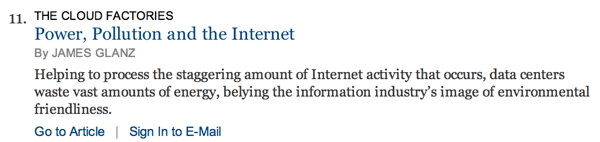
The most e-mailed shows the Power, Pollution and Internet at #11.

NewImage

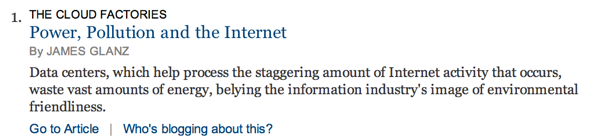
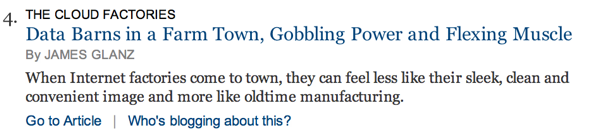
The article does get most blogged with #1 and #4 positions for the two articles

NewImage

NewImage

But the article doesn't make the Top 20 views for NYTimes overall or in Science over the last 7 days.

So this would seem like the articles stirred up the tech savvy data center community with e-mail forwarding and blog posts, but net didn't get that much traffic for the NYTimes.  

If you ran the NYTimes would you give the go ahead for more articles or not?

Why did the NYTimes cut off comments for both articles?


Virtualization as a management tool

I was reading GigaOm's Barb Darrow's post on the 5 changes that VMware is going through.  Barb's closing point.

The company’s aggressive goal is to get enterprise data centers — which Gartner estimates are about 60 percent virtualized now — to the 90 percent mark. Servers are just the tip of the iceberg there. Networking gear — switches, routers — and storage all need to make that leap as well.

Got me thinking.  Maybe part of VMware/EMC's strategy is to transition VMware into a management tool for servers, storage, and network.  Virtualization is simply a method to get control over each of these areas.  If you have control you can manage.  

If VMware's vision is fulfilled it would seem that all the rest of the management tools would be obsolete.  Or at least in the past vs. an environment that moves at the speed of VM deployment.  VMware doesn't care what OS you run on your Servers, Network, or Storage as long as it runs on their virtualization layer which they can manage and control.

Do you want to be a VMware shop?  It may be too late for many to make a choice.