Attending Oscon, the convergence of Open Source and Data Center

I have been thinking of different conferences to go and a bunch of my friends at Structure said they were going to OSCON.  Some of the biggest data centers run open source software and with Facebook's Open Compute project there is a convergence of ideas on open source the data center and server hardware in addition to software.

What is OSCON?

image

What do you do once you’ve changed the world? Do it again.

Join today’s open source innovators, builders, and pioneers July 25-29 as they gather at the Oregon Convention Center in Portland, Oregon, to share their expertise and experience, explore new ideas, and inspire each other.

Learn first-hand how new developments in open source are shaping the future. Challenge your assumptions, fire up your imagination, and kick your brain into high gear. Rub shoulders with open source rock stars—and have some serious fun with 2000+ people like you.

Here are a few of the sponsors are of OSCON that I know I will run into some friends from these companies.

Sponsors

Diamond Sponsor

  • Microsoft

Premier Platinum Sponsor

  • Google
    • SugarCRM

    Gold Sponsors

    • Facebook
    • HP
    • Intel
    • Rackspace Hosting

Drop me a line if you'll be there as well dave(at)greenm3.com.  The crowd is big so it is hard to just run into people randomly.

Time to make some changes, my present to myself for my 51st B'day, "it is time"

5 Years ago, I quit Microsoft after 14 years with no idea what I was going to do next.  What I did know is after 5 years I would be working on things that were much bigger and more fun than than what I was doing at Microsoft when I left.  Working on Win3.1, Win95, Windows 2000, and Windows XP were the most fun I had at Microsoft and I have the best memories.  Working at Apple, re-architecting the physical distribution system, being part of the hardware team on the Macintosh II, and working on software components for System 7 was when I had the most fun at Apple.  HP fresh out of school, I had all kinds of ideas on what I wanted to try.  Ideas in quality/reliability engineering, process engineering, and distribution logistics were fun.  Yeh, I am engineering nerd.  Why can’t the same ideas I worked on 30 years ago be applied to data centers?

I am lucky being 100% Japanese ancestry that I don’t look my age, but with 30+ years in high tech and even spending my summer jobs working in semiconductor companies, I am ready to move on to start having more fun like I used to.  It’s been fun having the role as a blogger, but it is not what I want to be known for 5 years from now, and too embarrassing for my kids

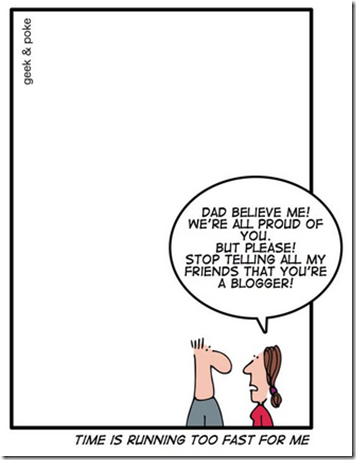
Being a Blogger is not what it used to be (humor)

FRIDAY, MAY 27, 2011 AT 6:39AM

I saw this cartoon and my kids are not old enough to make this point, but I also don’t tell my kids friends I am a bloggerSmile

image

What do I want to do? I want to get back to the fun making solutions to solve tough problems.  20 years ago, I took a sabbatical from Apple.  15 weeks from Memorial Day to Labor day, I got to enjoy the summer just like a kid.  Well a kid who started Zen Meditation when I was 14.  Summer was my time to think.  As my wife once said you like to think about how to think.  After all that time off, at the end of sabbatical I realized I loved to solve tough problems.  Energized I went back to Apple and told my manager I really like to solve problems.  Her response “that is nice,  but we are about process in this group.”  Within 9 months I left Apple to go to Microsoft to be the guy to get fonts for FE Win3.1- Japan, Mainland China, Taiwan, Korea where top priorities.

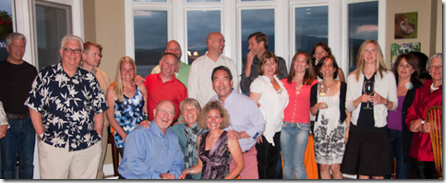
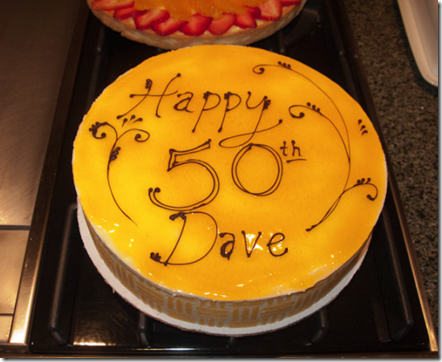
A year ago my wife threw me a surprise B’day party for my 50th.
image

image

Now I am going to turn 51, and I am going to give myself my own present.  I am going to start having fun again.  Solving really tough problems.  Going to all these data center conferences, meeting great people, watching the industry, working on various consulting projects I have all kinds of ideas on problems that need to be solved.  As Lion King’s Rafiki made a simple statement. “It is time.” It is time to start solving the problems like I used to do at HP, Apple, and Microsoft.

What does this mean?  Part of what this means is I am going to start travelling less, spending more time developing solutions and less time researching ideas.  Also, as it is the beginning of summer and it is the last day of school for my kids today they want me home more.

image

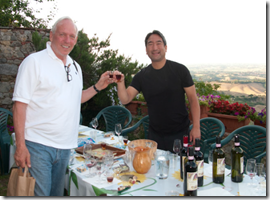
In addition to my surprise b’day party, we went to Italy for my 50th.

image

image

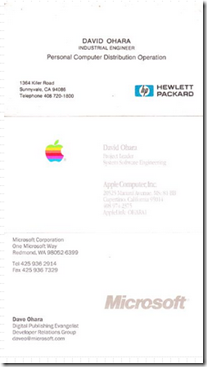
I have one event today that I will be attending today as a technical guy not as a blogger.  The event staff was nice enough to make an exception letting me attend as he understands my multiple roles.  Small world I sat next to one of the presenters at the event from SEA to SJC and reviewed his slide deck, making some suggestions.  And, he did say I thought there was no press at the event.  I told him I am attending not as press, but as a technical guy who knows a bunch of data center and server technology.  The blogger role has been useful and gets me media status for attending many events, but it is also limits what people think you do.  How many media people have these business cards?
image

I’ll be at GigaOm Structure June 22-23, and my next data center conference will not be for a while.  I will be at 7x24 Exchange Phoenix as I’ll most likely be presenting there on something.

Submit a Presentation Proposal Today!
2011 FALL CONFERENCE
November 13-16, 2011
Arizona Biltmore
Phoenix, AZ
Leveraging Innovation

Does this mean I’ll stop blogging?  No. I will be blogging about different things though.  And, besides I was getting kind of tired of seeing the same presentations repeated. 

Although am I really going to change how I blog as my criteria has been what are the things that solve problems?  There I go thinking about how to think. Smile

Some of the projects I have identified are with those who want to discuss data center ideas in an open and transparent manner.  Organizations that think of themselves as Fiercely Independent Companies, like I am a Fiercely Independent Guy.

Thanks for reading this blog.

-Dave Ohara
The ultimate hidden test of whether users are important at a Data Center Conference, how good is the food?

I've attended many IT events and worked behind the scenes at many as well.  My wife also used to work on many events for Ziff-Davis, Seybold Publications, and IDG.  Whenever we entertain we spend lots of time planning the food we'll serve, and we both agree that good food is a must for a successful event.

I've been thinking of how I compare Uptime, 7x24 Exchange, DatacenterDynamics, Gartner Data Center Conference, and DataCenterWorld.

Sometimes what seems like a silly idea can be a test.  David Lee Roth had a story about not wanting brown M&Ms backstage.  What is explained behind the story is it was a test to see if the concert host read the complete contract and was prepared to support the multiple eighteen wheelers of gear that would arrive for a show which could create a logistics challenge for some.

Mac McKinley’s blog Boomer Opinion retells a story about the importance of reading and understanding contracts.

In his autobiography, David Lee Roth, wrote that their touring contract demanded that at each venue backstage there would be a bowl of M&Ms with all of the brown ones removed. To most that sounds like the demands of some quirky rock stars, right?

There was actually a very valid reason for this demand. At each venue, the band arrived with nine 18 wheelers full of gear. Stage setup was quite complicated and had to be done with the precision of a Swiss watch. The touring contract demanded very specific requirements of each venue. For example, one section stipulated, “There will be 15 amperage voltage sockets at 20-foot spaces, evenly, providing 19 amperes.”

According to David Lee Roth, that touring contract was voluminous and read “like a version of the Chinese Yellow Pages”. Buried in the middle of the contract, Article 126 read, “There will be no brown M&Ms in the backstage area, upon pain of forfeiture of the show, with full compensation.”

When Roth arrived at a new venue, he would walk backstage and check out the M&Ms bowl. If he saw a brown M&M in the bowl, he’d demand a line check of the entire production. He knew from past experience that when the promoter did not read the contract fully, that other problems and technical errors would occur unless they fully vetted the production setup prior to the show.

So the brown M&Ms were just a warning signal or red flag that indicated bigger issues might arise that could threaten the successful completion of the concert at that venue. It was his way of ensuring that the management and stagehands at the new venue were indeed paying attention to every detail and had read the contract thoroughly.

After reading the story about brown M&Ms and food details, it gave me the idea to evaluate the data center events based on how good the food is.  A test that is not evident.

Gartner Data Center Conference is the typical large enterprise event for 3,000 people at a Las Vegas venue.  OK, not great.  Average.

AFCOM Data Center World is less quality than Gartner Data Center Conference.

DatacenterDynamics is a one day event that is better than the other two mentioned, but different given it is a one day event without dinner.

Uptime Institute Symposium is not any better than these, but one of the most expensive to attend.  Note: many Gartner data center conference attendees get passes because of their subscription to Gartner research.

What about 7x24 Exchange?  They have the benefit of having a smaller crowd which makes serving good food easier.  This last conference had 700 attendees, and being a non-profit they put the users at the core of what they do.  So how was the food?  Better than all the above.  When talking to the folks at 7x24 Exchange they said the food has been better at their other events, and Phoenix will be better than Orlando.

This may seem like something that doesn't seem like it is that important, but when people spend the extra time thinking and planning the food to be enjoyable then they probably have spent more time thinking about how to host an enjoyable event and provide useful content.

Do sometimes you feel like you are attending an event where the #1 priority are the event executives and their business model, the #2 priority are the vendors, and the users are third on  the list?

I do.

Solar Flares/Storms affect on Data Center is not known, an answer with data collection

One of the great talks at 7x24 Exchange was given by Alex Young on a subject few have thought about.

NASA - The Influence of Solar Flares and Solar Storms: Why We Should Care About Space Weather

The Sun produces solar storms in the form of intense radiation and fast moving material. These storms can interact with the Earth to create electric currents in our atmosphere. The study of space weather developed to predict solar storms and understand their impact on our technology. The world's electrical grids-that fundamental technology enabling modern society-are vulnerable to these currents. While most days the sun's impacts are minimal, large solar storms have the potential to have a devastating impact on mission critical systems. This talk will present an overview of Space Weather to help your business begin to prepare for worst-case scenarios.

C. Alex Young, Ph.D., Solar Astrophysicist at NASA's Goddard Space Flight Center with ADNET Systems Inc. and the SOHO/STEREO Science Team

Here is a video of Alex discussing the Solar Flare on June 7, 2011.

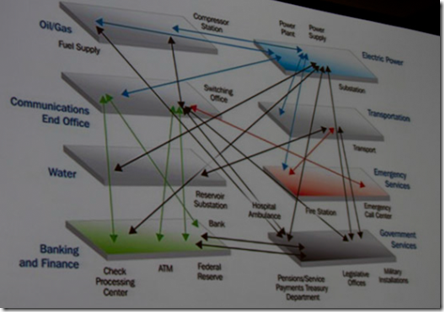
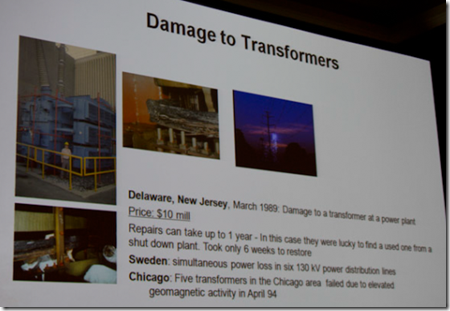
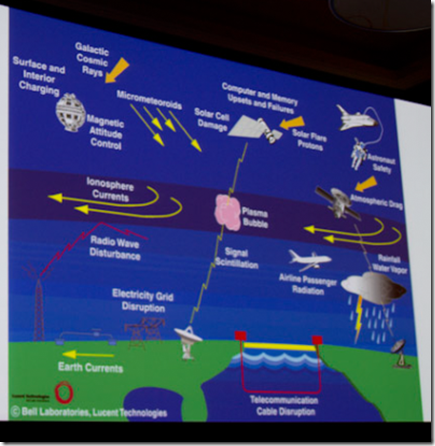
What are potential affects on the infrastructure is shown here.

image

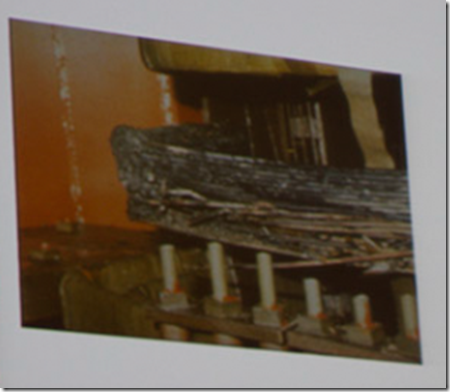
So what?  Check out this picture of what happened to a $10 Million power transformer in 1989.

image

image

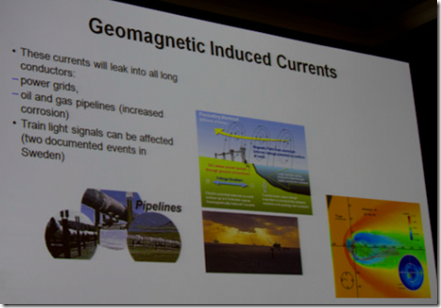
And what is the affect on the electrical grid.

image

So other than risk of power outage what is the risk to a data center?

Luckily I sat with Alex at the speaker dinner and had a chance to chat much more and another data center executive joined in the discussion on what you could do about a solar storm that could last for days.

One choice we discussed is you could hope the arrival of solar storm is timed when it is night time and the storm strikes the other side of earth, but some storms last for days.  You could turn off the servers which is a strategy used by some satellites, but not a top choice.

So what could we do?  Here was my idea.  Why doesn't NASA notify the data center run by a company that is fanatical about data collection and tell them is the exact time when a solar storm will arrive at the data center site.  The data center operator then shares information back to NASA on error statistics that are potentially caused by the electromagnetic radiation storm.  Keep running this experiment to get data to answer the question of what happens to a data center during an electrical storm.

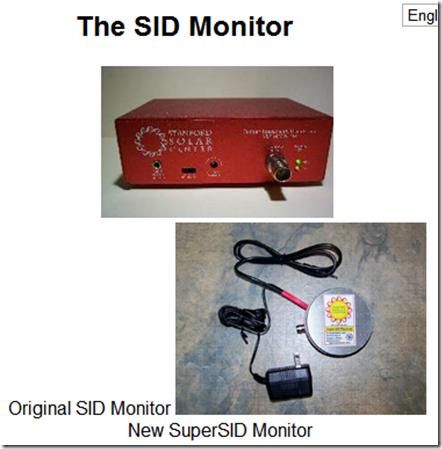
We moved to the Data Center Social 2.0 event and continued the discussions. One idea the data center executive came up with is can we collect information about the solar storm at the data center.  Alex said yes and pointed to Stanford Sudden Ionosphere Disturbance (SID).

image

So what is the plan.  The data center executive is going to back circulate the idea which we both agreed there would be two dozen data geeks who instantly jump on the idea.  Start the data collection and sharing with Alex at NASA, so he can start to answer the question of what is the effect on Solar Storms on a data center.

And, we may start an knowledge exchange that will get the data center industry ready for the peak in solar storms in 2013-2014, and answer the question what is the effect of a solar storm on a data center.

image

Inspiration for the Low Carbon Data Center, 7x24 Exchange keynote by Robert F Kennedy jr

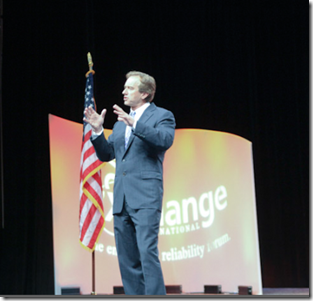
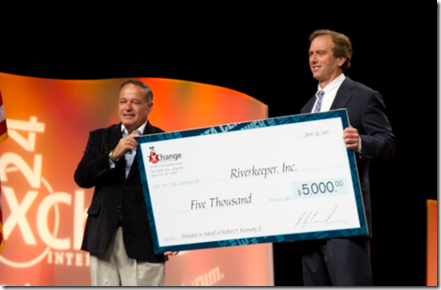
I am sitting at 7x24 Exchange, the first keynote is delivered by Robert F. Kennedy jr, and I was lucky to meet him at Breakfast.  Sometimes I wonder whether people get the idea of a Green (low carbon) data center.  What a great way to start a data center conference with a keynote educating the data center audience of the issues faced by a carbon based economy.

image

image

CONFERENCE KEYNOTE:
"Green Gold Rush - A Vision for Energy Independence, Jobs, and National Wealth"

The creation of a green economy is an increasingly promising solution to multiple challenges. Sustainable business and energy independence are keys to our economic revitalization, according to Kennedy. America can boost its own infrastructure by powering industry with plentiful and domestic renewable resources. A sophisticated, well-crafted energy policy will help sharpen American competitiveness while reducing energy costs and our national debt. Intelligent energy policy is also the national fulcrum for US foreign policy and national security. From green jobs and technologies to weaning our reliance on carbon energy, Kennedy offers a bold vision to restore US economic might, safeguard our environment, and reestablish America's role as an exemplary nation.

Robert F. Kennedy, Jr., Visionary, Environmental Business Leader and Advocate

Here is an article that captures part of what Robert F. Kennedy Jr. presented.

If ever an issue deserved President Obama's promise of change, this is it. Mining syndicates are detonating 2,500 tons of explosives each day -- the equivalent of a Hiroshima bomb weekly -- to blow up Appalachia's mountains and extract sub-surface coal seams. They have demolished 500 mountains -- encompassing about a million acres -- buried hundreds of valley streams under tons of rubble, poisoned and uprooted countless communities, and caused widespread contamination to the region's air and water. On this continent, only Appalachia's rich woodlands survived the Pleistocene ice ages that turned the rest of North America into a treeless tundra. King Coal is now accomplishing what the glaciers could not -- obliterating the hemisphere's oldest, most biologically dense and diverse forests. Highly mechanized processes allow giant machines to flatten in months mountains older than the Himalayas -- while employing fewer workers for far less time than other types of mining. The coal industry's promise to restore the desolate wastelands is a cruel joke, and the industry's fallback position, that the flattened landscapes will provide space for economic development, is the weak punchline. America adores its Adirondacks and reveres the Rockies, while the Appalachian Mountains -- with their impoverished and alienated population -- are dismantled by coal moguls who dominate state politics and have little to prevent them from blasting the physical landscape to smithereens.

Obama promised science-based policies that would save what remains of Appalachia, but last month senior administration officials finally weighed in with a mixture of strong words and weak action that broke hearts across the region. The modest measures federal bureaucrats promised amount to little more than a tepid pledge of better enforcement of existing laws.

And government claims of doing everything possible to halt the holocaust are simply not true. George Bush gutted Clean Water Act protections. Obama must restore them.