One Role to Rule All Server HW, Facebook's Manager of Supply Chain Operations

I've run some analysis thanks to a variety of contributors on the Facebook Server count and the number is bigger than anybody else I have seen discuss.  Over 100,000 servers.  When server counts get that high managing them takes a different type of person than the purchasing department.

I found this job posting on Facebook for Manager, Supply Chain Operations.  The Facebook guys have identified a Wal-mart type of supply chain manager.

Manager, Supply Chain Operations

Facebook is seeking a seasoned leader to be responsible for managing the Supply Chain Operations organization and supplier/partner strategy for all Facebook server suppliers. This includes strategic direction applied to tools development, supplier performance management, vendor relationships, and business processes. This is a full-time position based at our headquarters in Palo Alto.

Share

Apply for this position

Responsibilities

  • Manages up to ensure executives are informed of a partner performance/development/investment/escalation/negotiation approach

  • Manages a complex supplier, and fully understands the interdependencies and the impact to the business.

  • Responsible for the commercial relationship with the partner

  • Consults and partners with others, offers views and advice that add value and perspective to situations

  • Jointly responsible for supplier sourcing strategy, including risk mitigation

  • Responsible for partner based strategy – including industry understanding and driving competitive advantage for Facebook

  • Responsible for delivering a supplier’s productivity and overall cost performance

  • Responsible for benchmarking a supplier’s costs globally. Delivers and identifies a supplier’s pipeline productivity

Read more

Facebook is the Poster Child for Carbon in the Data Center Industry

Facebook has 0.5% of the installed base of Servers in World, hosted in about 10 colocation sites mainly in Santa Clara and Ashburn, VA.  Google and Microsoft have more servers in more locations, but Greenpeace and other environmentalists don't find these companies nearly as interesting.  Facebook represents its perception to media like OregonLive.

Q: Right after you announced your plans, Greenpeace and others chimed in about your power source (which includes PacifiCorp coal power). What did you learn about people's perceptions?

Jonathan Heiliger: In some respects it shouldn't be surprising, because we are a growing company and have become a fantastic target for people. That being said, we didn't explain well enough how efficient this site is relative to our current sites (Facebook currently leases data center space from other companies).

Facebook's new North Carolina Data Center is covered by the top technical news with many business journals and regular media picking up the news.  Keep in mind what media is after is traffic.  This isn't big news, and probably more news than Facebook wants as this type of news doesn't provide much business value to Facebook.

image

But this is enough news that Facebook's data center executives are in "damage control" of negative PR and Greenpeace is the top cause of the damage.

GreenFudge.org asks a good question.

Dirty coal and Green on Facebook. What’s the deal? And what should we do about it?

Posted by Murielle in Climate & Change, Science & Technology, Sustainable living, 2 minutes ago, 0

Recently Facebook launched their Green on Facebook page in an effort to green up their image after the big dirty coal data center debacle of earlier this year. According to their Facebook page, the Green on Facebook is

run by Facebook and will highlight our efforts to be a green and sustainable global citizen.

facebook dirty coal greenpeace 300x225 Dirty coal and Green on Facebook. What’s the deal? And what should we do about it?

Image by Library of Congress (source: Flickr)

Together with 56.000 others, I became a fan op the page, and as many others I’m sure I’m pretty disappointed with the content of it. The wall is filled with links to various articles about different environmental topics, but very little information is available about Facebook’s own efforts to be sustainable and green. One article, supposedly from Facebook’s own engineers, discusses the topic of cooling strategies in data centers to increase energy efficiency. I could not stop but wonder if this post has anything to do with the new dirty coal scandal that Facebook is looking at today.

According to Jodie Van Horn, blogger for Greenpeace, Facebook has chosen a new data center location near Forest City, North Carolina that will – again – increase the demand for dirty energy. Greenpeace energy campaigner Gary Cook issued the following statement about this news:

Facebook is becoming a vehicle and poster child for change.

So yes what Facebook is doing is not OK. Greening up their image and at the same time opening a new coal fueled data center. But let’s not kid ourselves, every time we surf the web we are pushing CO2 into the air. And in this story as in any other, we are the customers.

So what should we do about it? Get off the Internet as long as it’s not sustainable? That’s one option but maybe not the smartest one. A better idea might be to make more conscious choices, on and off the Internet, and to become aware that no company, organization or corporation will ever change their ways before we do. So in the end, or for starters, even if we don’t stop using Facebook (which we should eventually do, but hey we’re all human), a good step might be to sign up for Greenpeace’s Unfriend Coal campaign, as long as we understand that signing a petition now and again is not our way to carbon free heaven. It’ll take much, much more than that to get there.

BTW, all this noise and issues with Carbon in Data Centers makes it much easier to discuss Green Data Centers.

Go Facebook!!!

Keep on telling the environmentalist your PUE, LEED building certification, energy efficient servers and your chiller-less cooling system.

People will learn these technical data center details are not what the public cares about.  You can't change world talking about your Hadoop implementation.

Facebook has the world's largest Hadoop cluster!

It is not a secret anymore!


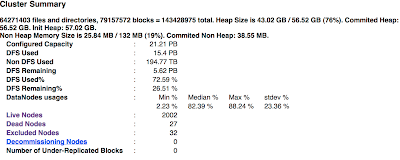
The Datawarehouse Hadoop cluster at Facebook has become the largest known Hadoop storage cluster in the world. Here are some of the details about this single HDFS cluster:

  • 21 PB of storage in a single HDFS cluster
  • 2000 machines
  • 12 TB per machine (a few machines have 24 TB each)
  • 1200 machines with 8 cores each + 800 machines with 16 cores each
  • 32 GB of RAM per machine
  • 15 map-reduce tasks per machine

That's a total of more than 21 PB of configured storage capacity! This is larger than the previously known Yahoo!'s cluster of 14 PB. Here are the cluster statistics from the HDFS cluster at Facebook:
Read more

Facebook’s Topping-Out Ceremony at Prineville Data Center

I posted on a data center topping-out ceremony I attended and got a chance to write on topping-out beam.

IMG_0834_edited-1

Facebook just posted their own pictures of their topping out ceremony on Nov 1.

Part of the ceremony is the tree.

Here is what I found regarding the tree tradition.

An interesting piece of trivia is the symbolism for the Christmas tree.

The custom of decorating the uppermost point of the structure with an evergreen tree is a tradition that predates the structural-steel industry in America by hundreds of years and has old Northern European roots. Although the topping out tree has ancient roots there is no consensus among modern ironworkers as to what exactly the tree symbolizes, or when and how it came to be used by the ironworkers. According to The Ironworker, the union's official publication, "for some the evergreen tree symbolizes that the job went up without a loss of life, while for others it's a good luck charm for the future occupants"(1984:11). Other accounts attribute the tree as signifying simply that "we [ironworkers] did it" (Kodish, 1989:2).

Little scholarship has been published on this custom. Most of what has been published has appeared in newspapers, popular magazines and engineering trade journals. One can get a feel for the age and scope of such tree rituals from James Frazer who discusses tree worship extensively in The Golden Bough. (Indeed, the title of the book itself is an allusion to tree worship.) For example, in Chapter Ten, "Relics of Tree-Worship in Modern Europe," Frazer reports that it was common practice in spring or early summer for the people to go into the woods and cut branches and fasten them to every house (1922:139). Frazer further remarks, "The intention of these customs is to bring home to the village, and to each house, the blessings which the tree-spirit has in its power to bestow" (1922: 139). The evergreen tree's ability to survive the harsh Northern European winter must have made it a powerful life-affirming symbol.

Read more

anti-Green Brown Energy supported by Coal lobbyist, affect future data centers

Greenpeace has been attacking Facebook on its use of coal power in the Prineville, OR data center.

The social networking site chose the high-desert timber town of 10,000 to take advantage of its cool nights and dry air in hopes of making its first-ever data center an energy efficiency landmark.

But the concept failed to impress Greenpeace.

In a report posted on the Internet last month, the environmental group praised Google and Yahoo for tapping hydro power - but challenged Facebook for building in coal country.

Greenpeace has a 500,000 plus Facebook community in English, French, and Spanish.  Will the Coal lobby start a 100% coal energy Facebook page?  Here is news on the Coal Lobbyists.

Coal Industry Spending to Sway Next Congress

By JOHN M. BRODER
Published: October 29, 2010

WASHINGTON — The coal industry, facing a host of new health and safety regulations, is spending millions of dollars in lobbying and campaign donations this year to influence the makeup of the next Congress in hopes of derailing what one industry official called an Obama administration “regulatory jihad.”

Multimedia

Graphic

The Coal Shovel

Political spending by the coal industry is on track to exceed that of the 2008 cycle, when the presidency was at stake and Congress appeared determined to move forward with a national energy policy designed to address climate change by cutting back on the use of coal and petroleum.

Over the last two years, the coal industry, along with its allies in oil and gas, electric utilities, manufacturing and agriculture, effectively killed any prospects for climate change legislation in the near future.

Will a pro-coal lobby make it easier to build coal powered data centers? Don’t expect a pro-coal government to make Greenpeace to back-off.

Greenpeace’s recent actions have made many reconsider carbon impact in site selection. 

Can you afford a high carbon data center?

Read more

Facebook posts on its Data Center Efficiency Project

Facebook data center engineering’s Jay Park posts on what Facebook presented at SVLG Data Center Efficiency Summit.

Optimizing Data Center Energy Usage

by Jay Park on Wednesday, October 20, 2010 at 8:32am

When it comes to optimizing data centers for energy usage, the minutest changes can have significant impact. Facebook’s growth over the years has expanded our data center footprint greatly, and we've learned many lessons and applied some of the industry’s best practices to make our data centers much more efficient, saving us money and using less energy. At the Silicon Valley Leadership Group's Data Center Efficiency Summit last week, we shared these lessons and the new strategies we've implemented with the data center community at large so they too can utilize these techniques, multiplying the energy savings and environmental protection across the infrastructure of many other companies.  

Based on this graph


A 9% improvement in IT load for a 276 KW savings means the IT critical capacity was 3 megawatts.  Assuming low power servers with around 6,000 servers per megawatt, the servers in the environment are 18,000.

Jay discussed saving 3 watts per server.

We discovered that the server fans were spinning faster than necessary, so we worked with the server manufacturers to optimize their fan speed control algorithm while keeping temperatures within the recommended range. For each server, this saves up to 3 watts and requires less air (up to 8 cubic feet per minute), which quickly adds up in a 56,000 square foot facility.

3 watts per server is 54,000 watts.  With 56,000 sq ft and 3 MW of power, the power is only 50 watts per sq ft which fits with this low density image below.  Note the amount of open space.

The inlet temperature is not mentioned in the post, but I recall that Jay said 68 to 72 degrees which fits with the raise in return temperature.

In the end, we raised the temperature for each CRAH unit's return air to 81 degrees Fahrenheit from 72 degrees Fahrenheit.

The group I was sitting with during Facebook’s presentation wasn’t overly impressed, but with 50 watts sq, ft, 3 megawatt IT load, leasing a facility (not owning), the Facebook engineering group most likely had a very short ROI payback, and wanted to keep their capital investment to a minimum.

Read more