Facebook Open Compute Summit NYC registration is open

If you are interested in Facebook’s Open Compute Summit in NYC registration is now open.

Open Compute Summit: October 27, Skylight West, New York City

Thanks for your interest in the second Open Compute Summit. The nascent Open Compute community is actively seeking participants who are passionate about making strong technical contributions to defining and delivering the most efficient server, storage and data center designs. We will have executives share the latest and greatest thoughts and innovations, and a number of community-participation sessions. We will be providing more details of the event schedule in the coming weeks.

Location

Map

Skylight West

500 West 36th Street
New York, NY 10018

Google opens Hamina Data center

WSJ reports on Google’s Hamina data center.

Google Inc.'s opening of a €200 million ($273 million) server hall in Hamina, Finland, over the weekend is boosting Scandinavian hopes that other big Internet companies will choose to build data centers in the region, attracted by its cold climate and low electricity prices.
SERVER

One interesting speculation in the WSJ article is Facebook is looking at a site in Sweden.

Mr. Engman has been active in promoting Luleå as a hot spot for data centers, and he has undoubtedly had some success. An undisclosed major U.S. Internet company, widely believed to be Facebook, is planning to build a giant data center outside the town center, in an investment estimated by local officials at between three billion and five billion Swedish kronor ($459 million to $764 million). Facebook has declined to comment on the matter.

The plan has been delayed by legal action brought by a private individual on concerns the data center may harm wildlife, but should the latest appeal fail, the center will represent the single largest corporate investment—more than three times the size of the nearest contender—ever made in the city.

Mr. Engman, who takes pride in having attracted the U.S. company to Sweden, says there are several reasons other than climate that contributed to its interest in Luleå.

"We've got a unique electricity infrastructure up here. The electricity network is built for [energy intensive users such as] paper mills and the metals industry, and our supply of hydroelectricity means electricity prices here are among the lowest in Europe," Mr. Engman says.

And the folks in Lulea claim they haven’t had a power outage since 1979.

"You can't have a blast furnace shutting down because of electricity shortages. Luleå hasn't had a power outage since 1979. When we informed executives at U.S. software firms about this, they had a hard time believing it," Mr. Engman says.

One of the reasons Sweden and Finland are interesting is proximity to Russia.

But it is not just the cool climate that makes the Nordic countries attractive, supporters say. "There are several factors," says Tomas Sokolnicki, a senior investment adviser at Invest Sweden. "We have political stability, excellent fiber-optic infrastructure, minimal risk for natural disasters and a favourable climate.

"Also the fact that we are geographically close to Russia is important. Many players want to establish data centers close to the growing Russian market, but few dare establish data centers in Russia itself."

Open Compute Project heads to NYC Oct 27, 2011 Registration is open on Sept 9

Open Compute Project had its West Coast event on June 17, 2011.  And the next OCP event will be in NYC Oct 27.  Registration will be open on Sept 9 at http://opencompute.org/

Luckily I was planning a trip with some data center executives that week and I have registered myself and others for the event.

NewImage

Here is a summary of the last OCP event in Palo Alto.

Reflections on the Open Compute Summit

by Yael Maguire on Wednesday, June 22, 2011 at 2:24pm

Facebook hosted the first Open Compute Summit last Friday to grow the community forming around the Open Compute Project.


More than 200 people traveled from around the world to participate in the event, representing many of the great technology and finance companies. After morning presentations, the group broke into a series of smaller discussions focused on a variety of topics ranging from server design to management software to how the ecosystem is evolving.


Doubling the Compute Density

Amir Michael, Facebook’s hardware design manager, introduced our new initiatives in server hardware, presenting new AMD and Intel motherboard designs that double the compute density relative to our original designs.


Instead of placing a single motherboard in each chassis, we’re now building servers with two narrow motherboards sitting next to each other. These motherboards support the next generation of Intel processors and AMD’s Interlagos. To enable these new designs, we’ve also modified the server chassis, power supply (700W output from 450W), server cabinet, and battery backup cabinet.

Facebook's Open Compute discusses HDD Power Savings

Facebook's Open Compute Project has a post by Eran Tal on HDD Power Savings.

SAVING DATA CENTER POWER BY REDUCING HDD SPIN SPEED

THURSDAY, AUGUST 18, 2011 | Posted by  at 20:40 PM

Many data centers sit on a lot of “cold storage” — servers containing terabytes of user data that must be retained but is rarely accessed, because users no longer need that data. While the servers are considered cold because they are rarely utilized, their hard drives are usually spinning at full speed although they are not serving data. The drives must keep rotating in case a user request actually requires retrieving data from disk, as spinning up a disk from sleep can take up to 30 seconds. In RAID configurations this time can be even longer if the HDDs in the RAID volume are staggered in their spin up to protect the power supply. Obviously, these latencies would translate into unacceptable wait times for a user who wishes to view a standard resolution photo or a spreadsheet.

Reducing HDD RPM by half would save roughly 3-5W per HDD. Data centers today can have up to tens and even hundreds of thousands of cold drives, so the power savings impact at the data center level can be quite significant, on the order of hundreds of kilowatts, maybe even a megawatt. The reduced HDD bandwidth due to lower RPM would likely still be more than sufficient for most cold use cases, as a data rate of several (perhaps several dozen) MBs should still be possible. In most cases a user is requesting less than a few MBs of data, meaning that they will likely not notice the added service time for their request due to the reduced speed HDDs. What is critical is that the latency response time of the HDD isn’t higher than 100 ms in order to not degrade the user experience.

One of comment responses is from a Western Digital employee.

Brandon SmithAug 20

I work at Western Digital, the largest disk drive producer in the world on motor control, and this is already being implemented. I am not sure how many drives this has already been shipped with, but we definitely have low RPM standby modes. I believe it might take a few hundred ms to get back up to speed and load the heads to get to the data, so if the latency requirement is less than 100 ms, I am not sure this strategy is the way to go for data centers. Also, a spindle motor designed to spin at 7200 RPM will not spin efficiently or consistently at 3600 RPM. 4500 to 5000 RPM is a more realistic number.

For this type of storage, SSD's are not the answer, because they are not even close to cost competitive. HDD's are the way to go, but we need to be realistic about the time it will take to access the data if we want to save energy.

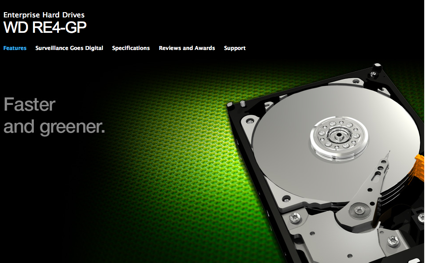
So what Green Technologies does WDC?

NewImage

NewImage


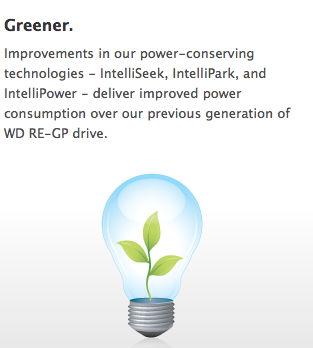
IntelliSeek.
Calculates optimum seek speeds to lower unnecessary power consumption, noise, and vibration. View demo
IntelliPower.
A fine-tuned balance of spin speed, transfer rate, and caching algorithms designed to deliver both significant power savings and solid performance. Additionally, drives with WD GreenPower Technology consume less current during start up allowing more drives to spin up simultaneously resulting in faster system readiness.
IntelliPark.
Delivers lower power consumption by automatically unloading recording heads during idle to reduce aerodynamic drag, and by disengaging read/write channel electronics.
Active Power Management.
Drives with WD GreenPower Technology monitor the work load and automatically invoke idle mode whenever possible to further reduce unnecessary power consumption. Drive recovery time from idle mode is less than one second, providing seamless power management between the drive and the host controller.
Ideal for:
Large data centers, web service providers, commercial grade surveillance systems and organizations requiring huge amounts of storage with limited budget and power allotment.


Facebook updates Open Compute Project for the community, launches new look

If you go to OpenCompute.org you'll see a new look.

image

Facebook's Yael Maguire discusses the changes.

WELCOME!

WEDNESDAY, JULY 27, 2011 | Posted by Yael Maguire at 16:08 PM

Welcome to the new opencompute.org! This revamp focuses the site on projects and the community. Please bear with us as we work out our kinks, but we have a new streamlined project browser with links to some projects on GitHub! Our original specifications were created in Word and converted to PDFs, not a code-friendly manner to do open hardware development. We decided to switch our V2 specifications to MultiMarkDown, a simple text format used for the Web that easily converts to HTML and PDF. With this switch we now have a process for making contributions:

  1. Sign up on the site (link through Facebook).
  2. Sign an individual Contributor License Agreement (CLA).
  3. Get the code on GitHub.
  4. Make a patch to a spec and submit it to us at https://github.com/facebook/opencompute/issues