Facebook joins Google disclosing power and carbon footprint of data centers, are you next?

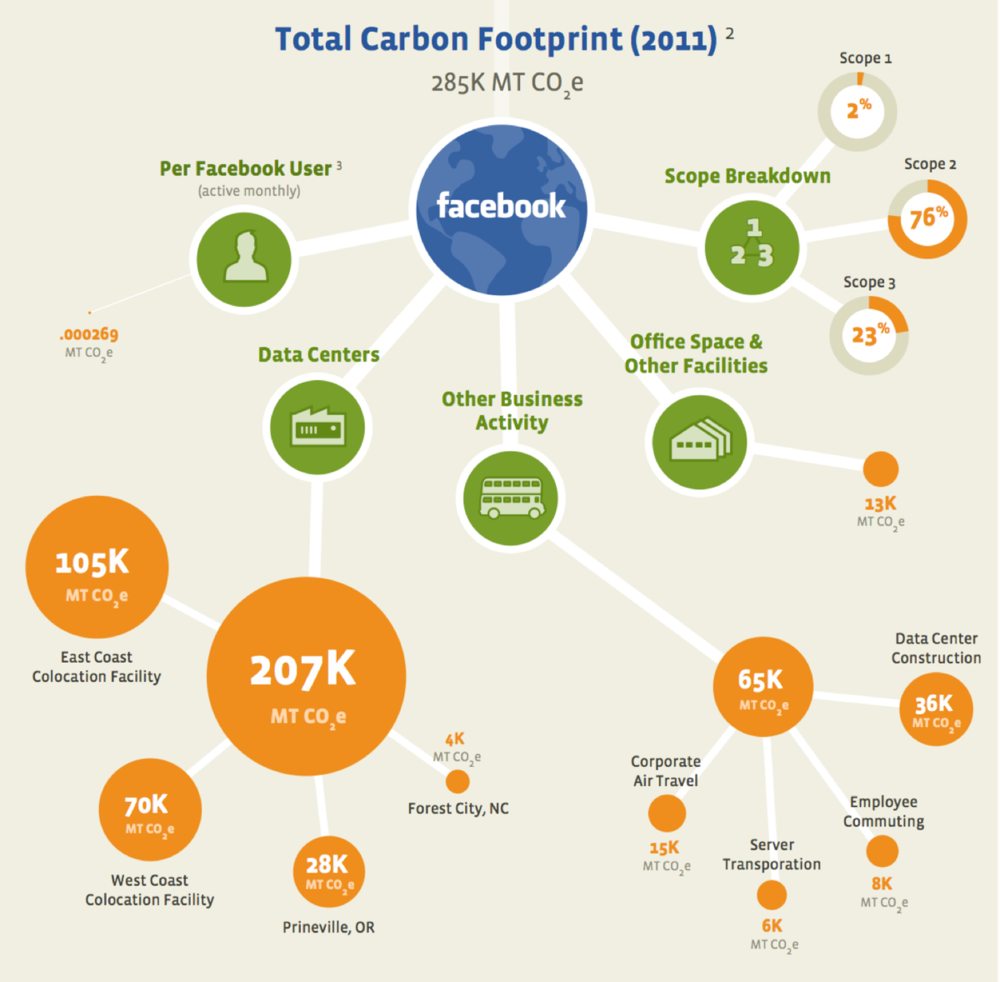
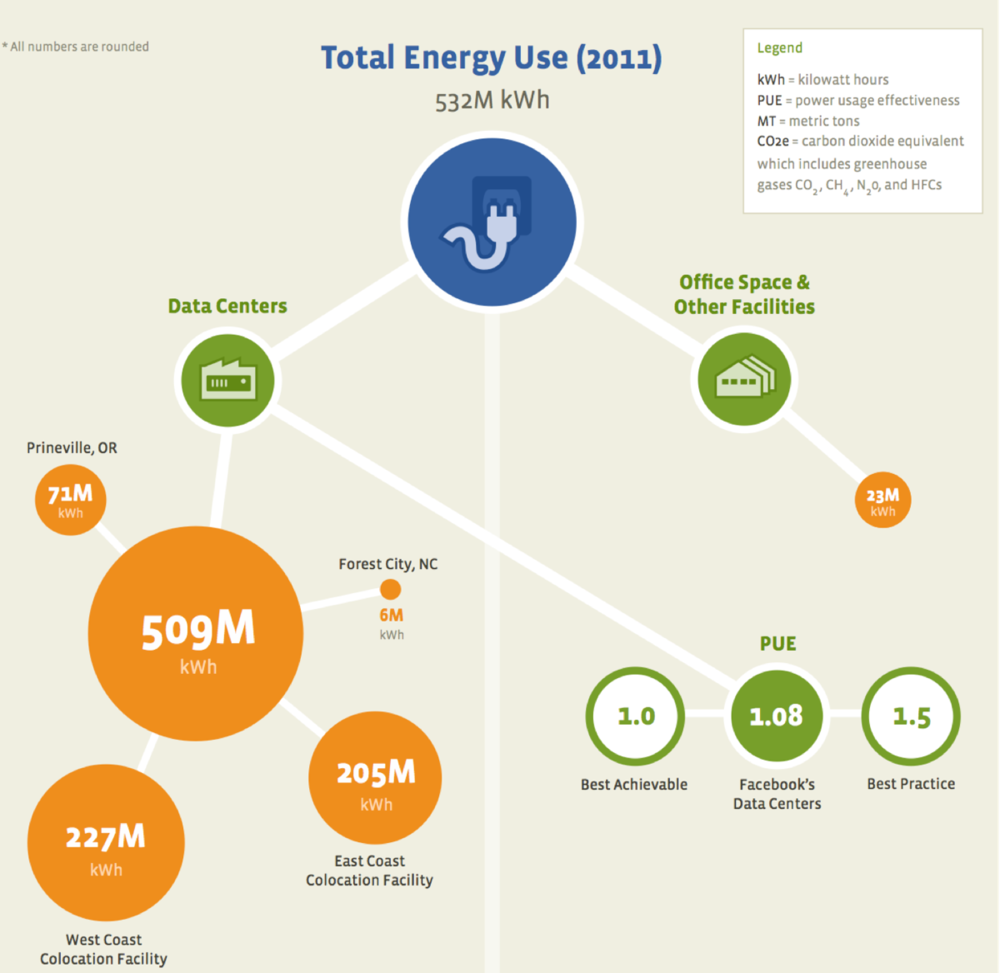
Facebook has published its 2011 corporate power consumption and carbon footprint. 

NewImage

NewImage

NewImage

The Guardian UK compared Google to Facebook.

The data, published on Wednesday, shows that despite the social networking's rising star, its carbon emissions are still a fraction of internet rival Google. Facebook's annual emissions were 285,000 metric tons of CO2 equivalent in 2011, compared with Google's 1.5m tons in 2010.

The vast majority of the emissions (72%) come from the company's data centres in the US. The annual footprint for each user that's active monthly is 269 grams, or around the equivalent footprint of a cup of coffee, the company calculated.

Greenpeace gave their approval to the disclosure.

Greenpeace welcomed the move's transparency and hailed it as an important benchmark. Gary Cook, Greenpeace International's senior IT analyst, said: "Facebook has committed to being fully renewably powered, and today's detailed disclosure and announcement of a clean energy target shows that the company means business and wants the world to follow its progress."

If you plan on having a green data center and not being a Greenpeace target you should follow Google and Facebook with an annual disclosure of your power consumption and carbon footprint.
Green Data Center in NC featuring Apple, Google, and Facebook

GigaOm's Katie Fehrenbacher has a detailed state of the green data center story in NC featuring Apple, Google, and Facebook.

The controversial world of clean power and data centers

Poles dot the dusty solar farm, which will eventually hold solar panels.

This article is the third in a four-part series that we’re publishing this week.

Over the past several years, a couple-hundred-mile area north of Charlotte, North Carolina, has emerged as a new hub for massive data centers that power the Internet, attracting industry heavyweights like Apple, Google and Facebook. North Carolina has been able win over those companies despite the fact it generates its power largely from dirty coal and nuclear, which runs counter to a general trend toward a desire for greener sources of energy.

The post is long, but a quick read.  Here is the main point that highlights Apple vs. Google vs. Facebook.

Grid-connected vs off-grid clean power

At this point, Apple seems to mostly stand alone in its desire to build such massive clean power plants next to a data center. The only other firm to announce that it will tackle something similar is eBay. Last month eBay announced that it would build an extension to one of its data centers in Utah that would run off 30 fuel cells, powered by biogas, and use the grid as backup power.

Google’s data center in Lenoir

Google has arguably been the most innovative and aggressive web business when it comes to clean power. But Google’s Demasi told me that Google has “a basic philosophy that renewable energy should be provided through the utility.”

Likewise Facebook’s VP of Site Operations Tom Furlong, told me: “The utility is the obvious location [for clean power]. It would be a lot easier if the utility came to the site with 20 percent renewables and said this is our mix.” Facebook’s sustainability guru Bill Weihl (formerly of Google) emphasizes that Facebook is still working out its strategy for clean power for data centers and he isn’t ruling out onsite clean-power generation. But Weihl also says he’s interested in one day possibly creating an industry trade group that could help bring together companies to influence utilities’ grid choices through the group purchasing of clean power.


Note that Greenpeace is planning an update tomorrow.

While questions still remain about how exactly Apple will meet its 100 percent clean power data centers goals (see Greenpeace report out tomorrow),  Apple is clearly acting as a pioneer.

Wow, Touring North Carolina sightseeing Data Centers of Google, Apple, and Facebook

GigaOm has a post on a tour of Google, Apple, and Facebook's data centers.

Would you take a trip to North Carolina to tour these data centers?  Well it's not really a tour if you don't get to go inside.  This is more like a drive by the gates of the data centers.

The ultimate geek road trip: North Carolina’s mega data center cluster

This article is the first in a four-part series that we’re publishing this week.

One day, one tank of gas, and three data centers – it was a road trip that only a geek would dream up. My destination: a cluster of cutting-edge and massive data centers spread across a few hundred miles north of Charlotte, North Carolina.

If data centers, filled with thousands of servers, are the engines of the Internet, then North Carolina is one of the garages for the Hummers of the tech world: The state is where Apple, Google and Facebook have decided to build their East Coast data centers. It’s a coup for North Carolina to have wooed all three elite Internet brands.


View Road trip: The North Carolina data center corrider in a larger map

Facebook discusses a move to add Edge Network

GigaOm's Stacey Higginbotham had a discussion with Facebook's Frank Frankovsky.

BREAKING FREE FROM A VENDOR-DEFINED ECOSYSTEM AND BEYOND

With the Open Compute Project, Facebook helped build a new type of infrastructure for its needs and the needs of other webscale companies that had been locked into a vendor-defined ecosystem. After taking the power in its own hands with Open Compute, Facebook isn't done. Frank Frankovsky, the director of hardware design and supply chain, highlights how to take webscale computing to the next level. Instead of just building data centers for scale, it's time to start thinking about how to operate them at scale too.

Moderated by:Stacey Higginbotham - Senior Writer, GigaOM
Speakers:Frank Frankovsky - VP, Facebook 

NewImage

Stacey reports on her own conversation with Frank.

Like Netflix, Facebook is boosting its edge network

Updated: Facebook is building out its own content delivery network edge network to help speed up the delivery of its photos according to Frank Frankovsky, a VP at the social networking company. Frankovsky outed his plans onstage at the GigaOM Structure 2012 event in San Francisco as part of a conversation about how the network plans to continue scaling out its infrastructure. His announcement comes just a few weeks after Netflix announced it was building its own CDN.

Open Compute Summit Keynote Summary by Frank Frankovsky OCP Chairman/President

Frank Frankovsky is the executive vision for Open Compute Project and he has posted a summary of points he made in his keynote here.

Enabling Innovation Where It Matters

Wednesday, May 2, 2012 · Posted by  at 15:00 PM

It’s amazing how much can happen in a year. Last April, when we open sourced a set of server and data center designs under the name “Open Compute Project,” we weren’t sure what to expect. It was our hope that we could inspire the industry to be a little more open, a little more innovative, and a little more focused on energy efficiency.

Today, as more than 500 people converge on San Antonio for the third OCP Summit, I think we can safely say that we’ve already achieved much more than that. The momentum that has gathered behind the project – especially in the last six months – has been nothing short of amazing.

For you ADD people who won't be patient enough to read the whole post. The ending is one of the most interesting things to wake you up to what OCP is doing.

On the other side of the equation, we’ve started to see a convergence of voices among the consumers of this technology around where we think the industry would benefit from standardization and where we think the opportunities for innovation are. Open Rack and Project Scorpio are perfect examples of these consumer voices coming together and communicating their needs more clearly – and the new Open Rack designs debuting today from HP and Dell are perfect examples of the supplier community’s response to that emerging clarity.

Perhaps most importantly, though, is the industry’s decreasing focus on what OCP founding board member Andy Bechtolsheim calls “gratuitous differentiation” and its increasing focus on driving innovation where it matters. This is the work we have ahead of us in the coming months, as we pursue even greater advances and efficiencies in scale computing technology. It is no small task that we’ve set for ourselves – but as the last year has proven, we can accomplish anything if we work together in the open.

Frank is founding board member of the Open Compute Project.