Biomass power plant and data centers, Google’s Finland data center site?

Found this interesting year 2000, document by National Renewable Energy Laboratory on 20 different biomass power plants most of which are forest mills.

image

EXECUTIVE SUMMARY
________________________________________________________________________
This report includes summary information on 20 biomass power plants—18 in the United States, one in Canada, and one in Finland, which represent some of the leaders in the industry. Table 1 lists the 20 plants in order of on-line date, the same order in which they are presented in the report. In some cases, the on-line date means the date an older fossil fired plant started using biomass fuel commercially (not its original on-line date). Some of the information in the table is abbreviated, but can be clarified by referring to the specific plant sections.

One of the sites studied is in Finland which reminded me of Google’s pulp and paper mill acquisition.

Google Confirms Data Center in Finland

March 4th, 2009 : Rich Miller

It’s official: Google will build a major data center at a former paper mill in Hamina, Finland, the company said today. Google bought the former Stora Enso newsprint plant for $51 million last month, and said it was “likely” to use the facility for a data center. Today Google posted details about the Hamina project on the data center section of its web site.

The site will come online in 2010.

“When fully developed, this facility will be a critical part of our infrastructure for many years to come,” Google said. “Limited testing of the facility should be underway in 2010 and the center should be fully operational later that year.”

On a humorous side, here is this post.

Biomass Power Plant Probably Hides Future Evil World Ruler

I don't know if I would like to have a biomass power plant next to my house, but if I have to get one, please let it be like this. Better yet, let me live in it.

This 49.3 megawatt biomass power plant in the United Kingdom will be fully integrated with its surroundings on the banks of the River Tees. Fully integrated as in "hey, look that cool big fat metal volcano coming out of those woods." [Heatherwick via Dezeen via Inhabitat]

Read more

Carbon Neutral Google focus on methane gas reduction projects

Google had a blog post on its carbon offsets as part of their carbon neutral commitment.

Carbon offsets at Google

12/17/2009 06:38:00 PM

As leaders from around the world meet in Copenhagen to address global climate change this month, we thought it was a good time to reflect on our own carbon footprint. In 2007, we committed to become a carbon neutral company. We know that it isn't possible to write a check and eliminate the environmental impact of our operations. So what does “carbon neutrality” mean to us?

The 2nd paragraph after this introduction discusses Google’s data center work.

First, we aggressively pursue reductions in our energy consumption through energy efficiency, innovative infrastructure design and operations and on-site renewable energy. Our Google designed data centers use half the energy of typical facilities.

With Google’s resources it was interesting to see they have the same problem we all have in what are the right carbon offsets to buy?

Here at Google, we have set a very high bar to ensure that our investment makes an actual difference in reducing greenhouse gas emissions by purchasing offsets that are real, verifiable, permanent and additional.

Based on Google’s research, they have a primary focus on methane gas.

To date, we have selected high quality carbon offsets from around the world that reduce greenhouse gas emissions — ranging from landfill gas projects in Caldwell County, NC, and Steuben County, NY, to animal-waste management systems in Mexico and Brazil. Our funding helps make it possible for equipment to be installed that captures and destroys the methane gas produced as the waste decomposes. Methane, the primary component in natural gas, is a significant contributor to global warming. We chose to focus on landfill and agricultural methane reduction projects because methane's impact on warming is very well understood, it's easy to measure how much methane is captured and the capture wouldn't happen without our financing (for the projects we're investing in, they couldn't make enough money selling the gas).

One area I want to investigate further is Google'.org’s carbon offset projects.

We need fundamental changes to global energy and transportation infrastructure to stabilize greenhouse gas emissions over the long term. In the meantime, the projects to which we contribute offer measurable emissions reductions and allow us to take responsibility for our carbon footprint. To that end, we're always looking for good emissions-reduction projects to support. If you have a landfill gas or agricultural methane carbon offset project you think we should consider, please visit this page for more information about how to participate in our latest carbon-offset procurement round.

The submittal page states Jan 6, 2010 is the deadline for submittals.

Request for Proposals

Carbon Offsets

In order to participate in Google's Carbon Offset procurement round, please submit the following web form by 12:00pm PST on January 6, 2010. After we receive your information, we will send a link to our standard Non-Disclosure Agreement (NDA). Once we have your signed NDA, you will receive our Request for Proposal (RFP) document. NDA acceptance along with any questions related to the RFP are due by 12:00pm PST on January 13, 2010. All responses to the RFP are due by 12:00pm PST on February 1, 2010.

Read more

Early indicator of Google Data Center growth? $400 SE Asia Japan cable project

Guardian UK reports.on the announcement.

Google backs world's fastest internet cable

• Undersea line set to run 5,000 miles across southeast Asia
• £245m cable marks latest investment in net infrastructure

In little more than a decade, Google has conquered the technology industry and become one of the world's most powerful companies. Its latest undertaking, however, may be one of its most ambitious: a giant undersea cable that will significantly speed up internet access around the globe.

The Californian search engine is part of a consortium that confirmed its plans to install the new Southeast Asia Japan Cable (SJC) yesterday, the centrepiece of a $400m (£245m) project that will create the highest capacity system ever built.

Gigaom references the 2008 SJC proposal.

Google’s Underwater Ambitions Expand

By Stacey Higginbotham December 11, 2009 1 Comment

0 45

The original SJC proposal

Read more

Pacific NW gets $89 mil of the $620 mil DOE Smart Grid grants

Pacific Northwest National Laboratory will manage the Pacific Northwest Smart Grid Demonstration project.

NW power grid project gets $89 million from DOE

A project to examine how high technology can improve the Pacific Northwest's electric power grid has received an $88.8 million grant from the U.S. Department of Energy.

By The Associated Press

RICHLAND — A project to examine how high technology can improve the Pacific Northwest's electric power grid has received an $88.8 million grant from the U.S. Department of Energy.

The money, to help pay for the $177.6 million Pacific Northwest Smart Grid Demonstration Project, was the largest among 32 grants DOE announced Tuesday as part of $620 million in stimulus aid.

The grant will go to Battelle Memorial Institute's Pacific Northwest National Laboratory in Richland, which will manage the project. The remainder of the project's cost will be borne by energy providers, utilities, technology companies and research organizations taking part.

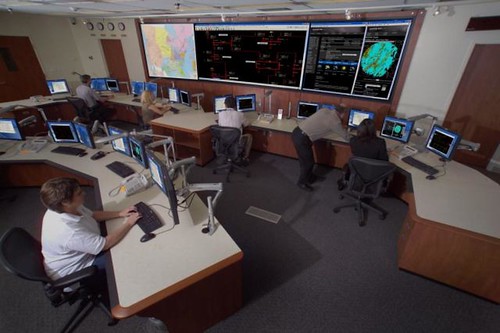
Electricity Infrastructure Operations Center

Electricity Infrastructure Operations Center  by PNNL - Pacific Northwest National Laboratory.

The Electricity Infrastructure Operations Center at PNNL is a user-based facility dedicated to energy and hydropower research, operations training and back-up resources for energy utilities and industry groups.

Smart meters are part of the project.

Among those taking part in the project are the campuses of the University of Washington in Seattle and Washington State University in Pullman. At both schools, "smart meters" will be installed to provide real-time information on power consumption, along with software and other gear to automate and monitor the electricity distribution system.

I wonder if anyone has thought including the Pacific NW data centers in Washington and Oregon in the project?  Problem is almost all the big data center operators wouldn’t want the public to know the power consumption of their data centers.

I hope someone proves me wrong and signs up with PNNL.

Read more

Partly Cloud Computing

Pixar has an entertaining video you can see as part of the movie Up, called Partly Cloudy.

Up

Google’s Dan Dodge makes a good point for moving some IT services to the cloud.  The new term that people need to think about is Partly Cloud Computing.  You don’t have to go complete cloud.  And no clouds are not good.

Moving to the Cloud is not an all or nothing proposition

The Enterprise Cloud Summit panel at the Interop Conference yesterday discussed some of the challenges and concerns of large enterprises and government agencies in moving their applications to the cloud. While there are some regulatory and compliance concerns for some applications, it isn’t an all or nothing proposition. Moving your email, calendar, spreadsheet, word processor, and other productivity apps to the cloud now can save big money, and free up your IT resources to focus on more strategic issues.

InformationWeek says “The vendors argued that cloud computing offers enough real benefits at the present time that most organizations should at least consider it for some functions. One approach, said Google's Don Dodge, is to move low-level data and services to the cloud while continuing to maintain sensitive information in-house.

Dodge told New York's CIO Rico Singleton that his cash-strapped state could save $50 to $100 million per year just by moving its 190,000 employees to Google's cloud-based Google Apps desktop applications. "It's not all or nothing," said Dodge. "Take advantage of the cost savings for the simple things," he said.”

CRN’s Channel Web captured the essence of the discussion;

Cloud evangelists from the technology companies led off the keynote extolling the various virtues of the cloud model, fromGoogle developer advocate Don Dodge emphasizing simplicity and cost-savings to Microsoft's Yousef Khalidi, distinguished engineer for Windows Azure, explaining how to leverage public and private cloud models to maximize efficiency for enterprises both public and private.

Read more