Google Data Centers, a part of their infrastructure advantage

I was talking to a Sr Google guy at a conference and asked what he does.  His response was "I work on Google's Infrastructure."

What is infrastructure as defined by searchdatacenter?

DEFINITION - In information technology and on the Internet, infrastructure is the physical hardware used to interconnect computers and users. Infrastructure includes the transmission media, including telephone lines, cable television lines, and satellites and antennas, and also the routers,aggregators, repeaters, and other devices that control transmission paths. Infrastructure also includes the software used to send, receive, and manage the signals that are transmitted.

In some usages, infrastructure refers to interconnecting hardware and software and not to computers and other devices that are interconnected. However, to some information technology users, infrastructure is viewed as everything that supports the flow and processing of information.

Infrastructure companies play a significant part in evolving the Internet, both in terms of where the interrconnections are placed and made accessible and in terms of how much information can be carried how quickly.

But, the Google guy clarified he works on the search and services infrastructure to support Google services.  Ohh, this is interesting Google defines infrastructure above what most think.

Which fits with a competitive Google has that GigaOm points out as an infrastructure advantage.

Google’s Growing Infrastructure Advantage

By Stacey Higginbotham Mar. 17, 2010, 7:50am PDT 2 Comments

75

Google’s content comprises between 6 and 10 percent of global Internet traffic, making its internal network one of the top three ISPs in the world, according to Arbor Networks. The maker of deep packet inspection equipment, which runs a survey of international ISPs, detailed Google’s traffic in a blog post Tuesday.

The original information came from here with details on Google's use of direct peering.

The graph below shows an estimate of the average percentage of Google traffic per month using direct interconnection (i.e. not using a transit provider). As before, this estimate is based on anonymous statistics from 110 providers. In 2007, Google required transit for the majority of their traffic. Today, most Google traffic (more than 60%) flows directly between Google and consumer networks.
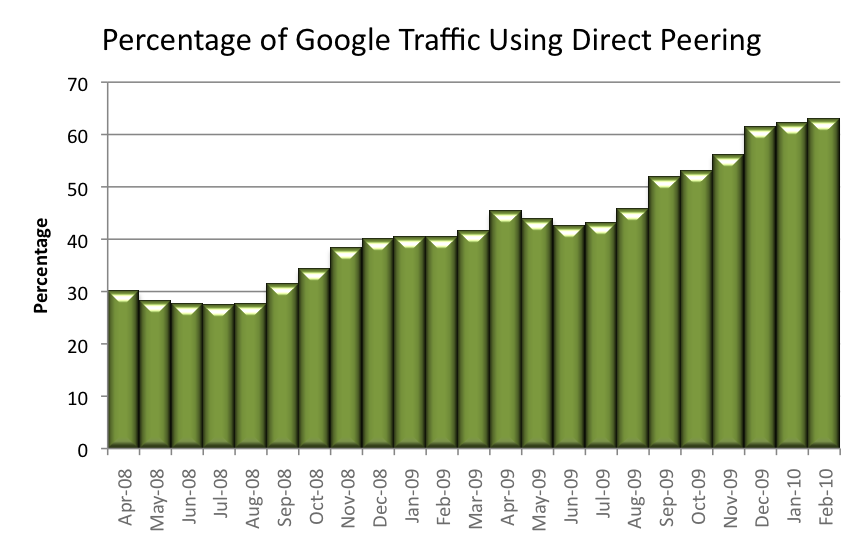
google_peering

So, even though the data center crowd thinks of data centers as infrastructure, Google has a bigger picture.

But even building out millions of square feet of global data center space, turning up hundreds of peering sessions and co-locating at more than 60 public exchanges is not the end of the story.

Over the last year, Google deployed large numbers of Google Global Cache (GGC) servers within consumer networks around the world. Anecdotal discussions with providers, suggests more than half of all large consumer networks in North America and Europe now have a rack or more of GGC servers.

So, after billions of dollars of data center construction, acquisitions, and creation of a global backbone to deliver content to consumer networks, what’s next for Google?

I am regularly surprised how data center discussions many times only discuss the data center, not the data center as part of the overall system.

Read more

Google Android’s team adds web expert Tim Bray as "developer advocate" for open web mobile experience

The battle being Google and Apple is reaching a media high point. Tim Bray, XML co-creator has joined Google as developer advocate and the media is highlighting the competitive move.

Tim Bray lands on Android team

Posted by Dana Blankenhorn @ 6:12 am

XML co-creator Tim Bray has joined the exodus from Oracle and landed at Google, as a “developer advocate” for the Android.

Bray, who like tech titans Steve Jobs and Bill Gates, was born in 1955 (as was this humble blogger), is now expected to be a much more familiar face to reporters, contrasting what he calls Android’s open development vision with the Apple iPhone’s “sterile Disney-fied walled garden surrounded by sharp-toothed lawyers.”

Tim Bray is a well known blogger and he writes on his move to Google.

How? · Google and I have been a plausible match for a long time. Web-centric, check. Search,check. Open-source, check. The list goes on. We’ve talked repeatedly over the years, but the conversations all ended at the point when I said “...and I don’t want to move to the Bay Area”.

Being an experienced tech guy, born in 1955 he gets the importance of energy efficient computing.

I’m not going to stop worrying about concurrent programming, because our failure to equip developers to do it right is going to bite our asses just as hard in the mobile space as anywhere else. Maybe harder, since mobiles are power-starved by definition and current data seem to show that slower many-core CPUs give you more computing per milliwatt.

Combine the energy efficiency focus in Android Mobile with Urs Hoelzle data center team, and there are huge synergies for energy efficient systems.

He who can use less energy for the same performance and capability has the advantage.

Read more

Who will be the winners of Mobile Computing?

Don Dodge let go from Microsoft, and currently Google employee blogs on the Platform shift to Mobile.

MARCH 04, 2010

Platform shifts Mainframe to Mini to PC to Mobile. Why leaders fail to make the shift

Platform shifts happen every decade or so in computing. The leaders of the previous generation are rarely successful in dominating the next generation platform. IBM dominated the mainframe business. They didn’t lose their dominance because another company built a better mainframe. They lost it because the market shifted to a new platform…Mini computers. Digital Equipment, Data General, and a few others dominated that market. Another platform shift is happening today, from PCs to Mobile devices, and another industry leader will be left behind. John Herlihy of Google Europesays “In three years time desktops will be irrelevant”

The issues for Innovator's Dillemma are referenced.

Why do leaders fail to adapt? The Innovators Dilemma, made famous by Clayton Christensen, clearly explains why market leaders fail to make the leap. Innovation usually happens at the low end of the market where the products are simple, prices are low, margins thin, and the market totally undefined. The industry leaders have great margins, high prices, and customers who want more features and are willing to pay for them. The industry leaders always move up market and leave the new emerging market to smaller innovators. The process usually follows these 6 steps;

  1. The disruptive technology is discovered, often by the market leading company.
  2. Marketing people seek reactions from customers and industry analysts.
  3. Established companies decide it is a better strategy to speed up the pace of sustaining technical advancement in their own product rather than go down market with the disruptive technology.
  4. Start-ups learn about the disruptive technology and see opportunity. They keep their cost structure low, build the technology, and find new markets through trial and error.
  5. The start-ups get some initial success and then move up market and eat away customers from the market leading company.
  6. The market leading company finally jumps on the bandwagon reluctantly with a half hearted attempt and fails. It is too late.

Morgan Stanley's Mary Meeker is referenced.

Platform shifts have 10X the number of devices and users. The move to Mobile is big and fast. Mary Meeker of Morgan Stanley says Mobile Internet usage is bigger than most people think, and it is exploding. Every platform shift has 10X the number of devices and users. There were about 1M mainframes, 10M mini-computers, 100M PCs, and 1 Billion cell phones. The next wave of mobile devices will be over 10B.

10x platform shifts

Mary Meeker's report has lots of good information in it.

image


image

Note the fast growth of Mobile Internet compared to other technologies

image

And, she makes the point I have seen few make which is spot on.  The growth of real-time wireless sensors.

image

I was talking to a Google developer brainstorming some mobile scenarios, and he laughed when i was going three steps beyond his ideas.  When we both worked at Microsoft we were talking about GPS data with photos in 2001, and people thought we were crazy - "that's too expensive and what would you do with GPS coordinates."  Make money!!!!

image

Google is all over this scenario.

image

What is the new publishing and distribution network for Mobile?

image

The Mobile's phone capabilities are less important and some young users look at phone calls as people who aren't with it.

image

Read more

Defining a Data Center API, on the list of things to do for Open Source Data Center Initiative

I have spent so much of my life working with Operating System nerds both at Apple and Microsoft that I take it for granted the concepts of an API.

An application programming interface (API) is an interface implemented by a software program to enable interaction with other software, similar to the way a user interface facilitates interaction between humans and computers.

A critical concept of an API is abstraction.

An API is an abstraction that defines and describes an interface for the interaction with a set of functions used by components of a software system.

The data center is waiting for abstraction..

In computer science, the mechanism and practice of abstraction reduces and factors out details so that one can focus on a few concepts at a time.

But the many people are concrete minded thinkers. Concrete Thinking is.

Thinking characterized by a predominance of actual objects and events and the absence of concepts and generalizations.

Google’s Urs Hoelzle and Luis Andre Barossa wrote on the concept of a Data Center is a computer.

image

Well if the Data Center is a computer it should have a set of APIs.  It is a fact that Google has interfaces for its data centers.  I haven’t talked to a single Google employee on this concept.  But, it has to be.  How else are you going to interface with all the data centers around the world in Google’s inventory?  if you search the google document you see multiple references to API.

image

image

In Google’s Warehouse-Scale computers they close with.

At one level, WSCs are simple—just a few thousand cheap servers connected via a LAN. In reality, building a cost-efficient massive-scale computing platform that has the necessary reliability and programmability requirements for the next generation of cloud-computing workloads is as difficult and stimulating a challenge as any other in computer systems today.

Google thinks about the programmability, the APIs, of the data center.

I don’t need any more proof data centers need APIs.  But, concrete thinkers will not believe it until there are multiple customers already doing this.

In the short term, we can use Johnson Controls solution GridLogix I blogged about as a reference point.

Information Management for Sustainability
Gridlogix provides your organization with the tools for sustaining your enterprise. More than going "Green", Gridlogix helps you continuously cut wasteful costs, prolong the life of your facilities’ equipment, and maintain a comfort level throughout your enterprise. With Gridlogix's Automated Enterprise Management solution, Gridlogix empowers anyone in your organization with the real time data that allows your organization to improve the efficiency of your facilities, typically reducing energy and maintenance costs by 10-20% with a payback of less than 18 months. Gridlogix delivers the best form of Green Energy, conservation.

Read more

GOOG, AMZN, AAPL are the media distributors, MSFT lost this ability in the DOJ/EU court

I am back in the bay area for a couple of days coming from Seattle, and it hit me after visiting a company yesterday that Google, Amazon, and Apple are the top companies in each of the areas – Search, eCommerce, Media who combined are defining media distribution.  What Microsoft lost in the DOJ/EU court cases is the ability to be in control of Windows as a way to define the user experience on PCs for these areas.  If Microsoft didn’t have the consent decree restraints it could be more powerful in search, ecommerce, and media.

But, even if Microsoft had not lost the DOJ/EU court cases would they have moved to Mobile, Search, and e-reader type of devices like its competitors?

Microsoft VP recently left Microsoft to Amazon to work on the Kindle.

Mike Nash, Corporate Vice President of Windows Platform Strategy, will be leaving the company in February. A Microsoft spokesperson confirmed his departure when I asked. From the e-mailed statement:

“We can confirm that Mike Nash is leaving Microsoft in a couple weeks. In his 19 years, Mike made an impact in number of key roles at the company. We appreciate his service and wish him well.”

Update: Nash will be joining Amazon.com to work on the Kindle, I hear. I’ve asked to see whether Nash will be replaced. No word back yet on that one…. Microsoft officials declined to comment (at least for now) on when and if that will happen.

There have been plenty of people who have left Microsoft to go to Google as well.

But, few who leave Microsoft to go to Apple.  I know plenty including myself who left Apple to go to Microsoft, but not the other way around.

Google, Amazon, and Apple are all trying to define the new media experience which as much as the content creators are in despair, I think throughout history the distributors, those who owned the channel defined the business model.

The content Publishers used to own the channel, now it is in the hands of Google, Apple, and Amazon.  Whoever who can define the best business model will win.

Read more