Google’s Data Center Security Video

Google’s Security and Data Protection in a Google Data Center video is viral with 152,000 views.  Yesterday when I checked it was at 110,000 since posting on Apr 13, 2011.  But, checking the comments started 3 days ago, so most likefly the video has been up on Youtube since April 13, but released Apr 23.  Google could not have asked for better timing to be right after AWS outage.

What I found interesting was one article saying the video is related to Facebook’s Open Compute Project.

The media has juxtaposed the data center video with Facebook's Open Compute project, in which the company open sourced its data center hardware and schematics earlier this month.

Facebook's move was an open-source olive branch to the computing community at large, but it was also a calculated play to urge the creation of less expensive, commodity servers.

Google's video tour is an educational play designed to assure enterprises and federal agencies considering a Google Apps collaboration software contract of its stringent data security.

I know Google guys have been thinking of this video for over 6 months to promote the security of data in Google data centers.  Has Facebook been thinking about the Open Compute Project for over 6 months?

The Register highlights the hard drive security

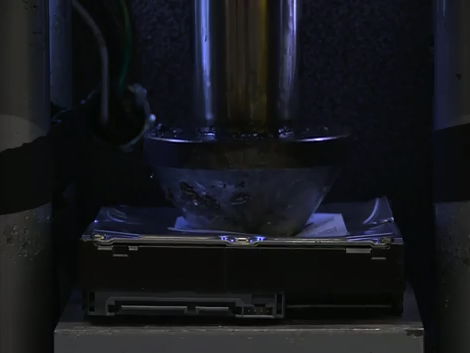
Nonetheless, when a hard drive fails or no longer exhibits prime performance and must be disposed of, Google uses multiple techniques to ensure that the data can't be read at all. It overwrites the data, and then it uses a complete disk read to verify that all data has been removed. When disk reaches the end of its life, Google will then destroy it. This involves pushing a steel piston through the center of the drive and then shredding it into relatively small pieces. The remains of the drives are then sent to recycling centers.

Google hard drive crusher

The Crusher: Google gives hard drives the piston treatment
What doesn’t get mentioned that I think is cooler than the low tech ways to handle hard drive security is Google’s shard methods to protect data and achieve scalability, but this is way too geeky for most users to be interested in.

We can hope that with the popularity of the video and news coverage that Google and others will create more data center videos.

Could you imagine a documentary style video of AWS outage?  Would the video be a comedy or drama?  A video of Sony’s playstation outage would be a tragedy, or comedy if you are from the Xbox Live team.

Absorbing information at Green:Net 2011 - Greenpeace and Google make announcements

I walked in the door at 7:40a to Green:NET 2011.  The room was sparse, but within 2 minutes I saw a good friend who I didn't expect  to see. The last time we saw each other was Olivier Sanche's memorial service in Los Gatos.  We quickly had a great conversation on Greenpeace's announcement.

Greenpeace Unveils Who’s Behind the Internet’s Dirty Power

By Katie Fehrenbacher Apr. 21, 2011, 6:30am PT 1 Comment

A group of the Internet’s most recognized brands — from Facebook to Apple to Twitter to Amazon — have received failing grades when it comes to using clean power for their web services, according to a new report unveiled by Greenpeace on Thursday at our Green:Net 2011 event. Greenpeace found that while a few companies like Akamai, Google, Yahoo and IBM have been taking important steps towards clean power, overall, many web companies “are perpetuating our addiction to dirty energy technologies.”

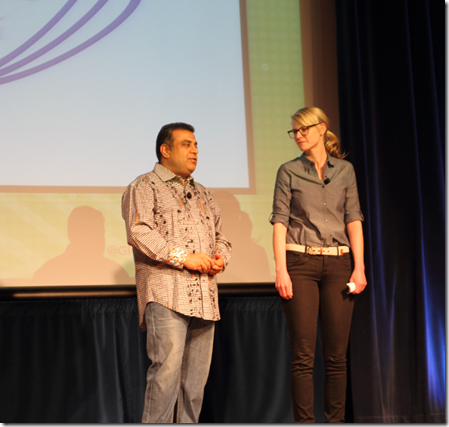
The day kicked off with Om Malik and Katie Fehrenbacher

image

Google  Energy announced their 100MW Wind Power purchase.

Google to Buy Another 100MW of Wind Power via Google Energy

By Katie Fehrenbacher Apr. 21, 2011, 8:00am PT No Comments

Google isn’t just continuing to investhundreds of millions of dollars into clean energy projects, but it’s also continuing to commit to buying up the clean power itself. On Thursday morning Google announced that it has made its second deal via its subsidiary Google Energy, and the search engine giant plans to buy 100 MW of power from a wind farm that’s under construction in Oklahoma.

Is Facebook the Lightning Rod for Environmental Impact of Data Centers?

DataCenterKnowledge posts on Facebook's 100KW Solar array.

Facebook Installs Solar Panels at New Data Center

April 16th, 2011 : Rich Miller

Facebook has built a large solar array next to its new data center in Prineville, Oregon (Photo: Rich Miller, Data Center Knowledge).

Facebook has installed a large array of solar panels at its new data center in Prineville, Oregon, which will supplement the local utility in providing electricity for the 300,000 square foot facility, which was officially opened at a ceremony yesterday.

For more than a year, the environmental group Greenpeace International has been bashing Facebook over its use of electricity generated by “dirty coal” to support its huge new Oregon data center  – a campaign that continued Friday as Facebook opened the new facility.

The photo Rich has of the solar array on a cloudy day reminded me of a post I wrote 2 years ago on who Greenpeace's first data center target would be.

What is the First Greenpeace Data Center Target? Apple? Google? Microsoft?

TUESDAY, JULY 28, 2009 AT 9:20AM

Datacenterknowledge blogs on how quickly Apple is building its $1 billion dollar data center.

APPLE MOVING QUICKLY ON NC PROJECT
July 28th, 2009 : Rich Miller

apple-ncApple is known for keeping its new technology secret prior to launch.

And, I closed with the following.

How can Greenpeace, not already have a plan in place to address Apple’s data center for its environmental impact?

Now, you could say Greenpeace why not go after Google or Microsoft?  Greenpeace could, but why haven’t they already.  It is not worth it for media coverage.  Going after Apple would get people’s attention.

If not Apple, who else makes sense to go after if you were Greenpeace?

With Earth Day coming up Facebook is the one company as a target for Greenpeace and the rest of the data center industry is relieved.  Facebook is a convenient target being the only data center operator I know that had an option to source hydro or coal power for its data center and selected coal.

When Greenpeace went after environmental impact of PC products they targeted HP, Dell, and Apple.  Is it time for Apple, Microsoft, and Google to feel the attention of Greenpeace or is Facebook the only high carbon impact data center user out there?

I'll be at Green:NET 2011 later this week and will be in this session.

GREENPEACE INTERNATIONAL WORKSHOP – ROOM 2

Dirty Data: How the Cloud is Powered and Why it Matters for the Climate

Greenpeace will release a new analysis that looks at leading IT companies (Facebook, Apple, Google, and more) and asks if IT, as it builds out the cloud, will perpetuate the dirty energy issues of older, entrenched industries or will be the innovative sector that creates a business model that prioritizes a future built on clean, renewable energy?

Speakers:Gary Cook - Senior IT Policy Analyst, Greenpeace International

Google Infrastructure is more than Data Centers and Servers, it's software

In the data center world if you hear the word infrastructure you naturally think of the data centers and servers.  Why not Infrastructure is defined as:

Infrastructure is the basic physical and organizational structures needed for the operation of a society or enterprise,[1] or the services and facilities necessary for an economy to function.[2] The term typically refers to the technical structures that support a society, such as roads,water supply, sewers, electrical grids, telecommunications, and so forth.

A couple of years ago at a conference I was talking to a Google architect and I eventually asked what he did.  He said I work on the infrastructure.  When he said infrastructure I named a few people in the data center group I had ran into at data center  conferences, but he didn't know any of those people.  Then, he repeated I work on THE infrastructure.  What we build our applications on - search, storage, compute.  OHHH, you guys get it that your infrastructure is more than physical devices.  Software is infrastructure few think about to build services.  Most typically think physical infrastructure.

GigaOm has a post with Google's Infrastructure czar, Urs Hölzle.  Om Malik says it has been 5 years since he has touched base with Urs.  I would never go that long.

Hölzle was company’s first VP of engineering, and he has led the development of Google’s technical infrastructure.

Hölzle’s current responsibilities include the design and operation of the servers, networks and data centers that power Google. It would be an understatement to say that he is amongst the folks who have shaped the modern web-infrastructure and cloud-related standards.

When you read the GigaOm post don't just think physical infrastructure, think about the software Google has in place to support cloud services.

Others might disagree, but Hölzle believes Google’s common infrastructure gives it a technological and financial edge over on-premise solutions. “We’re able to avoid some of that fragmentation and build on a common infrastructure,” says Hölzle. “That’s actually one of the big advantages of the cloud.”

Google's $900 mil bid for Nortel patents shows how important networking is

Google posted on its bid for Nortel Patent portfolio.

So after a lot of thought, we’ve decided to bid for Nortel’s patent portfolio in the company’s bankruptcy auction. Today, Nortel selected our bid as the “stalking-horse bid," which is the starting point against which others will bid prior to the auction. If successful, we hope this portfolio will not only create a disincentive for others to sue Google, but also help us, our partners and the open source community—which is integrally involved in projects like Android and Chrome—continue to innovate. In the absence of meaningful reform, we believe it's the best long-term solution for Google, our users and our partners.

The bid is reported to be $900 Mil.

Google bids $900M for Nortel patent portfolio

By Juan Carlos Perez

April 4, 2011 12:13 PM ET

IDG News Service - Google is bidding $900 million in cash for thousands of patents that Nortel will auction off as part of its bankruptcy proceedings, the companies said Monday.

As much as Google has its own patents, it is interesting they are the stalking-horse bid for 4,000-6,000 Nortel patents which you would believe are mostly networking base.  But, as their legal department explains they felt this is the best defense.

The tech world has recently seen an explosion in patent litigation, often involving low-quality software patents, which threatens to stifle innovation. Some of these lawsuits have been filed by people or companies that have never actually created anything; others are motivated by a desire to block competing products or profit from the success of a rival’s new technology. The patent system should reward those who create the most useful innovations for society, not those who stake bogus claims or file dubious lawsuits. It's for these reasons that Google has long argued in favor of real patent reform, which we believe will benefit users and the U.S. economy as a whole.