Google 250kW green data center Videos and PDF for improving PUE from 2.4 to 1.5

If you are looking to improve the PUE of a small data center (250kW), Google has shared its best practices they have implemented at 5 locations.

The question I asked Google's Joe Kava was what he thought the PUE could go to with more load in the facility.  The current load is 85 kW in a 250kW capacity.  PUE is currently at 1.5 and more load in theory bring PUE to 1.35-1.4, but there will be step function when an additional CRAC unit needs to be brought on line.

There are 4 CRAC units in the room and now only 2 are run while the other 2 are back-up.  After a week of operation, the operation is flipped evening out the wear on equipment and insuring the back-up cooling is operational.

Here is a PDF that describes the whole project - Google's Green Data Centers: Network POP Case Study.

image

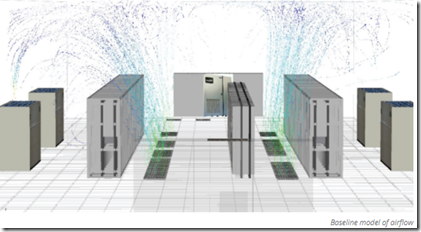
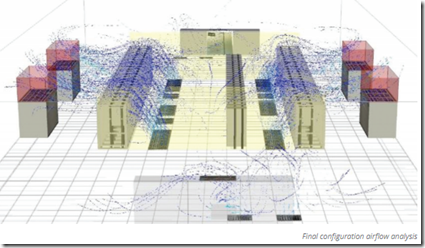
Here is before and after images of the airflow.  Joe said Google samples data once a second to monitor the power and cooling systems in the room.

image

image

A 10 minute video goes along with the white paper.

If you want to segment the 10 minute video into specific areas of interest here are 5 video segments you can view.

Data Center Efficiency Best Practices Part 1 - Intro and Measuring PUE

Data Center Efficiency Best Practices Part 2 - Manage Airflow

Data Center Efficiency Best Practices Part 3 - Raise the Thermostat

Data Center Efficiency Best Practices Part 4 - Utilize Free Cooling

Data Center Efficiency Best Practices Part 5 - Optimize Power Distribution

Google's Hamina Data Center follows #1 rule of architecture, respect "the genius of a place"

Google posted a video on its Hamina Data Center.

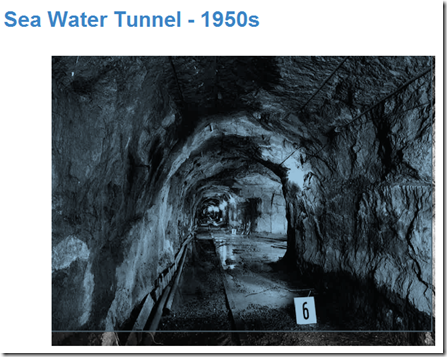
Joe Kava is featured in the videos, but the video I would have really like to see is Joe scuba diving through the sea water tunnel that brings water into the facility.  Below is a picture of the tunnel built in 1950.
image

If you want to see what the facility looked like before check out this tour Google gave to the press.

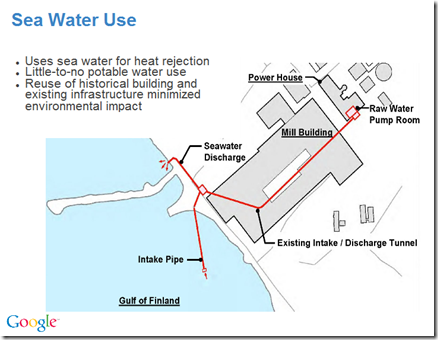
100% sea water use for cooling is a first for the data center industry, and Hamina has some unique characteristics.
image

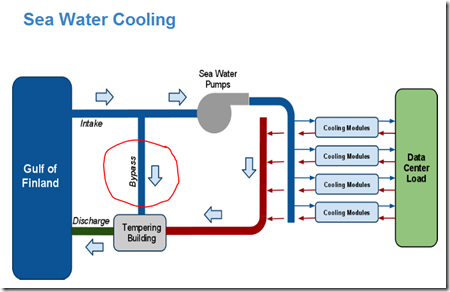
Google added a bypass mixing function to the sea water cooling system to lower the temperature of the discharge back to the gulf which was not a requirement by any government agency.  But, Google recognized this change would reduce the environmental impact which fits in a sustainability strategy.
image

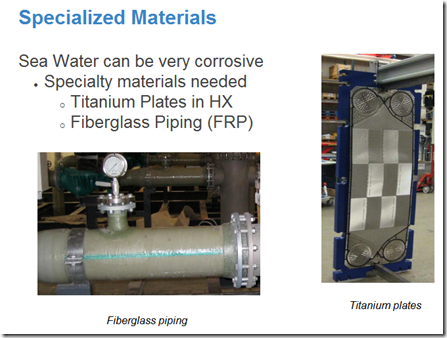
There was a lot of thought required for Google to have a sea water cooling system that runs 24x7 for years and years with no downtime.
image

I asked Joe some questions on his presentation, and one of the areas we covered is the maintenance issues for a sea water cooling system as a typical assumption at the company who designs sea water cooling systems is there is an annual maintenance that includes downtime.  You can imagine the Google guys telling the engineering company, there will be no downtime in this facility. 

Below is where Google lists an integrated Clean in Place (CIP) system and other features to address sea water fouling to eliminate maintenance downtime.

image

37Signals just posted on Ten Lessons for great landscape architecture.  You may think landscape architecture doesn’t have anything to do with data center design, but great architecture design is consistent across many areas.

Ten design lessons from Frederick Law Olmsted, the father of American landscape architecture Matt May 23

Latest by Naomi Tapia

Frederick Law Olmsted (1822-1903), the father of American landscape architecture, may have more to do with the way America looks than anyone else. Beginning in 1857 with the design of Central Park in New York City, he created designs for thousands of landscapes, including many of the world’s most important parks.

His works include Prospect Park in Brooklyn, Boston’s Emerald Necklace, Biltmore Estate in North Carolina, Mount Royal in Montreal, the grounds of the U.S. Capitol and the White House, and Washington Park, Jackson Park and the World’s Columbian Exposition of 1893 in Chicago. (The last of those documented excellently in Erik Larson’s book The Devil in the White City.) Plus, many of the green spaces that define towns and cities across the country are influenced by Olmsted.

Consider Lesson #1 of a great architect.

1) Respect “the genius of a place.”
Olmsted wanted his designs to stay true to the character of their natural surroundings. He referred to “the genius of a place,” a belief that every site has ecologically and spiritually unique qualities. The goal was to “access this genius” and let it infuse all design decisions.
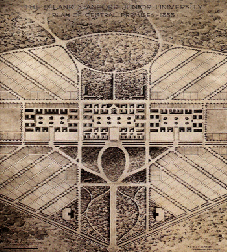
This meant taking advantage of unique characteristics of a site while also acknowledging disadvantages. For example, he was willing to abandon the rainfall-requiring scenery he loved most for landscapes more appropriate to climates he worked in. That meant a separate landscape style for the South while in the dryer, western parts of the country he used a water-conserving style (seen most visibly on the campus of Stanford University, design shown at right).

Think about these words and watch the video again.  Right at the beginning Joe talks about designing for the unique characteristics of a site.

You may think this idea is a waste of time and you don’t have the money, but 30 years from now or a 100 years from now great data center designs, designs that match a site will last and be upgraded.  Data Centers that are not designed for “the genius of a place” will fade and be demolished.
Google takes available space at 111 8th in NYC off the market

DatacenterDynamics reports on Google's move to remove 111 8th ave data center space off the market.

Google takes all available space at key NYC carrier hotel off market

Future of data center providers at 111 8th Ave. uncertain

Published 20th May, 2011 by Yevgeniy Sverdlik

111 8th Avenue in New York

Following its acquisition of one of East Coast’s largest carrier hotels at 111 8th Ave. in New York City, Googlehas taken all the space that was available in the building off the market. The building is home to a number of commercial data center providers, including Digital Realty Trust, Telx and Internap, among others.

I speculated that Google could use the space in 111 8th for carrier negotiations.

Google now owns a premium networking access point in NYC, the biggest concentration of money in the USA with the financials, stock exchanges, and other businesses.

As Google negotiates carrier access in various markets, it can offer a presence in 111 Eighth Ave.  This can change price points, and guarantees of service and access.

If Emerging Market Telecom sets up a relationship with Google, and agrees to a presence in 111 Eighth Ave, then the more the Emerging Market Telecom needs the location due to a variety of economic and technical reasons, the value works for Google.

Did Google just buy one the biggest bargaining chips it could have to negotiate access to WW Telcos?

With Centurylink's purchase of Savvis and Verizon's purchase of Terramark could they do what Google is thinking?  It is interesting to think one building is more valuable that Savvis or Terramark.

Google's low PUE from 10 data centers gets less media coverage than a Yahoo Chicken Coop and Facebook Open Compute DC

Chris Malone has a presentation at Uptime Symposium that DataCenterKnowledge covers Google's Data Center PUE status.

Google: No ‘Secret Sauce’ in Recipe for Efficiency

May 11th, 2011 : Rich Miller

A chart showing onoging improvement in Power Usage Effectiveness in data centers at Google.

Chris Malone didn’t come to the Uptime Symposium to reveal Google’s stealthy strategies to make its data centers super-efficient. Instead, Malone’s message was that no state secrets are required to make your facilities much more efficient – although perhaps not quite as efficient as Google’s highly-customized infrastructure.

There are ten data centers reported on starting 4 years ago. Yet, many data center novices are more aware of Yahoo's chicken coop and Facebook's Open Computer Data center., and think of these first data center build out as state of the art.

Yahoo’s Chicken Coop-Inspired Green Data Center

By Katie Fehrenbacher Sep. 19, 2010, 9:00pm PT Comments Off

Design inspiration can come from unusual places — for Yahoo and its data center design team, it was chicken coops, which utilize outside air and can reduce cooling power and costs. On Monday, Yahoo announced that the first data center to mimic this fine-feathered design has been built, commissioned and is up and running in Lockport, New York.

...

Facebook Open Sources Its Servers and Data Centers

By Stacey Higginbotham Apr. 7, 2011, 10:05am PT 20 Comments

Facebook has shared the nitty-gritty details of its server and data center design, taking its commitment to openness to a new level for the industry by sharing its infrastructure secrets much like it has shared its software code. The effort by the social network will bring web scale computing to the masses and is a boon for AMD and Intel and the x86 architecture.Sorry ARM.

Google is going to have its data center event in Zurich on May 24.  We'll see perception changes after Google's data center summit.

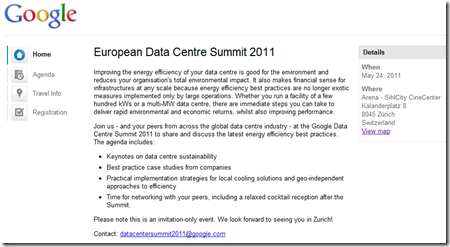
European Data Centre Summit 2011

Improving the energy efficiency of your data centre is a critical part of business best practices, ensuring the reduction of both your organisation's total energy consumption and its environmental impact.

The financial gains are potentially huge for infrastructures at any scale; whether you run a facility of a few hundred kWs or a multi-MW data centre, there are immediate steps you can take to deliver rapid environmental and economic returns.


Hot Ticket where EU gets priority, Google’s Data Center Summit 2011 in Zurich May 24

Google will officially announce its Data Center Summit 2011 next week for the world of Google data center followers.  Attendance is limited so not everyone can go.  What will get you to the top of the list of potential attendees is if you are based out of the EU and you have a passion for energy efficiency in the data center. 

Information about the Summit itself is straightforward - innovative thinkers and industry leaders are coming together to discuss energy efficiency best practices for data centres. For Google's part, we will share the total cost of ownership analysis of a computing and network room (CRN) retrofit and explain how seawater cooling makes sense for our facility in Finland. Other presenters will give similar accounts of the results from adhering to efficiency best practices as well as taking advantage of local cooling solutions. We are hoping to see the European data centre community continue to focus on improving operational efficiency.

If you don’t qualify pass this post on to a Green Data Center friend in the EU.

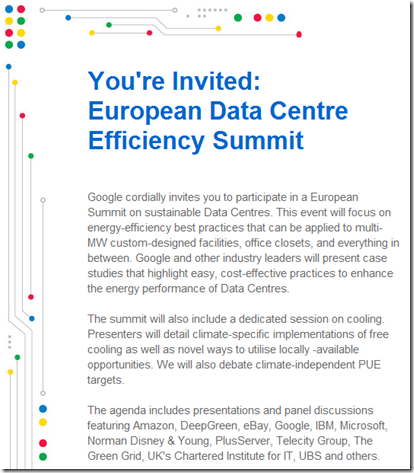
image

With Google’s permission I am sharing the event web site before they post the event on their blog next week.

image

Here is the event schedule with speakers.

Event Schedule

8:30
Keynotes on data centre sustainability and best practices
Zahl Limbuwala, Chartered Institute for IT; Harkeeret Singh, The Green Grid

10:00
Best practice implementation case studies
Joe Kava, Google; Dean Nelson, eBay

11:20
Panel discussion
James Hamilton, Amazon; Robert Coupland, Telecity Group; Brian Waddell, Norman Disney and Young; Mark Eichenberger, UBS

12:00
Lunch

13:30
Local cooling solutions and geo-independent approaches to efficiency
Joe Kava, Google; Dileep Bhandarkar, Microsoft; Jochen Berger, PlusServer; Chris Malone, Google

15:50
Panel discussion
Mark Monroe, The Green Grid; Andre Oppermann, DeepGreen; Bruno Michel, IBM Research Lab; Jeff Monroe, Verne Global

17:00
Reception

I’ll be at the event and most likely will attend DataCenterDynamics Zurich the day after and try to add some data center tours while I am there.

image