Google Uncloaks its Carbon Impact and Energy Use of company including Data Centers

3 Years ago I had the pleasure of talking to Google’s Urs Hoelzle regarding Google’s PUE.

And now Urs makes a bigger announcement today.

How our cloud does more with less


Posted by Urs Hoelzle, Senior Vice President, Technical Infrastructure
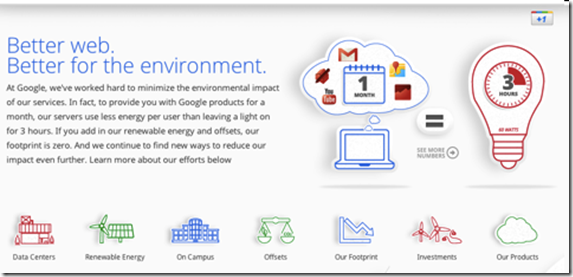
We’ve worked hard to reduce the amount of energy our services use.  In fact, to provide you with Google products for a month — not just search, but Google+, Gmail, YouTube and everything else we have to offer — our servers use less energy per user than a light left on for three hours. And, because we’ve been a carbon-neutral company since 2007, even that small amount of energy is offset completely, so the carbon footprint of your life on Google is zero.

We’ve learned a lot in the process of reducing our environmental impact, so we’ve added a new section called “The Big Picture” [link to come] to our Google Green site with numbers on our annual energy use and carbon footprint.

Google’s greener data centers get #1 position.

We started the process of getting to zero by making sure our operations use as little energy as possible.  For the last decade, energy use has been an obsession. We’ve designed and built some of the most efficient servers and data centers in the world—using half the electricity of a typical data center. Our newest facility in Hamina, Finland, opening this weekend, uses a unique seawater cooling system that requires very little electricity.
image

Renewable Energy gets position #2.

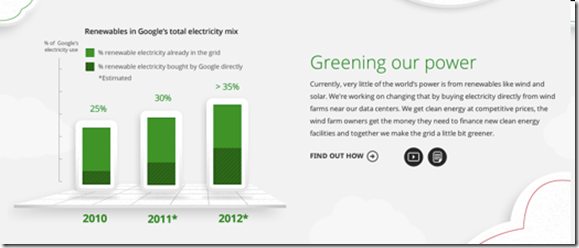
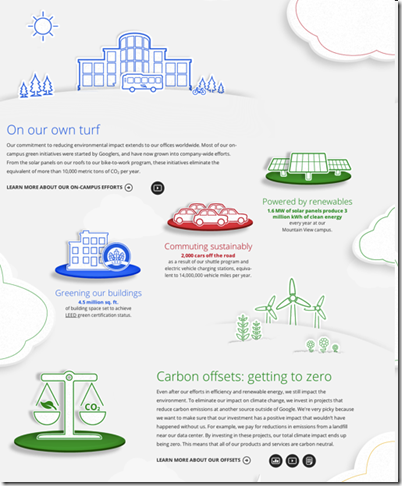
Whenever possible, we use renewable energy. We have a large solar panel installation at our Mountain View campus, and we’ve purchased the output of two wind farms to power our data centers.  For the greenhouse gas emissions we can’t eliminate, we purchase high-quality carbon offsets.
image

The company and carbon impact are #3 and #4.
image

1/4 watt per user to use Gmail, how much energy does your corporate e-mail use? 3x-10x more?

I just posted on Gmail's green data center impact with 1.2kg CO2 per year.  And, the nice folks at Google sent me a link to a PDF that provides much more details for my technical audience.

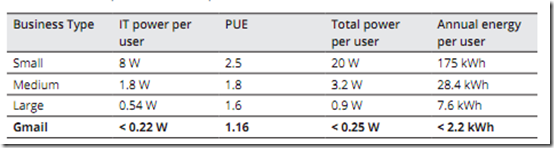
What kind of details?  How about 0.25 watt is the power consumption accounting for a 1.16 PUE.

image

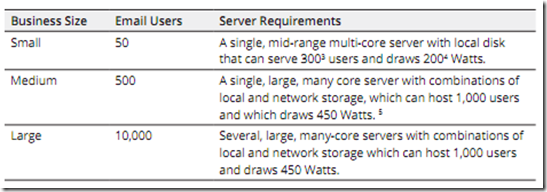
Small, Medium, and Large business sizes were used in the calculation.

image

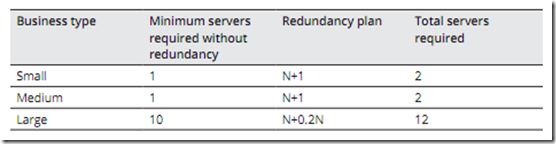
Redundancy calculations are made for each business size.

image

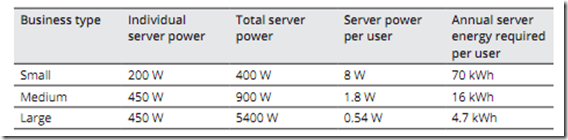
Add all this up accounting for the size of the servers.

image

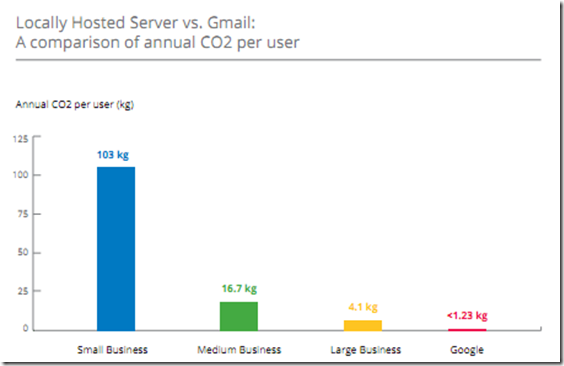
And you get the first graphic on the amount of power per user.  The biggest gain in energy efficiency is for the small business being 10X more energy efficiency, using 10% of the energy if they chose a gmail solution.

image

I use Gmail for my e-mail accounts and map domains for my own e-mail dave(at)greenm(dot)com.  It is nice to know I am consuming a 1/4 watt per account.

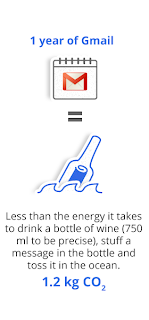
Gmail's Green Data Center footprint in the Cloud, 1 year = 1.2kg CO2

The Official Google Blog has a post on the carbon footprint in a Google's data center to support a Gmail account.

The data Google uses is:

We compared Gmail to the traditional enterprise email solutions it’s replaced for more than 4 million businesses. The results were clear: switching to Gmail can be almost 80 times more energy efficient than running in-house email. This is because cloud-based services are typically housed in highly efficient data centers that operate at higher server utilization rates and use hardware and software that’s built specifically for the services they provide—conditions that small businesses are rarely able to create on their own.

An illustration of inefficient server utilization by smaller companies compared to efficient utilization in the cloud.

Your carbon footprint is most likely larger for the device you use than what is in the cloud.

In calculating these numbers, we included the energy used by all the Google infrastructure supporting Gmail and YouTube. Of course, your own laptop or phone also consumes energy while you’re accessing Google, so it’s important to choose an efficient model.

If you wanted you could reverse calculate the number of users per server you can use the 1.2kg CO2 is X amount of kw-hr.  A Google server with PUE and Overhead and IT infrastructure could be 250 watts per server.  Calculate the # of kw-hrs over a year.  There are most likely 3 instances running your gmail account, so you may need to multiply by three.  Then you can come up with an estimate of how many users can be supported by a gmail server.

Steve Jobs Resignation triggers more traffic

Steve Jobs Resignation has media people coming up with content that discusses Steve's past. One of the entertaining ones for me is getting 833 hits to a blog post I wrote back in May 21, 2010 regarding Google's Vic Gundotra labeling Steve Jobs as "Big Brother."

NewImage

Here is the post that all of a sudden gets 833 hits but is over a year old.

Google's Vic Gundotra labels Apple's Steve Jobs as "Big Brother" A Draconian future, a future where one man...

Google's Vic Gundotra goes on the offensive vs. Apple with a declaration of Steve Jobs as a Draconian Big Brother 1984 theme.  eWeek and many others spread the news.

Gundotra met with Google's Android mobile operating system creator Andy Rubin, who told him that it was critical to create a free, open operating system that would enable innovation of the stack. Rubin also told him that if "Google did not act we faced a Draconian future, a future where one man, one company, one device, one carrier would be our only choice."

One of the rumors I heard was Google was tempted to spoof the infamous Mac 1984 commercial, but decided that was going too far.


Here are screen shots from Vic's declaration of a Draconian Future.

image


Google vs. Microsoft Data Center Videos

Google surprised many with its youtube video released on Apr 13, 2011 on Google Data Center security which has 514,374 views.

I wonder Microsoft’s GFIS data center  video on July 24, 2011 with 49,053 views was created in response to Google’s?

Who will be next?  Amazon…Amazon…Is Amazon data center on YouTube?