Green (Cheap) Backup, Hope was Blu-Ray, What’s Next?

Storage is increasing becoming a green topic.  Archiving is usually thought of last.  Here are a few thoughts on what was a hope, but what next?

With the rapid data growth, DVD backup are not realistic, a hope was Blu-Ray Storage Mojo’s Robin Harris has a few posts.

He hit a nerve as he is 713 comments on this post discussing Blu-Ray is Dead.

Blu-ray is dead - heckuva job, Sony!

Posted by Robin Harris @ 12:31 pm

Categories: Disk drives, Marketing

713 TalkBacks

Blu-ray is in a death spiral. 12 months from now Blu-ray will be a videophile niche, not a mass market product.

With only a 4% share of US movie disc sales and HD download capability arriving, the Blu-ray disc Association (BDA) is still smoking dope. Even $150 Blu-ray players won’t save it.

16 months ago I called the HD war for Blu-ray. My bad. Who dreamed they could both lose?

Snatching defeat from the jaws of victory
Delusional Sony exec Rick Clancy needs to put the crack pipe down and really look at the market dynamics.

In a nutshell: consumers drive the market and they don’t care about Blu-ray’s theoretical advantages. Especially during a world-wide recession.

Remember Betamax? SACD? Minidisk? Laser Disk? DVD-Audio? There are more losers than winners in consumer storage formats.

It’s all about volume. 8 months after Toshiba threw in the towel, Blu-ray still doesn’t have it.

The Blu-ray Disc Association doesn’t get it
$150 Blu-ray disc players are a good start, but it won’t take Blu-ray over the finish line. The BDA is stuck in the past with a flawed five-year-old strategy.

Then he continues the discussion of cheaper/greener backup storage.

What is a storage hungry consumer to do?

Massive removable/transportable storage
Together cheap CD/DVD media, thumb drives and ever-growing file sizes killed floppies, Zip drives and all the other removable magnetic disk media. Removable optical media may be next.

Historically, successful PC removable media have stayed in a fairly narrow capacity band relative to hard drives - somewhere between 10x and 50x. If the average PC has a 500 GB hard drive then a removable media between 10 GB and 50 GB is needed.

Dual-layer DVDs are just on the ragged edge of that number while dual layer Blu-ray could handle hard drives up to 2.5 TB. If Blu-ray will never achieve the ubiquity and low cost of DVDs what will fill the gap?

and, he closes with

The good news: consumers will want to archive. There is a huge opportunity for the company that can figure it out.

Read more

Green IT: Storage Matters

Information Week has an article on storage’s effect on a green data center.

Green IT Beyond Virtualization: Storage Matters

We save more and more stuff, drives get bigger and bigger, yet we must keep buying more disks to keep pace. Meanwhile, energy costs are through the roof. We can't go on like this.

By Behzad Behtash
InformationWeek
November 8, 2008 12:01 AM (From the November 10, 2008 issue)

Second of a three-part series

Is it time to do something radical with your storage infrastructure? Encouraging users to conserve space isn't working. For every conscientious employee who deletes files as defined by policy, three more are charter members of the "keep everything forever" club.

Maybe IT can't do much about these hoarders. But given the need to comply with industry and governmental regulations and, for many, a data storage volume increasing by 50% or more per year with the attendant expenditures on utilities, it's clear something must give.

If you maintain branch offices, as do the majority of the 560 business technology professionals who answered our recent InformationWeekAnalytics survey on business continuity, it may be time to seriously consider consolidation of the storage infrastructure--data center, branches, and disaster recovery sites, everywhere data resides.

While consolidation might have been impractical just 18 months ago, technology that enables consolidation is now better, faster and less expensive, and options such as cloud storage can help as well.

In this second installment in our series of three articles focused on ways to improve the efficiency of IT operations, reduce your overall environmental footprint, lower ongoing expenses, and generally be more green, we'll examine these questions.

Read more

Sun’s Dean Nelson, Applauds Microsoft and Google’s Sharing Data Center Information

I had a chance to interview Sun’s Dean Nelson. Before I could even ask a question Dean started out applauding Microsoft and Google’s efforts to share data center information. Dean continued on that these efforts drive energy efficiency and transparency of what works and what doesn’t.

Given Microsoft and Google’s market presence they are driving awareness and demand for more information.  And, I think Sun is one of the benefactors which is why Dean is becoming a data center star, focusing on opening the data center industry to share #’s.

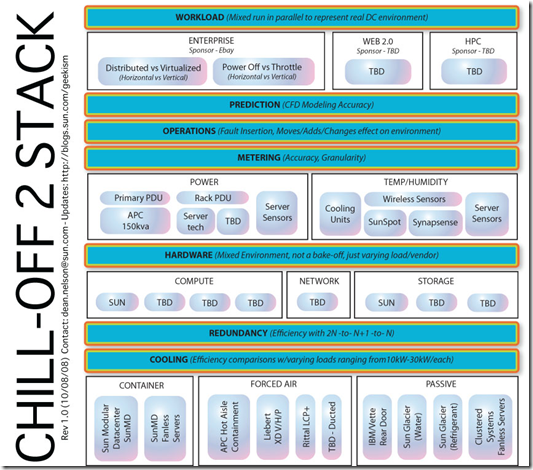
A specific example of Sun’s efforts are the Chill-off where Sun partnered with Silicon Valley Leadership Group and Lawrence Berkeley Labs. This PDF has more info.

image


Other areas where Dean is working on is www.datacenterpulse.com

Data Center Pulse is an exclusive group of global datacenter owners, operators and users.  The goal of this community is to track the pulse of the industry and influence the future of the datacenter through discussion and debate.

And, OpenEco.org

OpenEco.org is a global on-line community that provides free, easy-to-use tools to help participants assess, track, and compare energy performance, share proven best practices to reduce greenhouse gas (GHG) emissions, and encourage sustainable innovation.

image

One of the other areas Dean and I discussed is the inefficiencies of dev, test, pre-production labs.   Here is list of why these labs are inefficient

  1. Few labs are shared resources across a company, as most are dedicated to specific teams who have accumulate the space and equipment.
  2. Most of these labs are in office space and have a PUE in 2.5 – 3.0 range, but no one really knows as the HVAC and power systems are part of the overall office space. (Note: as a piece of trivia I was talking to EPA’s Andrew Fanara and he said part of what got the EPA/Energy Star group interested in energy efficient servers & Data Centers is when the EPA would try to categorize power consumption for buildings, but the exception where those buildings that had data centers in them. Those buildings had power usages that made it difficult to quantify what was an energy efficient building.)
  3. Most labs get the leftover equipment, almost no one puts state of the art equipment in their labs. The exception are a vendor’s demo labs, but these are few.
  4. The number of unused servers that should be decommissioned is just as bad as production environments.  When Sun consolidated its lab space it found 15% of the servers were not being used, but left on from past projects.
  5. Resource usage is extremely cyclical. What happens to all that equipment, when the product ships and the team takes a vacation.  Does anyone turn off the lab?
  6. Limited lab budgets force lab staff to make due with what they have.  Their focus is just get it working.  Production issues are to be looked at later.
  7. No energy monitoring of lab space.  This is changing, and I am having fun working with a few companies who are putting systems together, but it is still in the early days.

You add all this up, and one of the most wasteful areas that has the potential largest ROI percentage are these labs. Virtualization has a high % of adoption in lab environmetns, and is an ideal place to start using Cloud Computing Utility type of paradigms.  IBM has their offering in Rational Test Lab Manager, so you can look for more vendors to do the same.

It as quick conversation, but hopefully the first of many.

I do agree with Dean that Microsoft and Google are making the industry better for all us, except those people who think Microsoft and Google are the enemy.

Read more

Server Vendors Push Cloud Computing

WSJ has an article about the server vendors push towards Cloud Computing.  All the big boys, HP, Dell, IBM, and Sun have started data center practices.

Firms Push 'Cloud Computing'

By SCOTT MORRISON and BEN CHARNY

Last month, Microsoft Corp. became the latest entrant to cloud computing -- in which consumer and corporate IT services are provided over the Internet, rather than loaded onto individual PCs or corporate computers. Microsoft said it will use specially designed, high-density Dell servers to power the data centers behind its new Azure service, which will run online applications on behalf of start-ups and large companies.

Cloud computing is also fueling an investment boom by Internet players like Google Inc., Yahoo Inc. and Amazon.com Inc., which are building massive data centers to deliver consumer Web services and flexible access to powerful computer and storage resources for corporations.

One of the points made.

Forrester Research analyst James Staten said the emphasis on data center systems will require computer makers to rethink their approach because they currently are structured to sell relatively small enterprise systems to a large number of corporate customers. The advent of massive data centers will force them to now focus on winning a fewer number of huge contracts.

"If Microsoft is going to build another 1 million square foot data center and you lose that contract, that's a big loss," said Mr. Staten. "The stakes are a lot higher."

Cloud Computing has the potential to consolidate data centers into more efficient utility service based model.  As Amazon Web Services team has discovered, there is a hybrid approach as well, where companies use the cloud computing for some areas, and keep their own data center for baseline services.

Read more

HP Server Power Capping

I was reading HP’s press announcement on HP Thermal Logic.

HP Cuts Costs, Triples Data Center Capacity with New Energy-efficiency Technologies, Services

HP today broadened its Green Business Technology initiative with additions to its HP Thermal Logic portfolio that include power-capping server technologies and energy-efficiency services designed to reduce costs and extend the life of data centers.

In traditional data centers, customers invest millions in capital expenditures to create a redundant power infrastructure that maximizes uptime. Additionally, to ensure power availability, IT administrators overprovision server energy.

Given few people appreciate the problem’s the data center facilities staff have to balance power load across circuits, and some zealous virtualization designs to move IT load, HP has an answer by Power Capping their servers.

HP Dynamic Power Capping helps customers reallocate power and cooling resources in the data center by dynamically setting or “capping” the power drawn by the servers. This eliminates the need for overprovisioning by precisely identifying how much power is actually required to run each server and setting a limit based on that usage. As a result, companies reclaim their overprovisioned energy to improve the capacity of their data center.

HP is even promoting it is going to be energy star compliant.

HP is among the first companies working with the U.S. Environmental Protection Agency (EPA) to qualify servers with an ENERGY STAR® rating. New HP ProLiant and BladeSystem servers are expected to meet or exceed ENERGY STAR standards by early 2009.

DataCenterKnowledge has more info as well.

Read more