HP’s First ENERY STAR Servers

TheRegister has an article about HP and Dell’s ENERGY STAR Servers.

HP and Dell claim energy efficiency server firsts

Power test pass with a catch

By Timothy Prickett MorganGet more from this author

Posted in Servers, 6th July 2009 20:40 GMT

Getting IT vendors to agree to any standard, even one that they have a big hand in shaping, is almost impossible. And so it is with the new Energy Star specification for servers, supposedly embraced by server makers to show the energy efficiency of their metal.

The Energy Star specification for servers, which debuted in May, is designed to gauge server power consumption so IT managers can shop for the most energy-efficient machines using an agreed yardstick. In this case, a yardstick established by the US Environmental Protection Agency's popular Energy Star program.

HP has their own site for ENERGY STAR servers.

image

image 

Part of the ENERGY STAR specification are data sheets.  Here are a few HP has published.

HP ProLiant DL360 G6

HP ProLiant DL380 G6

Access Power, Thermal and Utilization Parameters

Read more

Facebook Technical Operations VP Jonathan Heiliger tells Server OEMs “You guys just don’t get it,”

GigaOm has an interview with Facebook VP Jonathan Heileger.

Heiliger had strong words for OEMs and system builders during his chat with Om. To compete with sites like Facebook and Google, Heiliger said, OEMs and system builders need to be more power- and cost-efficient. “You guys just don’t get it,” he said, adding that Facebook has reaped success from investing heavily in its infrastructure.

InternetNews focused on the Intel and AMD dig.

Intel, AMD Get Thumbs Down from Facebook

Head of the social network's technical operations say the latest and greatest from Intel and AMD don't make the grade.

June 25, 2009
By Andy Patrizio: More stories by this author:

SAN FRANCISCO – Intel and AMD just got a nasty smackdown from the person who run's Facebook's datacenters, saying the chips don't deliver on their promises.

Jonathan Heiliger, vice president of technical operations for Facebook, was being interview by GigaOm Network founder Om Malik here at the GigaOm Structure 09 conference. Malik asked him about unexpected problems in managing the fast-growing company's datacenters.

Reps from Intel (NASDQ: INTC) and AMD (NYSE: AMD), both running panels and present at the show, must have clenched their teeth when they heard this:

"The biggest thing … was less-than-anticipated performance gains from new microarchitectures, so new CPUs from guys like Intel and AMD. The performance gains they're touting in the press, we're not seeing in our applications," Heiliger told the audience.

He didn't let the tier one server vendors off any easier. "I'm not sure if I'm embarrassed or pleased for OEM vendors in the audience, but you guys don't get it. To build servers for a company like Facebook and Amazon, and other people who are operating fairly homogeneous applications, they have to be cheap and super power efficient," said Heiliger.

He added he's not sure why hardware vendors fail at the job, but thinks customers need to step up and apply pressure. ""Perhaps in the coming months we'll see more collaboration with people running small clusters and large clusters," he said.

Read more

Netbook, Small and Disruptive – Always Connected Servers and Devices

Economist has an article on netbooks titled “Small and Disruptive.”

Small but disruptive

Jun 11th 2009 | SAN FRANCISCO AND TAIPEI
From The Economist print edition

Laptops are evolving—and forcing the rest of the computer industry to change

Imaginechina

IT WAS like waiting for Godot: in the end, the great man did not come. The crowd at Apple’s jamboree in San Francisco this week was visibly disappointed when Steve Jobs, the computer-maker’s legendary chief executive, did not even put in a brief appearance after a six-month medical leave. But another no-show was perhaps more important. Proving many techno-pundits wrong, Apple did not present a “tablet”—a pared-down computer in both size and abilities, with a touch screen. Had it done so, it might have helped settle a question that has preoccupied the personal computer (PC) industry for some time: are netbooks—cheap and basic laptops that are flying off the shelves—just a fad, or the future?

The answer is probably both, as an “iPad”, or whatever Apple’s device may be called, would have demonstrated. Netbooks are already being supplanted by a plethora of new gadgets, including tablets and increasingly computer-like mobile phones (see article). But the idea they embody, that a near-permanent connection to the internet permits simpler technology, is already changing the economics of the PC business.

As companies build low power devices that can be on all the time, connected to servers on all the time there is a disruption in the industry. Energy efficient devices that can be left on all the time are changing how people use computers and what the expect.  It is no longer the common case of I am going to sit at my PC to use Word or Excel.

Yet although netbooks have acquired many frills and mutated into new forms, the theory behind them endures: computers do not need to be stuffed with the latest whizz-bang technology if they have a high-speed connection to the “cloud” of services available online. At Computex firms showed devices equipped with WiMAX, a new wireless technology that allows for fast, ubiquitous wireless connections.

It is this combination of connectivity and cloud computing that makes netbooks and their successors so disruptive. Some mobile-network operators now throw in free netbooks if subscribers sign up for a mobile-broadband contract. This will put further pressure on prices, since mobile operators have more bargaining power than individual consumers, although it also opens a huge new distribution channel for computer-makers.

I recently participated in a NDA video shoot for a new product 6 months out which fits in this category, and it got me thinking more on this subject.

So, I placed my order for an iPhone 3G S which I’ll get on June 19..  My Apple friends will be happy to see after all the years at Microsoft, I’ll be back to using an Apple product.

Read more

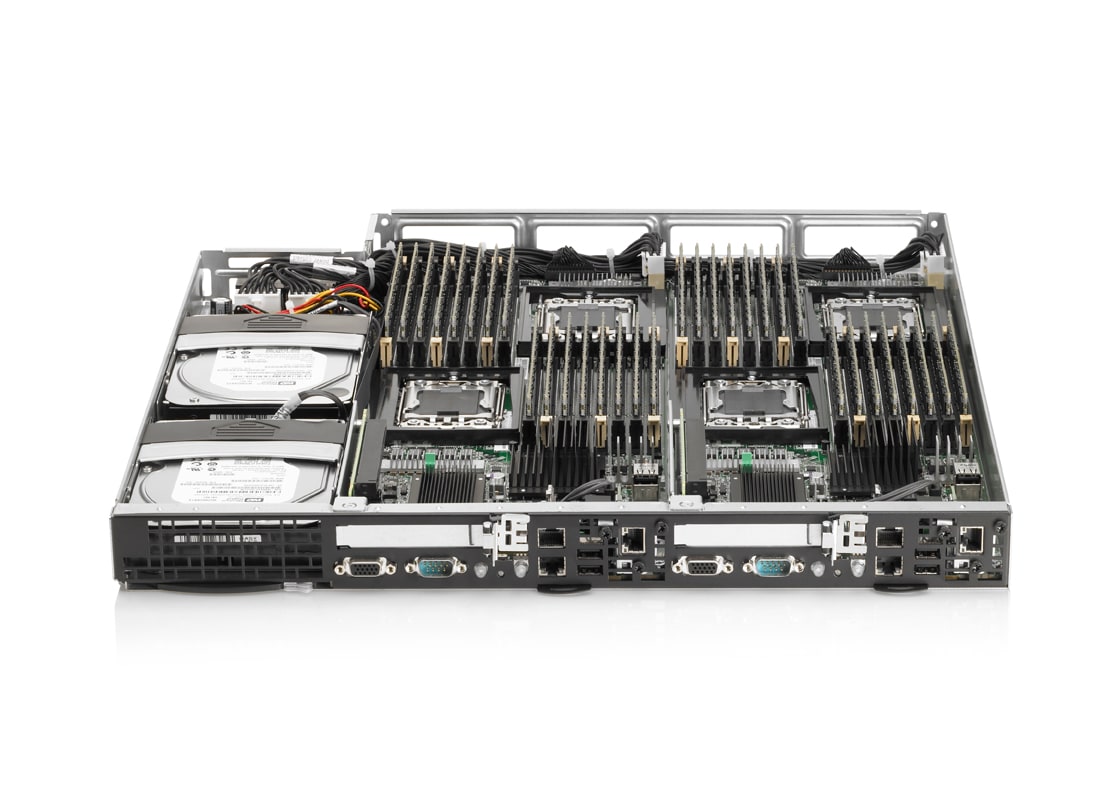
HP Proliant Z6000 G6, 28% Power Savings, 31% lighter - Higher Performance per Pound

When you look at HP’s new scale out servers ProLiant Z6000 G6.

image

you don’t see any fans or power supply. 

The module plugs into the power and cooling infrastructure

image

In this fact sheet.

Delivering unrestricted airflow through a shared power and cooling infrastructure in a 2U chassis lessens fan load, resulting in a 28 percent power decrease per server compared to traditional rack-based servers.(1)

and HP put the server on a scale

Removing up to 31 percent of weight per server and up to 838.5 tons of data center weight,(2) while reducing shipping as well as construction costs with a standardized, shared infrastructure.

the cabling’s been moved to front to improve access and airflow.

Reducing service and maintenance costs with front system cabling that allows easy access to key system components.

There are power sensors.

image

And air pressure sensors.

image

Read more

HP High Efficiency Cloud Infrastructure Servers, Moving Away from Blades, Learning from Data Center Operation

Notice how IBM, Dell, Rackable, and Dell’s high efficiency cloud infrastructure servers are not blade enclosures?  Maybe it’s because HP’s data center design group who creates solutions like this

image

are figuring out how inefficient blades are for Cloud Computing. Quoting HP’s press release.

With the HP ProLiant SL portfolio, customers can cut acquisition costs by 10 percent and power draw by 28 percent, while doubling their compute density.(2)

“Customers with scale-out business models need solutions that make every dollar, watt and square foot in the data center count,” said Christine Reischl, senior vice president and general manager, Industry Standard Servers, HP. “The HP ProLiant SL offers pioneering customers like these the most significant design innovation since the blade form factor, allowing them to achieve an economy of scale never before possible.”

And, HP includes an IDC quote.

“Businesses built on extreme scale-out environments, such as cloud, Web  2.0 and HPC, operate at maximum transaction volume and low margins,” said Michelle Bailey, research vice president, IDC. “These customers have very distinct and unique data center requirements, specifically around energy efficiency, cost and time to market. The introduction of technology solutions such as the ExSO portfolio from HP are specifically addressing customer requirements for optimizing capitol expenditures while lowering ongoing operating costs. As a result, these solutions are helping to redefine data center economics.”

The problem with blades is high density computing created hot spots with problems airflows.  But, this behavior to use blades was driven by chargeback models that used rackspace occupied.  Which artificially can bring down IT costs when in reality it increases costs. Just read the above quotes again, on how these latest servers are the most efficient.

Note in this picture how the removal of a Proliant SL is similiar to a what a blade removal picture would be.

image

One great thing about Sun, HP, Dell, and IBM all getting into the data center design business is these companies are learning what the impact is  of their hardware.

Wow think about this. For the first time many Server OEMs are building data centers to host their hardware, and they need to build hardware that works best in their data centers. Whoever can create the most efficient systems has a competitive advantage.

This is what Google does.

There is a new competition in data centers, and has a higher probability of a green data center.

Hey this will make a great white paper/presentation.

Read more