Another reason use for Google's expanding data center capacity, Home Entertainment Device

WSJ reports on Google's new home entertainment device.

Google Developing Home Entertainment System

Google Inc. is developing a home-entertainment system that streams music wirelessly throughout the home and would be marketed under the company's own brand, according to people briefed on the company's plans.

The effort marks a sharp shift in strategy for Google, which for the first would time would design and market consumer electronic devices under the Google brand. The company has up to now mainly focused on developing the operating system that powers devices such as smartphones, tablets and televisions and allowing other companies to build and brand the hardware that uses it.

Google's Android unit has led a multi-year effort to develop the new entertainment device, which is expected to be unveiled later this year, people familiar with the matter said.

Seems like Google and Apple are more on a collision course.

Partnerships between Google and device makers have made Android the No.1 operating system in smartphones in the U.S. and helped Google to extend its Web-search engine and other applications into devices beyond PCs. Google doesn't generate any revenue from sales of the devices.
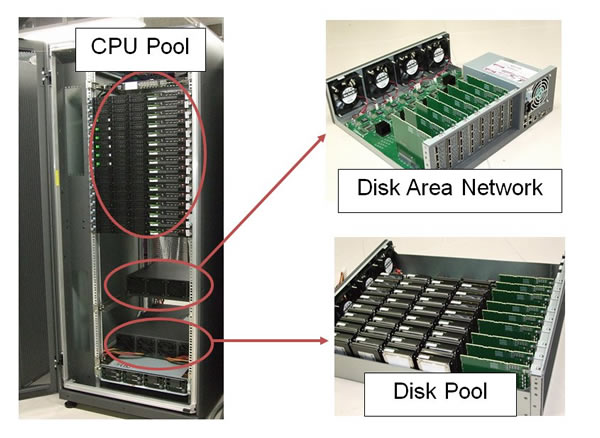
Fujitsu's Prototype Server pools CPUs and Hard drives for a flexible and performanec

Fujitsu has a web page on its new server prototype that pools CPU and Hard drives.

In the Tech product showcase I'll see if I discover more than is on the website.

September 26, 2011
Fujitsu Laboratories Ltd.

Fujitsu Develops Prototype of World's First Server that Simultaneously Delivers High Performance and Flexibility

Proprietary resource pool architecture enables the development of new ICT services

Kawasaki, Japan, September 26, 2011 — Fujitsu Laboratories Limited today announced the construction of a next-generation server that, using resource pool architecture, is the world's first to succeed in the simultaneous delivery of high performance and flexibility.

NewImage

NewImage


System (Server) on a Chip company comes out of Stealth Mode - Deca Technologies

WSJ has a post on TJ Rogers of Cypress Semiconductor starting a new company that can integrate multiple chips on wafer.

Cypress Semiconductor CEO T.J. Rodgers is a well-known maverick in the chip business, who played a sizeable role in the solar-power market with a spinoff called SunPower. Now he’s putting his weight behind another startup that is announcing its plans Wednesday after laboring two years in secrecy.

It’s called Deca Technologies, and the goal is to transform the way chips are packaged for use in products such as smartphones and computers.

Cypress Semiconductor
T.J. Rodgers

Packaging is an unglamorous part of the semiconductor business, which typically takes place after the higher-profile operation of processing chips on silicon wafers. After wafers are sawn into individual components, the chips are typically flown off to different facilities where they are encapsulated in plastic and metal modules that can be attached to circuit boards for use in a system.


The articles focuses on the mobile market, but the same technology could be applied to servers on chip.


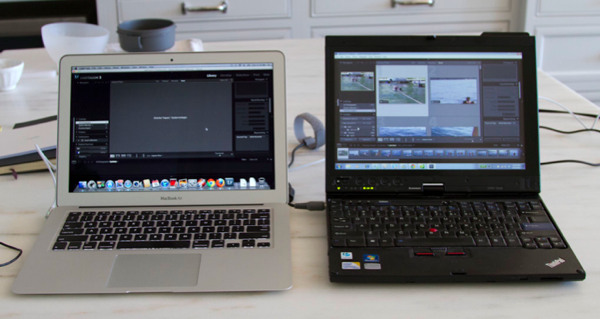
Blogging on a MacBook Air OSX Lion vs. Lenovo WIndows 7, part 1

About 3 months ago I bought a MacBook Air and posted on my transition.  Disclosure: I am biased.  I worked on the MacOs at Apple from 1985 - 1992, and Windows OS at Microsoft from 1992 - 2001.  In 2001, Windows XP was my last client OS, and I switched to work on servers and enterprise management from 2001 - 2006, and refused to use Windows Vista Beta. :-)

So, am i religious on the Mac vs. Windows?  i understand and appreciate the different perspectives

Think Different switch back to the Mac from Windows

I worked at Apple from 1985 to 1992.  The Mac was introduced in 1985 and 1991 Apple shipped System 7. I spent much of time working on Mac OS 6.0.x and System 7 was years of being immersed in Mac development.  When I moved to Microsoft to work on Win3.1 my coworkers and I spent much of time using Macs as we were working TrueType and the vast majority of tools where on the Mac.

Even though many of my friends used Macs I didn't take the time to switch.  But, yesterday I switched to a 3rd generation MacBook Air and the Lion OS.

NewImage

Back when I made the switch I was loyal to Windows Live Writer as my blogging tool.

I have written a few blog entries with MarsEdit.  Downloaded photos from my Canon 7D.  Installed Office, Aperture, Lightroom as well.

I was much faster writing with Windows Live Writer, but it's only my  second day switching back to the Mac after almost 19 years.

I have Parallels installed on the MacBook Air with Windows 7 and Windows Live Writer, and guess what I have not fired up Windows 7 with Live Writer for the last month.  Marsedit is not perfect as a blogging tool and there are some features that I like on Windows Live Writer, but they are not worth the time to switch to Windows 7.

I'll write another post on the specifics of using Marsedit vs. Live Writer.

It took me about a 6 weeks to get really comfortable with the MacBook Air and OSX Lion, but keep in mind again I worked at Apple so I was a loyal religious Mac User before.

One thing I am quite pleased with on the MacBook Air is the 256GB SSD integration.


SSDs arrive in the Public Cloud, Is CloudSigma starting a new trend

I speculated a year and half ago that AWS would add SSD, but I was wrong and AWS added HPC instead.

GigaOm reports on CloudSigma adding SSD support.

CloudSigma adds SSDs to its public cloud

Cloud provider CloudSigma has become the first to add solid-state-drive storage to its public cloud computing service. SSDs (aka flash memory) are well known for their ability to significantly increase storage I/O performance and decrease power consumption when compared with hard disk drives, but until recently they have been too expensive for consideration in most data centers that aren’t backed by serious computing needs and deep pockets. That’s starting to change with the advent of new companies promising ever-lower prices on enterprise-grade flash storage, but making flash available as a service to cloud customers is still relatively unheard of.

There is mention of the lower power consumption, but the key is performance.  BTW, part of why I like my MacBook Air is its 256GB SSD that makes my machine outperform my other laptops.

The SSD is meant for high performance areas of the cloud.

At this point, CloudSigma is targeting its flash offering at tiered storage environments in which companies place “hot” data or data that requires high I/O throughput on flash, while keeping less-performance-intensive data and backup operations on hard disks.