Mike Manos provide background on his Call to Action to stop being Donkeys

I blogged about Mike Manos’s talk at Uptime last week.

Mike Manos keynote question are you Donkey or a Chaos Monkey?

FRIDAY, MAY 13, 2011 AT 5:42AM

Mike Manos gave a keynote at Uptime Institute in his new role at AOL as VP of Technology, and was back with his entertaining presentation style.  Mike's talk was on "Preparing for the Cloud: A Data Center Survival Guide", but Mike wisely changed his presentation to challenge the attendees to stop being Donkeys.

And, Mike just posted his own summary of his observations at Uptime.

Chaos Monkeys, Donkeys and the Innovation of Action

May 19, 2011 by mmanos

Last week I once again had the pleasure of speaking at the Uptime Institute’s Symposium.  As one of the premiere events in the Data Center industry it is definitely one of those conferences that is a must attend to get a view into what’s new, what’s changing, and where we are going as an industry.  Having attended the event numerous times in the past, this year I set out on my adventure with a slightly different agenda.

One of the best parts Mike posts is his observation of the patterns he saw.

By listening the audiences, the hallway conversations, and the multitude of networking opportunities throughout the event a pattern started to emerge,  a pattern that reinforced the belief that I was already coming to in my mind.   Despite a myriad of talk on very cool technology, application, and evolving thought leadership innovations – the most popular and most impactful sessions seemed to center on those folks who actually did something, not with the new bleeding edge technologies, but utilizing those recurring themes that have carried from Symposium to Symposium over the years.   Air Side economization?  Not new.   Someone (outside Google, Microsoft, Yahoo, etc) doing it?  Very New-Very Exciting.  It was what I am calling the Innovation of ACTION.  Actually doing those things we have talked about for so long.

As Mike says.

As you contemplate your own job – whether IT or Data Center professional….Are you a Donkey or Chaos Monkey?

Think about People in the Data Center, A book on people skills in IT

ZDNET has a post on people skill in IT.

If you work in IT, you're in the people and influence business

By John Hazard | May 16, 2011, 2:30am PDT

Summary

The prevailing view is that IT is a business where abilities matter more than presentation skills or personal interactions. Wrong.

Wrong

Your aptitude should speak for itself. You shouldn’t have to dress a certain part or act a certain way to get a job done or advance your career. Your performance should speak for itself and people should trust you to do the job.

That is a prevalent thought in information technology, a business where the promise was that nerds could excel and science geeks could thrive on their abilities not their presentation skills or personal interactions.

Wrong, says Don Crawley. IT is very much a people business and successful IT pros rely on their ability to present themselves and influence those around them as much as any technical skill.

Don Crawley has a book on this subject.  I don’t know anything about the book, but I like there are more people understanding the people issues in IT. 

Mike Manos keynote question are you Donkey or a Chaos Monkey?

Mike Manos gave a keynote at Uptime Institute in his new role at AOL as VP of Technology, and was back with his entertaining presentation style.  Mike's talk was on "Preparing for the Cloud: A Data Center Survival Guide", but Mike wisely changed his presentation to challenge the attendees to stop being Donkeys.

Watch this video where Mike makes the point too many people behave like a donkey, like Eeyore and they are depressed about the coming of the Cloud.

Eeyore is generally characterized as a pessimistic, gloomy,depressed, anhedonic

Mike Manos Don't be Donkeys

Here is background on why Mike is calling out the Donkey analogy and how he was inspired for this talk..  at 3:45 mark is where the Donkey/Eeyore idea is mentioned.

Mike Manos Listening to the Uptime Audience

Mike challenges the tag line "disrupted data center" as most of what is being discussed this week was discussed last year and the year before.

Mike Manos disrupted data center

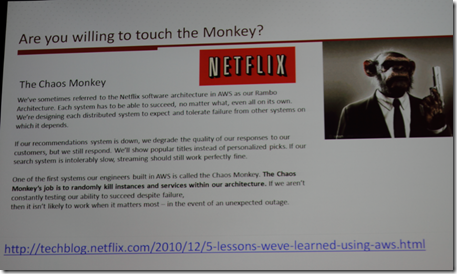
Mike uses Netflix's Chaos Monkey as a response to being a donkey.

The best way to avoid failure is to fail constantly.

We’ve sometimes referred to the Netflix software architecture in AWS as our Rambo Architecture. Each system has to be able to succeed, no matter what, even all on its own. We’re designing each distributed system to expect and tolerate failure from other systems on which it depends.

If our recommendations system is down, we degrade the quality of our responses to our customers, but we still respond. We’ll show popular titles instead of personalized picks. If our search system is intolerably slow, streaming should still work perfectly fine.

One of the first systems our engineers built in AWS is called the Chaos Monkey. The Chaos Monkey’s job is to randomly kill instances and services within our architecture. If we aren’t constantly testing our ability to succeed despite failure, then it isn’t likely to work when it matters most – in the event of an unexpected outage.

image

Are you a Donkey or Chaos Monkey?

Mike and I had a chance to talk about the reaction of people to his talk.  He had tons of people come up and say how they loved his talk.  Mike figured he had 50 people confess they were donkeys.  The funny thing is the guys I were hanging out during Mike's talk admitted they are chaos monkeys.  

Why are Donkeys so bad?  Because they slow down the movement of a group.  Consider this article on how groups disrupt crowd flow.

Secret of Annoying Crowds Revealed

by Dave Mosher on 7 April 2010, 5:00 PM

Get in line! People self-organize in crowds, often without thinking about it.

Push, shout, or politely excuse yourself all you want, but those slowpokes in your way just won't budge. A new study shows a long-neglected reason why: Up to 70% of people in crowds socially glue themselves into groups of two or more, slowing down traffic. What's worse, as crowds gets denser, groups bend into anti-aerodynamic shapes that exacerbate the problem. The study may be a boon to urban planners.

It is interesting to think of movement of ideas in the data center space like a crowds of people moving.

Uptime's Pitt Turner quickly adjusted his follow on to Mike Manos's call to action by telling people to take action and stop being donkeys.  But, telling people to move faster in a crowd can do more harm than good.

The study also determined that those who ask others to move faster actually do more harm than good. “You're contributing to chaos. Crowds are self-organized systems, so when you don't cooperate, the system breaks and you slow everyone down,” Moussaid concludes.

It was great to see Mike back in action and catch up.  I told Mike he should try and focus a presentation on the question of are you a Donkey or a Chaos Monkey?  It is a great topic that gets people thinking.

I think of my readers as more in the Chaos Monkey crowd.  I hope you do too.  I know I have too much fun creating making trouble.  I want one of the AWS Chaos Monkey T-shirts.

Designing a Cloud Friendly Data Center, Jim Kennedy RagingWire & Peter Panfil Liebert

Considerations to think about in Cloud Data Centers is how Jim and Peter kicked off their presentation of what a cloud data center is.

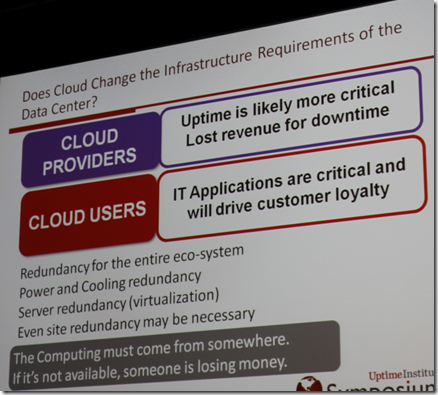
Jim made an interesting point that RagingWire stopped using the Tier rating system in its data centers as it confused the users.  RagingWire's focus is illustrated in the following slide where redundancy of the entire eco-system is a requirement.

image

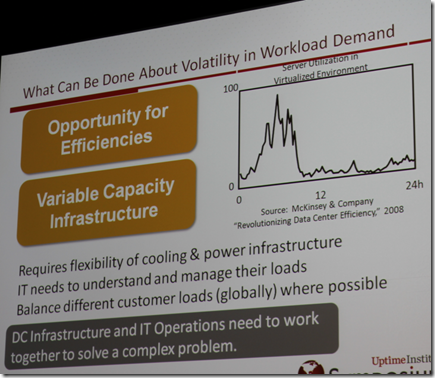
To create a cloud data center Jim makes the point that the data center needs to be more sensitive to the load being run.  And the last point made below is a difficult one - getting "DC infrastructure and IT operations to work together to solve this complex problem."

image

I just wrote about the separation between Facility Ops and IT, so I share many of the same views Jim and Peter are sharing.

Blue Collar vs. White Collar, understanding the separation between data center ops, IT, and business units

WEDNESDAY, MAY 4, 2011 AT 7:08AM

I posted on the idea of a System Program Manager in the data center.  In the same conversation I referenced, my friend and I were discussing how different data center ops is versus IT, let alone the business units who don't get their hands dirty. Getting your hands dirty is viewed by many as beneath them.

After listening to Jim and Peter, I have a simple way to explain what a Cloud Data Center is ... The Cloud Data Center takes what is typically separate groups roles and integrates the individuals into a more efficient team.  A team to provide data center services so customers get better uptime and availability for a given cost.   How well the team functions has a direct relationship to how well the cloud data center runs.  Cloud is IaaS, PaaS, SaaS are integration of teams to provide a service.

How many data center problems occur because individuals don't communicate as much as they should?  All it takes is one individual's mistake to bring down the whole team.

Blue Collar vs. White Collar, understanding the separation between data center ops, IT, and business units

I posted on the idea of a System Program Manager in the data center.  In the same conversation I referenced, my friend and I were discussing how different data center ops is versus IT, let alone the business units who don't get their hands dirty. Getting your hands dirty is viewed by many as beneath them.

get your hands dirty  (informal)

to involve yourself in all parts of a job, including the parts that are unpleasant, or involve hard, practical work Unlike other bosses, he's not afraid to get his hands dirty and the men like that in him.

Then we discussed the idea of a blue collar worker.

What Does Blue Collar Mean?
A working-class person historically defined by hourly rates of pay and manual labor. A blue collar worker refers to the fact that most manual laborers at the turn of the century wore blue shirts, which could hold a little dirt around the collar without standing out.
This working class stands in contrast to white collar workers, which historically have had the higher-paying, salaried positions to go with their clean and pressed white shirts.

So, we asked the question is the hourly work force, the people who get their hands dirty touching the facilities like a Blue Collar worker?  Could the same be implied for IT hardware and IT software?

In addition much of the blue collar work will be outsourced to outside companies. Is the separation between data center ops, IT and business units the same type of behaviors that exist in other industries between the blue collar and white collar workers?