Stress Testing the Kitchen, 12 pizzas cooked for Construction Party

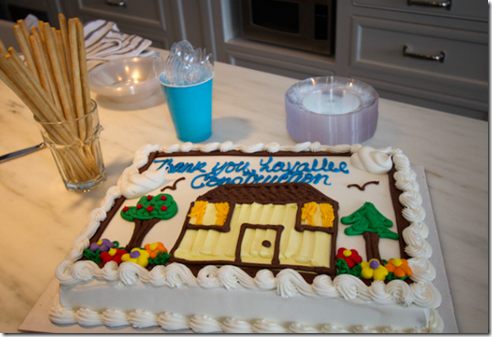
I've been practicing with my pizza oven and have cooked quite a few pizzas for data center friends with four pizzas cooked at the most.  Last night we had a party for our construction party.

image

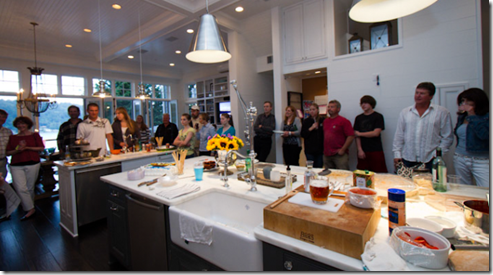
With all these people, 1/2 of the people there are in the picture below.  We needed to cook more than 4 pizzas.  12 is what we cooked, but I had enough dough for 15.

image

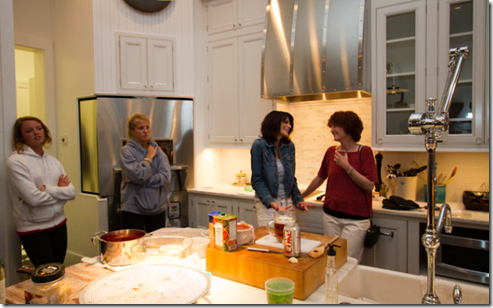
Here is a view of the kitchen after finished cooking the dozen pizzas.

image

Luckily I had help cooking the dozen pizzas.  I can cook a pizza in 6 minutes, rotating the pizza after 3 minutes, then load another pizza, cooking 2 pizzas at the same time.  I needed some help preparing, cutting, and serving the pizzas while I focused on cooking.  Margaret and Maddy were our hired help, and are part of the kids swim group.

image

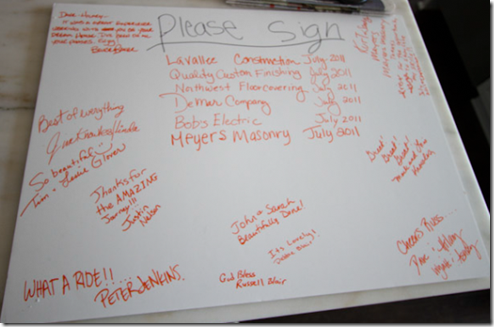
Our construction company was Lavallee Construction, http://www.lavalleeconstruction.net/.

image

image

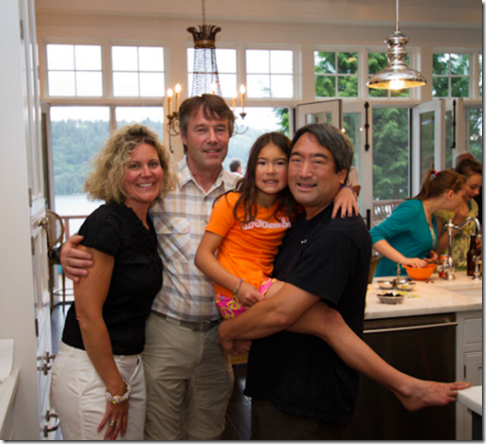
Here is Russ Lavallee with the family.

image

except for my son who was socializing his new look.

image

Now that  I cooked 12 pizzas, I'll see if I can cook 20 pizzas.  In theory I could cook the 20 pizzas in an hour, but find about 10 an hour a good enough pace.  I never thought I would say I feel comfortable cooking 10 pizzas an hour at home.  Tonight is an easy night, I just have three pizza doughs for cooking.

Organizational Charts- Google, Amazon, Apple, Facebook, Oracle, and Microsoft

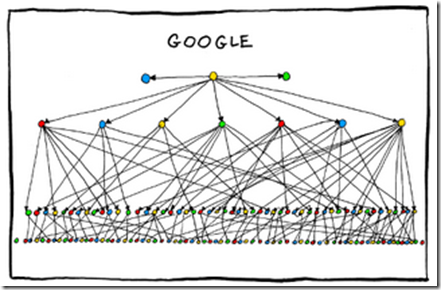
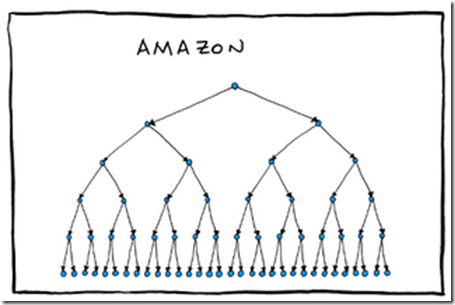
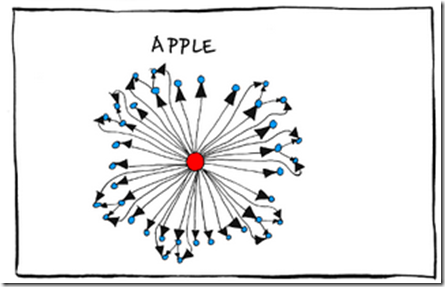
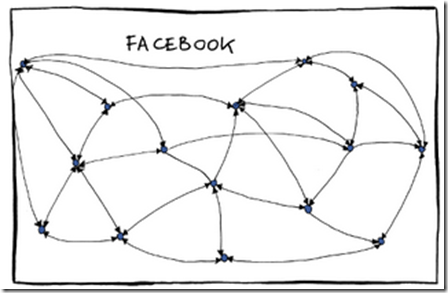
Here is a post a a friend shared on some tech companies organizational Charts.

I don't know about you, but I couldn't have done any better to add humor to how companies can look.

Google's shows a complexity in the hierarchy.

image

Amazon has simplicity that comes from a Retailer with separate business units.

image

Apple shows how the world revolves around the red dot - Steve Jobs.

image

Facebook is different version of a flat organization.

image

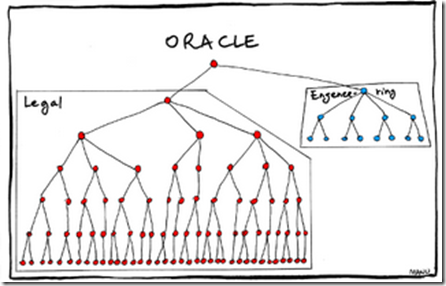
Oracle shows the power.  the power of Oracle Legal.

image

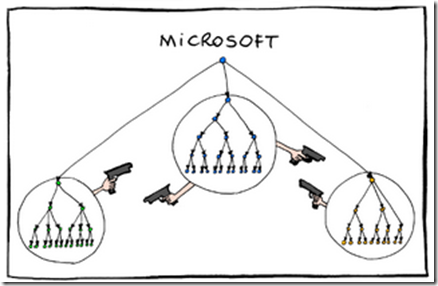
And, Microsoft.  This is one way to explain business units (Windows, Office, and XBOX) survival tactics.

image

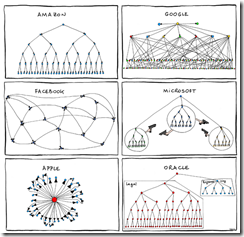
The complete original post is here.  But, it was more fun to break up the sections.

image

CA Technologies, a cloud player most don’t think about

CNET has an article about CA Technologies focus on cloud computing.  Check out this statement.

As a side note, I've always thought of CA as a place where software goes to die--an image that the company is well aware of and working to fix. I was impressed with the focus and forward-looking comments from both Fry and Debra Danielson, senior vice president of mergers and acquisitions, and I expect to see them be more aggressive about marketing their cloud-oriented products.

The article is about a discussion with Jay Fry, VP of marketing for cloud computing.

Jay Fry, VP of Marketing, Cloud Computing Business, CA

At this week's Structure conference in San Francisco, I spoke with Jay Fry, vice president of marketing for cloud computing, about what the company is doing to address the burgeoning cloud marketplace. (The company changed its name last year from CA, and before that it was Computer Associates.)

According to Fry, this year is about figuring out what customers really want--not just from CA Technologies, but from any vendor focused on the emerging cloud market. Enterprise users are trying to keep things under their control while service providers are looking to get users connected to their services. The rate and pace of cloud adoption are very different depending on the use case.

I’ve known Jay Fry since his days at Cassatt, a company CA acquired and Jay came over.  Jay is a data center guy and I’ve chatted with Jay at Gartner Data Center, Uptime Symposium, Structure, and even at a Starbuck’s when we have been able to connect our schedules when we are both in the bay area.

It is nice to see a write-up on what I have learned in my conversations with Jay.  If you haven’t thought about CA Technologies as a cloud player, you should.

First task if you are building your first data center, fire the executives

I am spoiled spending a bunch of time with executives who have built many data centers which also means we spend time in bars and talk about all kinds of stuff.  What is one of the most hilarious observations is watching what occurs when companies build their first data centers.  The mistakes are funny, but expensive.  Chatting with a guy who has built more than many would build in a lifetime, it hit me.  "How about if the CFO/CEO fired the IT data center staff as the first step after the data center project is approved?  Then went out to the data center community to hire a free agent, experienced data center expert who knows how to design, build, and operate data centers."

Why would you do this?  Because, as soon as the data center project is approved, the #1 goal of the DC project team, composed of the real estate, facilities, and IT staff is not to lose their job in one of the biggest projects they have ever done.  As opposed to the #1 goal of an experienced executive is to design a data center which aligns with the business model of the company.  They have worked on many different version of data centers and know the trade-offs made in design that affect performance, cost and operations.  They have the confidence of experience and are not scared of losing their jobs as they know there is a long line of people who would hired them.

Morale could be bad when you fire the top guys, but don't get rid of the people who do the work.

The rank and file at Patni must have grown nervous seeing you fire so many executives. How are you handling employee morale?

First, I've done a lot of town halls. Second, I've made it very clear that beyond the executive level, I'm not letting anyone else go. Third, we've shown a huge difference in transparency between the way we do things and the way Patni did. That's gone a long way with people. Things are quite positive right now, but it will take a few quarters to work everything out. If we grow revenues quickly enough, people will trust us.

If you hired top data center talent for $500,000 a year salary with a two year contract you will save this big salary cost before you even start operating the data center as an experienced data center executive knows the way the numbers work in data center design, construction, and operations.  You could subscribe to all the consulting, analyst, and vendor advice you want, but very rarely do you find someone who has actually been the end user who has design, build and operate data centers.  There are about 7 guys who come to mind that could be data center free agents which are the same guys I thought of that use good management practices.

Robert Gates's 7 management rules for managing the Pentagon, some good ideas for Data Center Executives

TUESDAY, JUNE 21, 2011 AT 10:36AM

I am lucky to spend a lot of time with some really good data center executives.  When I read this WSJ article on Robert Gates's 7 rules for managing the Pentagon it reminded me a lot methods I see these guys using.  I can name about 7 guys who use these methods.  Can you?  One who used these rules is my dear departed friend Olivier Sanche.

The ironic part of using this strategy is the data center team who is looking to build their first data center may rethink how it approaches the data center project if they think they may be fired and replaced by an experienced data center executive.

The funny thing about this idea is I got a bunch of people thinking they would be up for the free agent data center position if became an industry standard practice.  And, the guys who would be most scared is the data center consultants, analysts, and vendors as the free agents shift the negotiating power.

Posting this blog may put at risk my working for a first time data center executive, but the CFO/CEO may contact me to ask who a data center free agent is and what they could do.  And, I actually enjoy having CFO data center discussions as they ask good questions on how to spend their money.
Facebook invites Goldman Sachs, Rackspace, AMD, and Microsoft to speak at Open Compute Summit, announces Open Compute Foundation non-profit

In Facebook's summary of the Open Compute Summit, they mention a community of presenters - Rackspace, Goldman Sachs, AMD, and Microsoft.

As a part of growing the community, the following people shared their perspectives:

  • Joel Wineland and Bret Piatt from Rackspace shared their thoughts on how Open Compute Project servers could fit into their data center business. What was really awesome is that Rackspace benchmarked our Open Compute Project AMD 1.0 servers  against their own off-the-shelf hardware, and our servers did very well. For the first time, independent, external feedback on our designs was shared with the community! Rackspace also expressed what they would like to see this community do: to be ambitious and, most of all, to innovate.
  • Grant Richard and Matthew Liste from Goldman Sachs presented their vision of OCP hardware filling a big role in their large scale compute clusters and, more importantly, how hardware from multiple Open Compute Project vendors could dramatically improve their ability to manage their systems, which are much more heterogeneous than ours.
  • Bob Ogrey from AMD presented interest in Open Compute technology from China and other countries in East Asia, and discussed how AMD intends to open up their motherboard design files to ODMs in the near future.
  • Dileep Bhandarkar from Microsoft shared his experiences building modular data centers, comparing and contrasting with the data center and server designs from the Open Compute Project. Most importantly, Dileep presented a number of technological areas Microsoft is potentially interested in engaging with the Open Compute Project going forward.

To continue the community effort Frank announced they will launch the Open Compute Foundation.

To help facilitate collaboration, Frank also announced our intention to create a non-profit foundation with roles ranging from using this hardware to building it to actually contributing to the specifications and leading entire projects. While all of the details aren't yet worked out, each project will be separate, allowing you to choose exactly the areas where you want to contribute and want to avoid. These projects must embody the four tenets of efficiency, economy, environmental friendliness, and openness that have driven the Open Compute project from the start. Projects and hardware sold based on these designs must be aligned with these core tenets before they can call themselves "Open Compute."