Coal use is Rising, IEA issues warning

WSJ reports on the IEA's observation that coal use is rising.

Rising Use of Coal Prompts Warning

PARIS—The world is headed for a "dire future" where high energy prices drag on economic growth and global temperatures rise dangerously, unless significant innovations are made to lower the cost of clean energy and carbon-capture technology, the International Energy Agency said.

Senior officials from the agency painted the gloomy picture of the world's current trajectory at a two-day meeting with international energy ministers and business leaders in Paris.

Participants concluded that growth in energy demand will be met largely by coal—and that the only hope of keeping global temperatures at safe levels would be in the creation of cheaper technologies to capture carbon dioxide.

"Unless much stronger action is taken," the IEA said in a statement Wednesday, "energy related CO2 emissions would rise to a level consistent with a long-term global temperature increase of more than 3.5 [degrees] Celsius, with dangerous consequences for the global environment and human welfare." Such an increase would be equivalent to 6.3 degrees Fahrenheit.

...

Current clean-energy technologies can't meet carbon-reduction targets, so in the nearer term improving energy efficiency is the most important action to take, the IEA said in the statement.

In addition, growing dependence on fossil fuels will damage economies, the IEA said. "Persistently high levels of spending on energy imports would impose a drag on economic growth in many countries," the agency warned. "The risk of serious energy-supply disruptions would continue to mount."
Google Uncloaks its Carbon Impact and Energy Use of company including Data Centers

3 Years ago I had the pleasure of talking to Google’s Urs Hoelzle regarding Google’s PUE.

And now Urs makes a bigger announcement today.

How our cloud does more with less


Posted by Urs Hoelzle, Senior Vice President, Technical Infrastructure
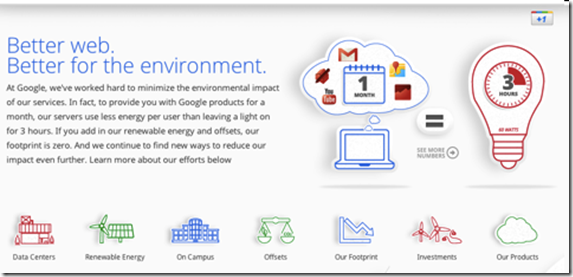
We’ve worked hard to reduce the amount of energy our services use.  In fact, to provide you with Google products for a month — not just search, but Google+, Gmail, YouTube and everything else we have to offer — our servers use less energy per user than a light left on for three hours. And, because we’ve been a carbon-neutral company since 2007, even that small amount of energy is offset completely, so the carbon footprint of your life on Google is zero.

We’ve learned a lot in the process of reducing our environmental impact, so we’ve added a new section called “The Big Picture” [link to come] to our Google Green site with numbers on our annual energy use and carbon footprint.

Google’s greener data centers get #1 position.

We started the process of getting to zero by making sure our operations use as little energy as possible.  For the last decade, energy use has been an obsession. We’ve designed and built some of the most efficient servers and data centers in the world—using half the electricity of a typical data center. Our newest facility in Hamina, Finland, opening this weekend, uses a unique seawater cooling system that requires very little electricity.

image

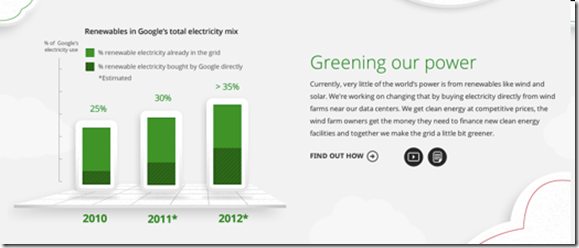
Renewable Energy gets position #2.

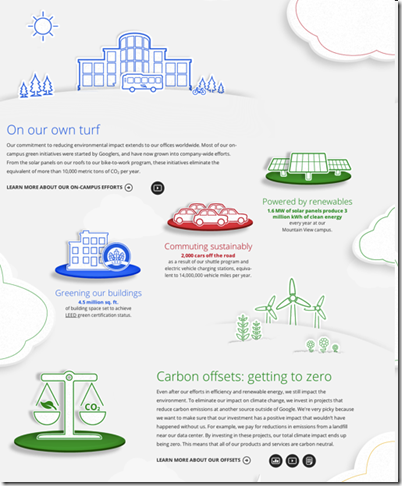
Whenever possible, we use renewable energy. We have a large solar panel installation at our Mountain View campus, and we’ve purchased the output of two wind farms to power our data centers.  For the greenhouse gas emissions we can’t eliminate, we purchase high-quality carbon offsets.

image

The company and carbon impact are #3 and #4.

image

Quincy Data Center Diesel Generator Count is up to 132 with Dell and Sabey most recent addition

Wenatchee World has an article on the diesel generators permitted by the Washington Dept of Ecology.

Ecology issues more generator permits

Wednesday, August 31, 2011

QUINCY — The state Department of Ecology on Friday issued an air quality permit to Sabey Corp., allowing the company to install 44 backup generators for a 520,000-square-foot Intergate-Quincy Data Center in case of a power outage.

On Aug. 5, Ecology approved 28 backup generators for the Dell Data Center in Quincy. Last year, Microsoft won approval to expand its diesel generators to 37, and early this year, Yahoo! was granted permission to increase its generators to 23.

This brings the total diesel generators permitted to 132.

That brings the total number of approved backup generators in Quincy to 132.

The state agency evaluated the potential health risks from that much diesel exhaust, which has several toxic pollutants.


California environmentalist sue to block Solar Farm, $1.8 billion 399MW project

It's kind of hard to get renewable energy, especially when various groups block projects based on the environmental impact.  It is really hard tto have zero environmental impact.  An example of the problem is in the SJ Mercury news article about a solar project facing a court battle.

Huge San Benito County solar farm proposal has its day in court

By Paul Rogers

progers@mercurynews.com

Developer PV2 Energy of San Francisco is proposing to build a 399-megawatt solar farm over 3,200...

A proposal to build one of the world's largest solar farms south of Silicon Valley had its day in court Monday as a long-simmering battle between the Bay Area investors supporting the project and environmentalists who say it will harm wildlife finally came before a judge.

At the center of the debate is a $1.8 billion, 399-megawatt solar farm proposed for Panoche Valley, an arid expanse of rangeland and barbed wire 50 miles southeast of Hollister. Last year, the San Benito County Board of Supervisors voted to approve the project, saying it would make rustic San Benito County -- known more for its cattle and condors than computer chips -- a national center of clean energy.

What is the problem?  The environmentalist think this is the wrong place to put solar farm.

Society, the Sierra Club and a group of local residents known as Save Panoche Valley sued to block it, claiming the 4 million solar panels that would be constructed across the roughly 3,200 acres west of Interstate-5 would harm endangered species and disrupt the rural character of the area.

"Solar obviously is very critical. No one disputes the necessity for solar energy," said Rose Zoia of Santa Rosa, the attorney representing the three environmental groups, during oral arguments. "The issue here is that it is improper on this site."

This problem is occurring at other California projects.

The case is symbolic of a recent trend across California and other parts of the nation. As concerns over global warming have grown and with it, government and private funding for huge solar and wind projects, the main opponents have often been environmental groups. The issue has split the environmental movement. Some conservationists argue that they need to change their approach while others stick to the lawsuits they have traditionally used to block logging, mining and development.

Last month, for example, California Gov. Jerry Brown filed a brief asking a federal court to deny a request by an environmental group seeking an injunction to stop a $2.2 billion solar power project in the Mojave Desert. The Western Watersheds Project wants to stop construction of the 370-megawatt Ivanpah project because of desert tortoises at the site.

Data Center Expert sees Biomass-Powered as the next step, Yea! another vote for the Grass Fed Data Center

Emerson's Jack Pouchet has an article on the step for Green IT being a Biomass-Powered Data Center.  I know Jack and I've been working on the Biomass data center (aka Grass Fed Data Center) for 2 years that Jack refers to in Missouri.

Biomass-Powered Data Centers: Next Step for Green IT?

Jack Pouchet

Over the past several years, those of us in the data center industry have seen dramatic strides in Green IT, primarily focused on improving energy efficiency. It is now much more common to see data centers designed to meet the LEED standards of the U.S. Green Building Association (USGC).  In addition, through the efforts of The Green Grid, the industry has adopted a standard method for assessing the energy efficiency of data center infrastructure, known as power usage effectiveness (PUE). This standard gives data centers a better tool for messaging progress when evaluating ways to improve energy efficiency.
Director of Energy Initiatives
Emerson Network Power
...

These are important steps. But, as President Josiah Bartlet used to ask on The West Wing: “What’s next?” I think onsite generation of green energy would be a major step forward. For instance, several companies, including Emerson, have addedsolar power to their data centers as a supplementary power source. Wind power also scales nicely to data center energy demands.

Biomass, however, may offer the best near-term route to onsite power generation as a primary energy source for a data center. Biomass-to-energy facilities convert just about any organic material made from plants or animals into electricity. Examples include wood and sawdust from forest slash or lumber mills, or agricultural wastes from plants or animals. It’s a clean, renewable energy source that reduces CO2 emissions.

Jack lists three Biomass projects.

Plans for biomass data centers are underway in several states. As reported in Environmental Leader last year, HP Labs has developed a system that could power a 1 megawatt data center using manure from a 10,000 cow farm – with enough electricity left over the run the farm. In Missouri, community leaders are pushing for a data center to be powered by grass, wood or hay.

Closer to completion is the Vineyard Data Center Park in Colorado Springs, which will feature 100 percent renewable power. It’s scheduled to open this year. The 50-megawatt facility has been dubbed a “trash-burning data center” for its planned use of bio-solids and municipal waste. Based on recent discussions with industry experts, biomass projects are in various stages of development in Ohio and Georgia.

Jack even mentions the idea of siting a data center at an old pulp & paper mill.  This is what Google did by going to Hamina, and this idea has been kicked around by a few us for over three years.

I started thinking about this after talking to a friend from high school about a paper mill closing in Hoquiam, Washington. We concluded that maybe it’s time the high-tech electronics industry that is rapidly displacing the need for paper could be the solution to reinvigorating these communities, buildings, and local economies.

Renewable baseload energy is coming to green the data center.

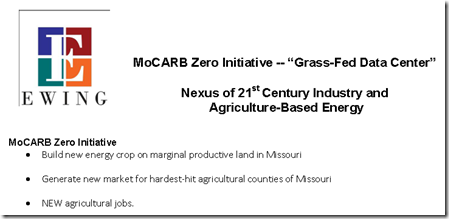
Here is more information about the Missouri project.

image