Taking a Staycation?

MSNBC.com has an article about the idea of a "staycation".

Imagine the perfect summer vacation: Swimming in clear blue water, tennis and a little bicycling, barbecued meals, a concert under the stars, a ballgame with fireworks, maybe even a museum or two …. and all for free.

Well, okay, not for free – but for a fraction of what other people will pay.

How? By vacationing at home.

To save you the time I submitted my survey input to this article, and got the following results with the # of people who are going to stay home.  It's a bad time to be an airline company.

Are you planning a vacation closer to home this summer?   * 141 responses

Yes, fuel prices are just too high.
72%

No, I'm hitting the road.
23%

Not sure, I'll wait and see if pump prices come down.
4.3%

Not a scientific survey. Click to learn more. Results may not total 100% due to rounding.

I thought about going to IDC's Green IT conference, but I decided to stay home. Thanks to friends and the power of blogging/news reporters, I'll get most of the news from conferences, and just save the gas and stay home.

For those of you have haven't visited my office, this is my view, so I have an incentive to just stay put.image001

Read more

Amazon Web Services provides resizable compute capacity

AWS blog posts an entry they have added the capability to two new "high-cpu" instance types.

Amazon EC2 users now have access to a pair of new "High-CPU" instance types. The new instance types have proportionally more CPU power than memory, and are suitable for CPU-intensive applications. Here's what's now available:

The High-CPU Medium Instance is billed at $0.20 (20 cents) per hour. It features 1.7 GB of memory, 5 EC2 Compute Units (2 virtual cores with 2.5 EC2 Compute Units Each), and 350 GB of instance storage, all on a 32-bit platform.

The High-CPU Extra Large Instance is billed at $0.80 (80 cents) per hour. It features 7 GB of memory, 20 EC2 Compute Units (8 virtual cores with 2.5 EC2 Compute Units each), and 1,690 GB of instance storage, all on a 64-bit platform.

Behind the scenes amazon uses Citrix Xen for virtualization.

Amazon Elastic Compute Cloud, also known as "EC2", is a commercial web service which allows paying customers to rent computers to run computer applications on. EC2 allows scalable deployment of applications by providing a web services interface through which customers can request an arbitrary number of Virtual Machines, i.e. server instances, on which they can load any software of their choice. Current users are able to create, launch, and terminate server instances on demand, hence the term "elastic". The Amazon implementation allows server instances to be created in zones that are insulated from correlated failures.[1]. EC2 is one of several Web Services provided by Amazon.com under the blanket term Amazon Web Services (AWS).

EC2 uses Xen Virtualization. Each virtual machine, called an instance, is a virtual private server and can be one of three sizes; small, large or extra large. Instances are sized based on EC2 Compute Units which is the equivalent CPU capacity of physical hardware.

1 EC2 Compute Unit equals 1.0-1.2 GHz 2007 Opteron or 2007 Xeon processor. The three available Instance sizes are sized as follows:

Small Instance

The small instance (default) is the "equivalent of a system with 1.7 GB of memory, 1 EC2 Compute Unit (1 virtual core with 1 EC2 Compute Unit), 160 GB of instance storage, 32-bit platform " [1]

Large Instance

The large instance is the "equivalent of a system with 7.5 GB of memory, 4 EC2 Compute Units (2 virtual cores with 2 EC2 Compute Units each), 850 GB of instance storage, 64-bit platform"

Extra Large Instance

The extra large instance is the "equivalent of a system with 15 GB of memory, 8 EC2 Compute Units (4 virtual cores with 2 EC2 Compute Units each), 1690 GB of instance storage, 64-bit platform."

Wouldn't it be great if enterprise IT was run this way. Amazon is figuring out how to sell compute better than anyone else, and that is their business as a retailer.

Read more

Greening the Data center with IBM Tivoli Software

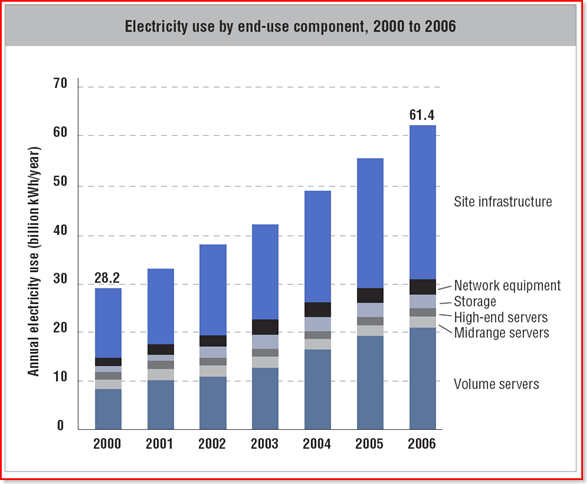
IBM released a marketing document on how Tivoli software provides an integrated approach to managing software. It's pretty good for a marketing document on integrating the information for a green data center.

IBM assumes a PUE of 2.0 and don't discuss how they can use their tools to improve PUE.

The one thing I did find useful is their electricity use by component, 2000 to 2006.image

For now a green data center tool I like is Mike Manos's Scry.

Read more

Down on the Server Farm, writes The Economist

The Economist continues its coverage of the data center industry by another writer in Seattle, referencing - Jonathan Koomey, Rich Miller (Data Center Knowledge), Mike Manos (Microsoft), Mike Foust (Digital Realty Trust).  The writer even mentions Microsoft Cblox containers.

The real-world implications of the rise of internet computing

Data Islandia

EVEN when the sky is blue over Quincy, clouds hang in the air. The small town in the centre of the state of Washington is home to half a dozen huge warehouses that power the global “computing clouds” run by internet companies such as Yahoo! and Microsoft. The size of several football pitches, these data centres are filled with thousands of powerful computers and storage devices and are hooked up to the internet via fast fibre-optic links.

Yet even more intriguing than the buildings' size is their location. Quincy is literally in the middle of nowhere, three hours' drive from the nearest big city, Seattle. But it turns out to be a perfect location for data centres. As computing becomes a utility, with services that can be consumed from everywhere and on any device, ever more thought is being put into where to put the infrastructure it needs.

Where the cloud touches down is not just the business of the geeks. Data centres are essential to nearly every industry and have become as vital to the functioning of society as power stations are. Lately, centres have been springing up in unexpected places: in old missile bunkers, in former shopping malls—even in Iceland. America alone has more than 7,000 data centres, according to IDC, a market-research firm. And each is housing ever more servers, the powerful computers that crunch and dish up data. In America the number of servers is expected to grow to 15.8m by 2010—three times as many as a decade earlier.

Read more

Data Centers Lack Tools and Commitment for Green Initiatives, says ARI survey

Aperture Research Institute has a survey report, "Data Centers lack tools and commitment to deliver on the ambitions of their green initiatives."

One of the results

Only 24 per cent of the organisations we surveyed said that the IT department charges the business for energy use.

I don't know about you, but I find the 24 per cent number high, but maybe it includes those who count power bills in their calculation in charge backs, not those companies who provide direct energy charge backs base on usage. 

So, 76 per cent of the companies do not look at the power bill in their charge back. We may have to wait until the power bill gets so large, the finance department gets a clue the large power bill is coming from its data centers.

Maybe I need to look at writing for an article for http://www.cfo.com/ on energy charge backs for data centers. CFO.com had an article on energy, but it's dated Aug 8, 2006.

Read more