Intel to ship OS Independent Power Management

Power Management is strategic for Intel. News.com reports Intel is dedicating 1 million transistors to do power management functions on chip.

That news was revealed to this reporter by an Intel employee as senior vice president Pat Gelsinger was delivering his IDF keynote, which included more specifics about Nehalem, the family of chips the company plans to begin rolling out in the fourth quarter. Gelsinger, the general manager of Intel's Digital Enterprise Group, showed the first wafer holding individual eight-core processors, detailed the power-saving features of the Nehalem processors, and confirmed future mobile Nehalem processors.

Intel Nehalem processor lineup as shown at IDF 2008

Most of his keynote centered on Nehalem, and one of the features Intel was pushing hard at IDF was a technology called Turbo mode.

Turbo mode is essentially a switch that turns off unused processor cores and then uses the remaining active cores more efficiently. This kind of sophisticated power-management technology will be used in both Nehalem-based laptops and servers, according to Gelsinger, and will become increasingly necessary as Intel brings out chips with more cores like the eight-core Nehalem processor due next year.

In short, in multi-core processors, cores not doing much can still use power. So, it's better to use, for example, a couple of cores more efficiently than four cores inefficiently.

Turbo mode is enabled by a "power control unit which is an integrated microcontroller which only works on power management," said Rajesh Kumar, an Intel Fellow, who spoke during Gelsinger's keynote. There are about 1 million transistors dedicated solely to power management, Kumar said.

This makes a lot of sense to eliminate the dependency for power management from the OS or Hypervisor.  If Intel continues down this path, they could build power management integrated into their motherboards independent of the OS.

Saving energy is a top differentiation for Intel. Intel gets it that they need to support Green sustainable computing.  And, this is a way for them to drive upgrades.

Read more

Microsoft Presents Container Data Center Details at Intel Developer Forum

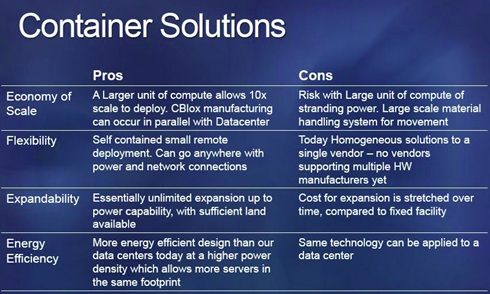
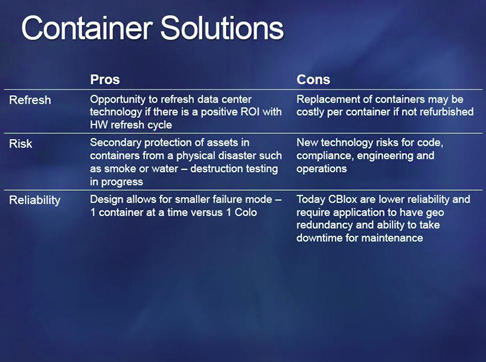
Microsoft Data Center Research Mgr Daniel Costello presented Microsoft’s Cblox (container) solution at Intel Developers Forum. The slides provide a good set of issues to look at when evaluating containers.

There are a total of 6 sildes, Here are three slides that provide the most information.

image

image

image

The full slide deck can be accessed here under Container Slides.

Unfortunately, I couldn’t find the presentation posted as this was a Day 0 presentation.

Read more

Intel Atom vs 8 year old AMD Athlon, AMD wins on Power and Performance

I’ve had a chance to research the Little Green Server ideas more, and I think Via and AMD are potential better platforms for low power servers.  Tom’s Hardware has this post on Intel Atom vs. AMD Athlon.

With the development of the Atom processorhttp://en.wikipedia.org/wiki/Intel_Atom , Intel introduced a totally new chip design that consumes very little energy. AMDhttp://en.wikipedia.org/wiki/Advanced_Micro_Devices had to strike back, and did so by clocking down its Athlon 64http://en.wikipedia.org/wiki/Athlon_64 , employing the K8 micro architecture, down to the lowest possible frequency of 1 GHz. The Athlon 64 2000+ runs with a core voltage of 0.90 volts and uses just 8 watts. As a result, the CPU easily operates without a fan. If you drop the 8 W Athlon 64 into a motherboardhttp://en.wikipedia.org/wiki/Motherboard based on the 780G chipset, then the system hits power consumption numbers that, in our measurements, are below Intelhttp://en.wikipedia.org/wiki/Intel_Corporation ’s Atom desktop solution. We were even able to lower the core voltage by 11%, without stability problems, and the power analyzer read lower numbers. Interestingly, AMD’s Athlon 64 2000+ processor, unlike Intel‘s Atom CPU, is not embedded in the motherboard. It can be run on any board with an AM2 or AM2+ socket.

Compared to Intel’s Atom, which runs at 1.6 GHz, the Athlon 64 2000+ is clocked at 1 GHz—60% lower. Despite this, the Athlon 64 outperforms the Atom in several benchmark tests as a result of its more efficient K8 architecture. In addition, the energy consumption of the entire system is lower, and that’s what really matters most.

In the conclusion.

In our Munich lab’s duel of the energy-savers, the AMD Athlonhttp://en.wikipedia.org/wiki/Athlon 64 2000+ beats the Intel Atomhttp://en.wikipedia.org/wiki/Atom 230 in energy consumption and processing power. Each of the systems was based on a desktop platform. The Achilles heel of the Intelhttp://en.wikipedia.org/wiki/Intel_Corporation system is its old system platform with the 945GC chipsethttp://en.wikipedia.org/wiki/Chipset , while AMD offers a more modern 780G platform.

The energy-saving solution from AMDhttp://en.wikipedia.org/wiki/Advanced_Micro_Devices offers more possibilities: it has three times as many SATA ports, possesses better onboard graphics performance, and can also support two monitors. Unlike the Intel solution, an HD resolution (1920x1200) with high picture quality is possible through DVI/HDMIhttp://en.wikipedia.org/wiki/High-Definition_Multimedia_Interface ports. And early information suggests that the AMD Athlon 64 2000+ should cost close to $90.

Read more

Cloud Computing Blogs

DataCenterKnowledge has a good list of Cloud Computing Blogs.  If you doubt whether Cloud Computing is game changing, the fact that there are these many bloggers will get you thinking.

  • Elastic Vapor: The ramblings of Reuven Cohen, co-Founder & CTO of Enomaly (ElasticDrive). A consistently interesting read.
  • Cloud Musings: Thoughts on cloud computing from Kevin Jackson, a senior IT technologist specializing in government requirements.
  • Cloudy Thoughts: Markus Klems writes about cloud computing, grids, distributed programming and agile Web development.
  • Geva Perry's Blog: Views on cloud computing from Geva, the Chief Marketing Officer at GigaSpaces Technologies.
  • Cloud Security: Craig Balding provides an important look at the security implications of clouds and how they interact with one another.
  • IT Management and Cloud Blog: The view from the clouds from technologist and author John Willis.
  • Perspectives: Excellent blog from James Hamilton of Microsoft, with great content on scalability and databases as well as cloud computing.
  • The Wisdom of Clouds: James Urquhart's thoughts on "Cloud Computing and Utility Computing for the Enterprise and the Individual." Very informative.
  • GigaOm: Om Malik and company provide strong coverage of cloud computing services and business models.
  • Smoothspan Blog: Blog by Bob Warfield focused on "radical technology innovation with equally radical business model innovation to literally reinvent software."
  • Production Scale: Blog from Kent Langley at SolutionSet tracking scalable web infrastructure and cloud computing.
  • Rough Type: From Nicholas Carr, author of "The Big Switch." Nick is in low-post mode for the summer, but is one of the best soruces on clouds and SaaS.
  • Server Farming: A TechTarget blog on grid computing, supercomputing and utility computing.
  • Sam Johnston: Lots of good info on cloud computing, especially the recent trademark flap.
  • Salesforce Times: All Salesforce, all the time, from founded by Adam Killam of Vancouver.
  • William Vambenepe: Views on grids, clouds and databases from an Oracle architect.
  • Hot Cluster: Topical blog from Bert Armijo and Berry Lynn of 3Tera, which makes the AppLogic "cloud OS" software.
  • OnSaaS: Links and more from Jian Zhen of LogLogic and Michael Mucha from Stanford Hospital.
  • In The Clouds: Cloud computing blog from Dell, where the company shares information about its cloud servers and services.

As Rich Miller says he is monitoring this list.

It's a lot to read. If you can't track that many blogs each day, just keep reading Data Center Knowledge! We're monitoring these sites, as well as numerous searches on topics of interest in the Data Center. News tips and backlinks are always welcome!

Read more

IBM's Green Sigma

IBM put together the idea of Green and Six Sigma as news.com reports.

IBM launches 'Green Sigma' business consulting

Big Blue has devised a consulting service to profit from corporate initiatives to "go green."

IBM on Monday detailed its "Green Sigma" consulting practice for reducing energy and water usage at businesses by using networked sensors and data analysis software.

A shot of IBM's carbon dashboard for tracking energy usage at businesses.

(Credit: IBM)

It's based on the Lean Six Sigma management strategy that was originally designed to focus on operational efficiency and customer requirements.

The idea with Green Sigma is to do an accounting of a company's water and energy usage, both at its own facilities and also its supply chain partners. IBM is piloting the method at two of its own facilities and at two of its customers'.

This is an idea I've actually used to explain how going green is a commitment like six sigma.   Also it is good to see IBM is including water in its resource management.

Read more