Ran into this video on YouTube from Sybase as a response to IBM’s Green Data Center Man Video.
The Sybase video is informative.
The IBM video is humorous with no information.

Here is IBM’s Green Data Center Man video.

Your Custom Text Here
Ran into this video on YouTube from Sybase as a response to IBM’s Green Data Center Man Video.
The Sybase video is informative.
The IBM video is humorous with no information.
Here is IBM’s Green Data Center Man video.
A stimulating conversation with a data center executive got me thinking about modeling for a Green Data Center, and what method would make sense for modeling method. Given my software background, my first look was at Universal Model Language (UML).
Unified Modeling Language (UML) is a standardized general-purpose modeling language in the field of software engineering. UML includes a set of graphical notation techniques to create abstract models of specific systems, referred to as UML model.
After looking at how UML could be used in IT for data center design, I hit upon Systems Modeling Language (SysML).
The Systems Modeling Language (SysML), is a Domain-Specific Modeling language for systems engineering. It supports the specification, analysis, design, verification and validation of a broad range of systems and systems-of-systems.
The dominant group influencing the creation of SysML were aerospace and defense contractors who build complex systems integrating hardware, software, and people. A SysML FAQ points out strengths of SysML vs. UML.
SysML offers systems engineers the following advantages over UML for specifying systems and systems-of-systems:
- SysML expresses systems engineering semantics (interpretations of notations) better than than UML. It reduces UML's software bias and adds two new diagram types for requirements management and performance analysis: Requirement diagrams and Parametric diagrams, respectively.
- SysML is smaller and easier to learn than UML. Since SysML removes many software-centric and gratuitous constructs, the overall language is smaller as measured in diagram types (9 vs. 13) and total constructs.
- SysML allocation tables support various kinds of allocations (e.g., requirement allocation, functional allocation, structural allocation) thereby facilitating automated verification and validation (V&V) and gap analysis.
- SysML model management constructs support the specification of models, views, and viewpoints and are architecturally aligned with IEEE-Std-1471-2000 (IEEE Recommended Practice for Architectural Description of Software-Intensive Systems).
Looking for whether anyone who has used SysML in data center construction I hit upon a google forum thread.
Do any of you know or have heard of SysML being used to model building systems in the construction-industry (parametric building design, logistics/processes, etc)?
Here is the response from a SysML architect.
Here's a short analysis. First, let me say that I am an Aerospace kinda
guy. I have worked just about every aspect of it spending about 20 years in
the Skunkworks and beyond. I am also a Enterprise Architect and specialize
in interoperability and NetCentric Operations. Most recently I have been
helping out in Disaster Relief and Recovery as well. The answer to your
question is that no, I haven't heard of it being used yet and it's probably
because SysML spec has only been out about a year. Second part is most
definitely it can apply. Especially when the construction looks at the
larger "Enterprise" context which would apply to more than the construction
of the building itself but the infrastructure of the environment such as
urban planning, green enterprise application and those things that are
beyond cement and wires.My first recommendation is to read Tim's book (System Engineering with
SysML/UML). If I was given the task of "parametric building design, etc.,",
I would view the task using Tim's SysMOD process. It's not an end all, but
it's a start. Secondly, I would look at some the advances in "Green
Enterprise Architecture". These are those initiatives that could be applied
to help the construction domain with the rapid advances of the green
enterprise. I think that it's very useful to view these things from the
domain of the customer that "wants to do the right thing" for the
environment. This is where the SysML modeling tools can help a bunch.
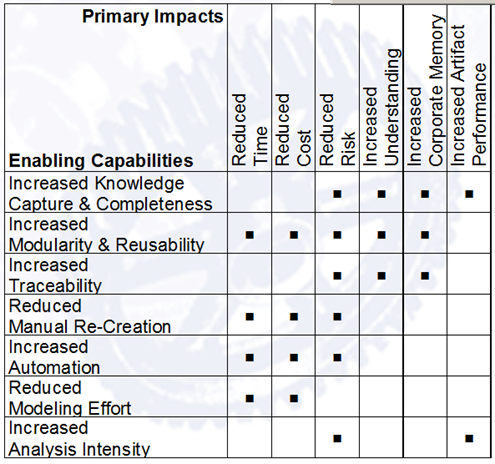
Why would you model? Consider this matrix for benefits of modeling.
ZDNet posts on Green IT adoption in Universities.
A majority of technology professionals at these schools also are actively powering down their data centers on a regular schedule to cut back on power use (about 55 percent use these techniques). Close to 30 percent have made changes to their data center designed and 20 percent have simplified their networks with energy savings in mind.
Some of you may be surprised by these facts, but I'm not. As I've had the experience with Cornell Medical School's BioMedicine department. Their IT attitude of doing the right thing, setting an example on what can be done, and low labor costs from student faculty creates an environment for green innovation and early adoption.
Other interesting parts of the blog post.
A survey from the Association for Information Communications Technology Professionals in Higher Education finds that at least two-thirds of colleges and universities are adopting energy-savings programs or other policies that could be deemed environmentally conscious. The findings were collected from member schools. (There are 2,000 members from 780 schools.)
In a move that I find fascinating, giving the poor action taken by the general public in this area as evidenced by the Forrester poll I wrote about yesterday, 80 percent of the surveyed universities are recycling computer and networking equipment — a figure much higher than the general public. About 73 percent of the schools said they are buying more energy-efficient equipment, and 63 percent have adopted policies to cut back on printing.
One big indicator about the future of education, given both technology and the green influence: 65 percent of the respondents said they bought new equipment for the specific purpose of launching distance learning or online education programs.
And, the blog finishes with a dig on corporate environments.
Two other interesting stats to leave you with:
- One in four schools is using at least one alternative energy source to provide power on campus.(Can your company say the same?)
- One in four schools has adopted telecommuting policies for their faculty. (Ditto?)
Going over the session program for Data Center Dynamics Chicago on Sept 16, I found the below description of Mike Manos's keynote.
Microsoft’s Chicago Containerized Data Center
Michael Manos, General Manager, Data Center Services - Microsoft
Join this unique Keynote Session, as Microsoft takes us through their Chicago Containerized Datacenter and its C-blox design. Microsoft is embracing containers as the key to building scalable, energy-efficient cloud computing platforms. The company's bold move is an affirmation of the potential for containers to address the most pressing power, cooling and capacity utilization challenges facing data center operators. The Chicago facility is part of the company’s fleet of next-generation data centers being built to support its Live suite of "software plus services" online applications. Microsoft has developed its own specifications that include, for example, configuration for electrical components and the layout of physical servers, for its containers. Those specs make Microsoft’s containers different from anything on the market today, and a potential opportunity for future Microsoft products. The containers, which Microsoft calls C-blox, are largely self-contained and will require very little hands-on maintenance.
The Microsoft Chicago facility is a two floor design where the first floor is a containerized design housing 150 to 220 40’ containers each 1,000 to 1,000 servers. Chicago is large facility with the low end of the ranges yielding 150k serves and the high end running to 440k servers. If you assume 200W/server, the critical load would run between 30MW and 88MW for the half of the data center that is containerized. If you assume a PUE of 1.5, we can estimate the containerized portion of the data center at between 45MW and 132MW total load. It’s a substantial facility.
Container-based data centers allow for better IT reporting all around, users will be able to chart the IT productivity of each unit and get clean statistics on data such as e-mail usage, search queries and any number of other business processes. As the doors are closed, and because of the level of automation in its systems, Microsoft can run them and accept a certain amount of failure over time, which more cost effective to build redundancy and automation into Microsoft’s data center applications and allow some hardware to fail than it would be to physically manage such a large data center. The hands-off approach also means design can be tweaked to allow for maximum cooling and energy efficiency without worrying about how accessible the systems are to human hands. Of course, Microsoft also builds backbones that link power, cooling, and bandwidth among the containers. In the C-blox world, a truck drops off a data center container and then picks it up again in a few years when Microsoft is ready to switch over to new hardware. Administrators will only enter the physical C-blox in the rarest of occasions which will also allow Microsoft to run the entire Northlake facility with a continuous staff of little more than 20 or 30 employees.
I'll be there ready to blog Mike's presentation, but I'll be busy with my own session later.
Fellow press/bloggers you may want to attend the event as well.
The Power of Software blog has a new post by Amaya Souarez. There is so much information in this post, it is hard to summarize, so let’s start with a list, extracting words from the post.
I believe that implementing chargeback models based on power usage will encourage customers to consider power efficiency more seriously and reduce our overall impact on the environment.
I would like to illustrate this point by using the analogy of getting a first car for a teenager. By the way, if you currently have one of these creatures at home, then you have my commiserations.
Comparing Chargeback Models
Let’s say you are investigating the conditions under which you will allow your teenager to have a car. Consider the following two options:
For each option, what sort of car do you think your teenager will want?
With option 1, you may find that they come back with a clapped out 351 cubic inch monster with the thirst of a Jentil, maybe something like the “striped tomato” from Starsky and Hutch. And who cares? You’re paying for the gas, right?
But there’s no point in having the coolest car in the neighborhood if you can’t even afford to take a date to a drive-in movie. If you select option 2, you may find your teenager develops a more healthy interest in how many miles per gallon (MPG) something more sensible can manage (like the new Prius hybrids at the Redmond Campus), rather than whether they have enough torque to leave tire slicks longer than a 747 landing at Princess Juliana International airport.
With servers, the situation is more complex; the main issue that we struggle with is the fact that there is no direct equivalent to miles per gallon. How do you measure application output? It isn’t just about CPU utilization. What about an application that makes repeated calls to hard disk but doesn’t use much in the way of processor resources? If you fit more memory to the server, it can may be able to cache the disk access calls, but you’re then consuming more power in the additional memory module.
All the standard performance monitoring areas, such as processor, memory, hard disk, network, and cache make varying contributions to power consumption. What we needed at Microsoft was a chargeback model that is easy to understand, straightforward to administer, and allocates data center costs to customers proportionately.
For the Microsoft data centers, the effort to change our chargeback model was not a simple conversion, as it took us one and a half years to move from our previous model of charging for floor space based upon rack utilization to the new model. Not surprisingly, it was not the tooling or process modifications that posed the biggest hurdle but the cultural and political changes that were required. Even today, I frequently have to remind customers that ‘DC space is power.’
The final model that we now use has two basic components:
- Floor Space. This component is billed per kilowatt (kW) of usage and includes all the floor space costs.
- Power and Cooling. This component is billed per kilowatt hour (kWh) of usage and includes the cost of electricity as billed by our energy suppliers.
I’m not using real figures here, but you should be able to see the basis of how we implemented charging based on power consumption.
And there is plenty more in the blog entry.
Amaya Rocks!
Here are her final words.
Summary
Changing our chargeback model to one that uses power as the basis for floor space makes sense, both for us and for our customers. As older equipment is retired and replaced, we expect to see greater emphasis on power efficiency rather than raw output. Reducing power consumption on individual servers results in a reduction in the total power consumption for the data center, helping to conserve our power bandwidth and minimize our impact on the environment.

Quisque iaculis facilisis lacinia. Mauris euismod pellentesque tellus sit amet mollis.