Uptime Institute - A Victim of Fiefdom Syndrome?

Today was a good talking to another architect, discussing disruptive/game changing action.

One of his points he made is Bob Herbold's book on Fiefdom Syndrome.

Is your company threatened by turf battles, shut out of key data sources by territorial "lords," or ravaged by hundreds of "micro-companies?" If so, your organization may be suffering from a potentially crippling case of "Fiefdom Syndrome." Robert Herbold, former COO of Microsoft, presents a wealth of case studies from the usual (and always interesting) suspects--IBM, Proctor and Gamble, Microsoft, and Wal-Mart--to illustrate an affliction that affects for-profit and non-profit organizations alike.

Like headaches, fiefdoms can become a persistent problem and if left untreated, can send organizations into an endless loop of deteriorating health and repeated investigations into the cause. Prudent companies will take Herbold's advice and learn how to prevent and treat their little fiefdom problem. --E. Brooke Gilbert

TechHermit put up the following post on Uptime Leadership Split.

Details are sketchy at the moment but I just received word that John Thornell has left the Uptime Institute.  Thornell who has been an instrumental force at Uptime after his departure from APC.  A key driver in Uptime’s marketing efforts over the last few years was made president of the Institute last year.  Indications are that the split is a result of heated debate and differences between Ken Brill and himself.  There is a growing concern over Uptime Institutes relevancy in the industry and its less than subtle attempts to scuttle alternative data center related organizations and metrics such as Green Grid, PUE, and others.  More to come.

Uptime Institute is not a big company, but from listening to conversations from others who are closer, it looks more like a fiefdom syndrome in action: Uptime Institute vs. other data center  organizations.

I enjoyed attending  Uptime Institute's Symposium 2008, but the main thing I learned is there wasn't much new presented. On the other hand the networking was great.

Personally, I am finding the Data Center Dynamics conferences more useful given their customer focus for regional events. I'll be at Data Center Dynamics Chicago on Sept  16. 

Isn't it greener to have the presenters travel to the customers, reducing travel overall?
Read more

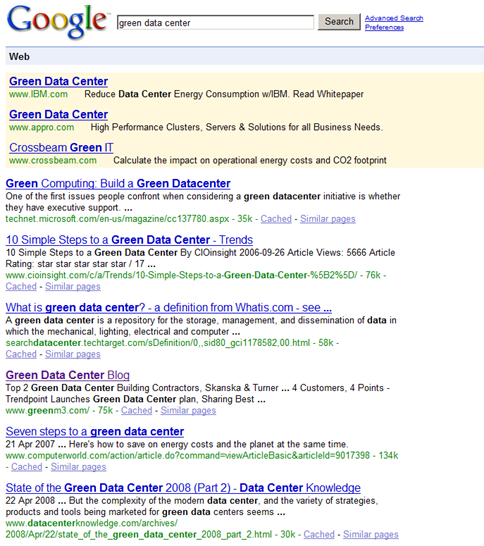
Google Search “green data center”

With this post I’ve hit my 452nd post on the green data center blog. Out of curiosity I wanted to see how well my google search results work for “green data center”.

Good news my TechNet article I wrote a year ago is #1.  My blog is #4.

Not too bad for starting my blog 9 months ago.

Thanks for visiting my blog.

-dave


image

Here are my top 12 search queries according to Google webmaster tools.

image

Note the interest in Intel Atom server. This helps to confirm my ideas on the Little Green Server and people want to run their own energy efficient servers.

Read more

Commoditization, Standardization, or Industrialization of Data Centers

DataCenterKnowledge has a post on Industrialization and Standardization of data center design.

The focus on smaller spaces provides greater flexibility, but also allows data center builders to standardize many elements of the process, enabling an “industrialization” of data center design. That term has been adopted recently by the world’s two largest data center operators - Digital Realty Trust and IBM.

“We’re really seeing the standardization really resonating with a lot of customers,” said Jody Cefola, Site and Facilities Services marketing Manager for IBM. “We liken it to what’s happened in IT, where companies have gone to standardized operating environments in their software.

Christian Belady has been presenting on this topic for the last 2 years and uses the term commoditization as well, and how the data center industry needs to change.

“The real driver behind this is the fact that the cost of computation is going down,” said Belady. “The problem is going to get worse. As the price goes down, demand goes up. I think what you’re going to see is the commoditization of the data center. Standardization will create a plug-n-play environment.”

Part of making Green Data Centers is improving efficiencies, and this can be done by using standard units used across multiple facilities no different than any other industrial process as data center services become a commodity.  There I used the title terms with all the "izations" removed.:-)

Read more

Thin Clients + The Cloud

GigaOm has a post on the merging of Thin Client and Cloud Computing. Some of these ideas are being driven by Citrix (owner of Xen) who benefits from the adoption of this idea.

Today the organization behind the popular Xen open-source hypervisor announced the latest release of its virtualization software. It’s smaller, has better power management and graphics capabilities, and can run on machines ranging from servers to laptops and mobile phones.

One areas I do agree with is the interest in companies for thin clients to save energy.

Participating in a call related to the semiconductor industry earlier this week, I heard from one of the analyst participants that thin-client sales were on the upswing as management focused on power savings, security and manageability. A virtualized desktop can be delivered via a USB drive, a thin client, and on hypervisor-equipped laptops. The benefit of virtualization to most companies is that mobile users can take USB drives, thin-clients or laptops and recreate the corporate compute environment in a secure and controlled setting. This takes a lot of the expense out of managing hundreds or thousands of desktops.

An idea which agrees with conversation’s I’ve had with others is thin clients connected to cloud computing.

As virtualized servers have been gathered into computing clouds, hooking some kind of virtual desktop to that cloud has become easier to implement and manage, making desktop virtualization more interesting for corporate buyers. That was a reason Microsoft found startup Kidaro interesting enough to acquire in March and is also the value proposition behind MokaFive. The next few years could see some real changes in corporate computing.

Read more

Avanade's Anti-Greenwashing Initiative, Part 1

Avanade's Toby Velte is about to have a book published on Green IT.  Here is a link to the book on amazon.com.

"Green IT is a social imperative that meets the needs of business. This book guides organizations in applying environmentally sound practices to business and technology decisions--helping them reduce their consumption of resources, energy dependencies, and costs. These issues are real and the time to act is now." --Adam Warby, CEO, Avanade

After talking to Toby to understand his book and Avanade Tools.

Avanade has created a tool that uses more than 120 variables and real-world customer data to measure the concrete impact of Green IT projects for a customer. This deep ROI modeling tool measures the true impact that virtualization and data center optimization projects can have on costs, energy use, carbon footprint, etc.

I was thinking great I will write a blog entry. Where is your url for your Green IT initiative?  "Well, we don't have a place on our web site."  So, I can't actually link to anything on Avanade's web site.

Wait, you have a book, you have Green IT analysis tools, and you don't have a marketing site.  How can anyone claim what you are doing is greenwashing when you don't have a marketing initiative?  You are truly working on filtering the greenwash: anti-greenwashing.

Here is a sample screen shot from Toby's tool.

image

This screen is a sample of a virtualization calculation taking into account typical TCO costs, but adds specifics for kW/Hr and carbon footprint. Staring at these numbers Toby calculates data center facilities cost per sq ft. It would be more accurate to calculate the data facilities cost as a function of kW capacity.

It turns out Toby is going to be coming to meet with a software company in Redmond in two weeks, and I can meet with him face to face as my office is close to a Redmond software company too.

This is Part 1 of what I am sure will be another post after I meet with Toby and get a copy of his book.

Reduce the environmental and budgetary impact of your IT infrastructure

This groundbreaking work offers a complete roadmap for integrating environmentally sound techniques and technologies into your Information Systems architecture. Green IT explains how to adopt a business-driven green initiative and provides a detailed implementation plan. You will find strategies for reducing power needs, procuring energy from alternative sources, utilizing virtualization technologies, and managing sustainable development. Case studies highlighting successful green IT projects at major organizations are included. Keep your IT department and your organization in the green--both environmentally and financially--with help from this comprehensive guide.

  • Work within current global initiatives and standards for e-waste

  • Minimize power usage and use alternative cooling methods in your datacenter
  • Transition your office into a paperless environment
  • Equip your organization with green hardware, including EPEAT-, RoHS-, and ENERGY STAR-certified machines
  • Implement efficient datacenter design in terms of energy consumption, cooling, server configuration, consolidation, cabling, redundancy, and more
  • Virtualize servers and storage using the latest technologies from VMware, Microsoft, Compellent, Incipient, and others
  • Measure existing datacenter efficiency using current metrics, and track progress with Business Intelligence tools
  • Establish a green supply chain
  • Explore the Software as a Service (SaaS) model
  • Manage ongoing compliance and sustainable growth

I have a copy of the virtualization chapter, but I want to see what Toby has for his data center optimization advice.

Read more