Amazon’s New Oregon Data Center

DataCenterKnowledge reports on Amazon.com’s new Oregon Data Center.

Amazon Building Large Data Center in Oregon

November 7th, 2008 : Rich Miller

Amazon.com appears to be the tenant in a large data center rising on the banks of the Columbia River in Oregon, joining Google in harnessing the region’s cheap energy resources to power huge cloud computing data centers.

The $100 million data center is being built in Boardman, Oregon in the Port of Morrow, a 9,000 acre industrial park. Plans call for three large buildings on the site, according to The Oregonian, which reports that representatives of Amazon have attended local meetings to discuss permits for the site. The first building is underway and will be 116,000 square feet.

I was starting to wonder if Amazon had some secret to keep us from knowing what is was building.

Amazon is historically tight-lipped about the location of its data centers. But the rapid growth of its Amazon Web Services (AWS) cloud computing platform long ago exceeded the excess capacity in the data centers supporting the company’s retail operations. As AWS grows, Amazon will need to continue adding dedicated infrastructure to add capacity. Amazon recently said its S3 cloud storage service was now storing 29 billion objects.

But, you can’t build big data centers without the insiders finding out or the local press.  Especially when you are looking for cheap and/or green power for your data center.

The Columbia River basin has large resources of hydro electricity generated from dams along the river. This cheap, clean power was a factor in Google’s decision to build a huge data center in The Dalles, Oregon and has fueled the tranformation of  Quincy, Washington from a small farming town into a data center hub with new facilities from Microsoft and Yahoo.

A 10-megawatt power substation is being built adjacent to the new data center in Boardman, the Oregonian reports. The paper said a $320,000 Oregon Department of Transportation grant was awarded to the port to connect the data center to local utilities. The grant will cover about half the total cost of the additional power infrastructure.

We’ll see if Amazon changes and follows the Microsoft and Google model to share some of their best practices.
Read more

Accenture’s Green IT Around The World Perspective – Aus, Neth, Spain, Japan

Found this post on Accenture’s Green IT blog.  As the author Andrew Skinner, says this is not necessarily a scientific approach, but useful to gain some perspective.

Have you seen a development in clients' interest in Green IT over the past 6-12 months?

  • Australia: Recently we have seen an increase in the focus from the media with regard to Green IT. A number of major events have been planned (such as a symposium and CIO roundtables) and we are beginning to see the topic enter the CIO agenda.
  • Netherlands: Our clients are increasingly interested in the developments in the topic of Green IT, but they still find it very hard to prioritize the topic on the overall IT agenda. When it comes to a discussion about cost or service versus green then the former two topics seem to gain much greater support.
  • Spain: In Spain we have seen an overall interest and movement, but clients are only now beginning to look at establishing Green IT programs. Typically Green IT is a collateral result of projects such as cost reduction or virtualization. Clients are now beginning to see that projects with a different focus can also be used to deliver green benefits.
  • Japan: In Japan we have seen a significant increase of interest in Green IT. We are, on a weekly basis, being asked to present material to interested organizations and external seminars as well as develop proposals for our clients. It is great that Accenture can leverage the work that we have developed on a global basis for these sessions, but even better that we get to feed information back and help set the overall agenda.

It is interesting how the different countries are finding different interest from Sectors in Green IT.

Is there a noticeable difference in interest in Green IT from clients in different industry sectors?

  • Australia: In Australia, it looks like government organizations will take a leadership position early, with other sectors following closely behind. Typically, lT is seen as both an enabler and leader in a client’s wider sustainability goals.
  • Netherlands: I have noticed that all industries are influenced by the growing call for sustainability by regulators and consumers. There is no noticeable difference in interest between industry sectors; the actions a company takes are more dependant on its sustainability strategy and related corporate citizenship programs.
  • Spain: Within the Spanish market the clients within financial services and resources (particularly the utility companies) have taken a strong lead. We are now beginning to see more activity in public sector and from products organizations.
  • Japan: The consumer goods, automotive and retail industry groups within Accenture have taken the lead on a move towards greener IT within Japan and they are potentially leading the drive globally. We have seen little activity within the financial sector at present but this is probably due to external influences. Although resources clients have shown an interest, the impact of Green IT is very small compared with their overall emissions.
Read more

Reducing Spam Saves Energy

Here is a case study of a realtor eliminating 95% of its spam.

Using Postini Perimeter Manager, APR hasbeen able to:
• Eliminate more than 95 percent of spam messages were blocked before they reached APR’s network, reducing the volume of incoming email traffic by nearly 75 percent (more than 30,000 messages a day), freeing agents to concentrate on their sales activities.
• Avoid the planned purchase of additional servers to handle growing spam traffic. Gain a significant reduction in the labor required to manage its email system, saving the IT Director from having to dedicate a full time position to email administration.

This company Postini was acquired by Google a year ago.

If you are looking for your own solution to reduce spam another company to look at besides Postini is http://mailchannels.com/ product Traffic Control.

MailChannels Traffic Control provides innovative email traffic shaping solutions for organizations of all sizes, enabling customers to simultaneously solve their spam problems and reduce their email infrastructure costs.

Innovative approach

Traffic Control takes a new approach to stopping spam.  It evaluates the sender of the email instead of the content, and slows down any suspicious email.  Legitimate email is let through right away but during the slow-down, spam often gives up and filters have more time to react.

Highly effective

MailChannels customers are much better equipped to deal with increasing volume and severity of spam attacks. With our patented SMTP multiplexing technology, organizations of all sizes are protected at a fraction of the cost of the problems caused by spam over-sized infrastructure, help desk and related costs, and reduced productivity.

Here is mailchannels case study.

Before adopting the MailChannels solution, he considered and rejected several different options to solving his problem including:


Buying more servers with higher CPU power
Using an outsourced service such as Postini or MessageLabs
Installing a dedicated email appliance or appliance cluster
Deploying greylisting

Read more

Sun’s Dean Nelson, Applauds Microsoft and Google’s Sharing Data Center Information

I had a chance to interview Sun’s Dean Nelson. Before I could even ask a question Dean started out applauding Microsoft and Google’s efforts to share data center information. Dean continued on that these efforts drive energy efficiency and transparency of what works and what doesn’t.

Given Microsoft and Google’s market presence they are driving awareness and demand for more information.  And, I think Sun is one of the benefactors which is why Dean is becoming a data center star, focusing on opening the data center industry to share #’s.

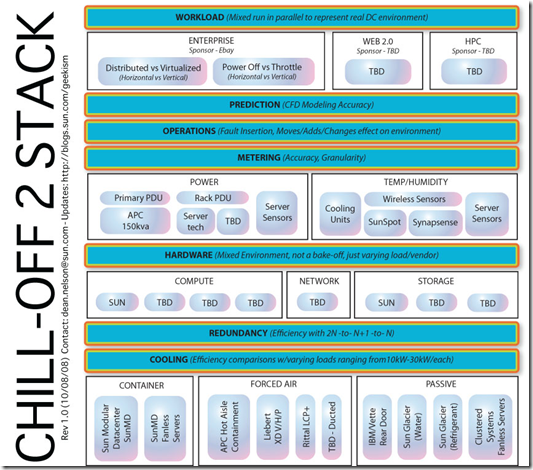
A specific example of Sun’s efforts are the Chill-off where Sun partnered with Silicon Valley Leadership Group and Lawrence Berkeley Labs. This PDF has more info.

image


Other areas where Dean is working on is www.datacenterpulse.com

Data Center Pulse is an exclusive group of global datacenter owners, operators and users.  The goal of this community is to track the pulse of the industry and influence the future of the datacenter through discussion and debate.

And, OpenEco.org

OpenEco.org is a global on-line community that provides free, easy-to-use tools to help participants assess, track, and compare energy performance, share proven best practices to reduce greenhouse gas (GHG) emissions, and encourage sustainable innovation.

image

One of the other areas Dean and I discussed is the inefficiencies of dev, test, pre-production labs.   Here is list of why these labs are inefficient

  1. Few labs are shared resources across a company, as most are dedicated to specific teams who have accumulate the space and equipment.
  2. Most of these labs are in office space and have a PUE in 2.5 – 3.0 range, but no one really knows as the HVAC and power systems are part of the overall office space. (Note: as a piece of trivia I was talking to EPA’s Andrew Fanara and he said part of what got the EPA/Energy Star group interested in energy efficient servers & Data Centers is when the EPA would try to categorize power consumption for buildings, but the exception where those buildings that had data centers in them. Those buildings had power usages that made it difficult to quantify what was an energy efficient building.)
  3. Most labs get the leftover equipment, almost no one puts state of the art equipment in their labs. The exception are a vendor’s demo labs, but these are few.
  4. The number of unused servers that should be decommissioned is just as bad as production environments.  When Sun consolidated its lab space it found 15% of the servers were not being used, but left on from past projects.
  5. Resource usage is extremely cyclical. What happens to all that equipment, when the product ships and the team takes a vacation.  Does anyone turn off the lab?
  6. Limited lab budgets force lab staff to make due with what they have.  Their focus is just get it working.  Production issues are to be looked at later.
  7. No energy monitoring of lab space.  This is changing, and I am having fun working with a few companies who are putting systems together, but it is still in the early days.

You add all this up, and one of the most wasteful areas that has the potential largest ROI percentage are these labs. Virtualization has a high % of adoption in lab environmetns, and is an ideal place to start using Cloud Computing Utility type of paradigms.  IBM has their offering in Rational Test Lab Manager, so you can look for more vendors to do the same.

It as quick conversation, but hopefully the first of many.

I do agree with Dean that Microsoft and Google are making the industry better for all us, except those people who think Microsoft and Google are the enemy.

Read more

NYTimes AWS Cloud Computing Mistake Cost $240

Nicholas Carr discusses what is possible with Cloud Computing.

The new economics of computing

November 05, 2008

Are we missing the point about cloud computing?

That question has been rattling around in my mind for the last few days, as the chatter about the role of the cloud in business IT has intensified. The discussion to date has largely had a retrospective cast, focusing on the costs and benefits of shifting existing IT functions and operations from in-house data centers into the cloud. How can the cloud absorb what we're already doing? is the question that's being asked, and answering it means grappling with such fraught issues as security, reliability, interoperability, and so forth. To be sure, this is an important discussion, but I fear it obscures a bigger and ultimately more interesting question: What does the cloud allow us to do that we couldn't do before?

The history of computing has been a history of falling prices (and consequently expanding uses). But the arrival of cloud computing - which transforms computer processing, data storage, and software applications into utilities served up by central plants - marks a fundamental change in the economics of computing. It pushes down the price and expands the availability of computing in a way that effectively removes, or at least radically diminishes, capacity constraints on users. A PC suddenly becomes a terminal through which you can access and manipulate a mammoth computer that literally expands to meet your needs. What used to be hard or even impossible suddenly becomes easy.

His example is the NYTimes.

My favorite example, which is about a year old now, is both simple and revealing. In late 2007, the New York Times faced a challenge. It wanted to make available over the web its entire archive of articles, 11 million in all, dating back to 1851. It had already scanned all the articles, producing a huge, four-terabyte pile of images in TIFF format. But because TIFFs are poorly suited to online distribution, and because a single article often comprised many TIFFs, the Times needed to translate that four-terabyte pile of TIFFs into more web-friendly PDF files. That's not a particularly complicated computing chore, but it's a large computing chore, requiring a whole lot of computer processing time.

Fortunately, a software programmer at the Times, Derek Gottfrid, had been playing around with Amazon Web Services for a number of months, and he realized that Amazon's new computing utility, Elastic Compute Cloud (EC2), might offer a solution. Working alone, he uploaded the four terabytes of TIFF data into Amazon's Simple Storage System (S3) utility, and he hacked together some code for EC2 that would, as he later described in a blog post, "pull all the parts that make up an article out of S3, generate a PDF from them and store the PDF back in S3." He then rented 100 virtual computers through EC2 and ran the data through them. In less than 24 hours, he had his 11,000 PDFs, all stored neatly in S3 and ready to be served up to visitors to the Times site.

The total cost for the computing job? Gottfrid told me that the entire EC2 bill came to $240. (That's 10 cents per computer-hour times 100 computers times 24 hours; there were no bandwidth charges since all the data transfers took place within Amazon's system - from S3 to EC2 and back.)

An interesting part of the story on the original blog which was confirmed by an Amazon Web Services evangelist is the NYTimes had to run the cloud computing job twice, as the first had errors.

I then began some rough calculations and determined that if I used only four machines, it could take some time to generate all 11 million article PDFs. But thanks to the swell people at Amazon, I got access to a few more machines and churned through all 11 million articles in just under 24 hours using 100 EC2 instances, and generated another 1.5TB of data to store in S3. (In fact, it work so well that we ran it twice, since after we were done we noticed an error in the PDFs.)

So, it cost the NYTimes an extra $240 for their mistake as they had to run the job a second time.

Read more