Outliers, 10,000 hrs of Practice

I just finished reading Malcolm Gladwell’s Outliers book.

Amazon Best of the Month, November 2008: Now that he's gotten us talking about the viral life of ideas and the power of gut reactions, Malcolm Gladwell poses a more provocative question in Outliers: why do some people succeed, living remarkably productive and impactful lives, while so many more never reach their potential? Challenging our cherished belief of the "self-made man," he makes the democratic assertion that superstars don't arise out of nowhere, propelled by genius and talent: "they are invariably the beneficiaries of hidden advantages and extraordinary opportunities and cultural legacies that allow them to learn and work hard and make sense of the world in ways others cannot." Examining the lives of outliers from Mozart to Bill Gates, he builds a convincing case for how successful people rise on a tide of advantages, "some deserved, some not, some earned, some just plain lucky."
Outliers can be enjoyed for its bits of trivia, like why most pro hockey players were born in January, how many hours of practice it takes to master a skill, why the descendents of Jewish immigrant garment workers became the most powerful lawyers in New York, how a pilots' culture impacts their crash record, how a centuries-old culture of rice farming helps Asian kids master math. But there's more to it than that. Throughout all of these examples--and in more that delve into the social benefits of lighter skin color, and the reasons for school achievement gaps--Gladwell invites conversations about the complex ways privilege manifests in our culture. He leaves us pondering the gifts of our own history, and how the world could benefit if more of our kids were granted the opportunities to fulfill their remarkable potential. --Mari Malcolm

One of the interesting points is 10,000 hrs of practice are required to achieve a level of expertise.  An excerpt published in the Guardian is available.

This idea - that excellence at a complex task requires a critical, minimum level of practice - surfaces again and again in studies of expertise. In fact, researchers have settled on what they believe is a magic number for true expertise: 10,000 hours.

"In study after study, of composers, basketball players, fiction writers, ice-skaters, concert pianists, chess players, master criminals," writes the neurologist Daniel Levitin, "this number comes up again and again. Ten thousand hours is equivalent to roughly three hours a day, or 20 hours a week, of practice over 10 years... No one has yet found a case in which true world-class expertise was accomplished in less time. It seems that it takes the brain this long to assimilate all that it needs to know to achieve true mastery."

For an exercise I tried to figure out what I had practiced for 10,000 hrs. And, what I came up with is being a technology evangelist.

A technical or technology evangelist is a person who attempts to build a critical mass of support for a given technology in order to establish it as a technical standard in a market that is subject to network effects.[citation needed] Professional technology evangelists are often employed by firms which seek to establish their proprietary technologies as de facto standards or to participate in setting non-proprietary open standards. Non-professional technology evangelists may act out of altruism or self-interest (e.g., to gain the benefits of early adoption or the network effect).

Technical evangelists may act, officially or unofficially, on behalf of a company or organisation, or on a personal basis, for instance open source evangelism. An evangelist promotes the use of a particular product or technology through talks, articles, blogging, user demonstrations, recorded demonstrations, or the creation of sample projects. The word evangelism is taken from the context of religious evangelism because of the similar recruitment of converts and the spreading of the product information through the ideological or committed.

Being independent of an organization has allowed me to have more fun blogging on the Green Data Center topic, and working with whoever I want.  Working at companies like Apple and Microsoft I learned a lot, but being on my own is turning out to be like graduating from college, taking the path of altruism.

Blogging is part of my practice; researching and writing about technology and methods to create greener data centers. I have a long way to go to achieve 10,000 hrs on green data centers, but I am sure time will go by quickly.
Read more

Nuclear Energy Reading List, WSJ

WSJ has a reading list on Nuclear Energy

Reading Up on Nuclear Energy

The debate over nuclear energy has gained new life thanks to concerns about climate change and the need to reduce our reliance on fossil fuels. We asked several experts on the topic to suggest resources for understanding -- and joining -- the debate.

-- Michael Totty

PETER A. BRADFORD, adjunct professor, Vermont Law School, and former member of the Nuclear Regulatory Commission:

  • For an even-handed recent overview of most nuclear power issues, see "Nuclear Power Joint Fact-Finding," a June 2007 report by the Keystone Center, a non-profit organization that brought together a cross section of parties interested in nuclear energy – including environmentalists and consumer advocates, industry representatives and government officials – to create a base of agreed-upon knowledge about the costs, risks and benefits of nuclear power.
    www.keystone.org/spp/documents/FinalReport_NJFF6_12_2007(1).pdf

And here is a talk at Google on Liquid Fluoride Thorium Reactor

Joe Bonometti's "Tech Talk" at Google

Dr. Joe Bonometti, gave a "Tech Talk" at Google this past Tuesday on the subject of Liquid-Fluoride Thorium Reactors. You can also download a copy of his slides here:
LFTR Google Presentation
We really appreciate all of Joe's efforts to advance and promulgate this important technology!

Read more

Good Times for Building a Data Center? Surprise Drop in Power Use Jolts Utilities

WSJ writes on how utilities are reacting to changes in electricity use by utilities.

Surprise Drop in Power Use Delivers Jolt to Utilities

By REBECCA SMITH

An unexpected drop in U.S. electricity consumption has utility companies worried that the trend isn't a byproduct of the economic downturn, and could reflect a permanent shift in consumption that will require sweeping change in their industry.

Numbers are trickling in from several large utilities that show shrinking power use by households and businesses in pockets across the country. Utilities have long counted on sales growth of 1% to 2% annually in the U.S., and they created complex operating and expansion plans to meet the needs of a growing population.

What is scaring the Utility companies.

The data are early and incomplete, but if the trend persists, it could ripple through companies' earnings and compel major changes in the way utilities run their businesses. Utilities are expected to invest $1.5 trillion to $2 trillion by 2030 to modernize their electric systems and meet future needs, according to an industry-funded study by the Brattle Group. However, if electricity demand is flat or even declining, utilities must either make significant adjustments to their investment plans or run the risk of building too much capacity. That could end up burdening customers and shareholders with needless expenses.

To be sure, electricity use fluctuates with the economy and population trends. But what has executives stumped is that recent shifts appear larger than others seen previously, and they can't easily be explained by weather fluctuations. They have also penetrated the most stable group of consumers -- households.

This looks like it is a good time to build a data center or at least lock in future capacity as utilities look for revenue growth.

Some utilities are even thinking of changing their rate schedules.

Utilities are taking a hard look at the way they set rates and generate profits. Many companies are embracing a new rate design based on "decoupling," in which they set prices aimed at covering the basic costs of delivery, with sales above that level being gravy. Regulators have resisted the change in some places, because it typically means that consumers using little energy pay somewhat higher rates.

One good change about this economic environment is it is driving some of the biggest changes in world economies since the industrial revolution.  Change is always painful, but in the long run good.

Read more

Another Green Data Center Article, Wells Fargo Shares

If a year ago you tried to get a company to discuss its data center operations, you would have found few willing to talk.  But, Green momentum has more and more companies talking.

Is this due to the data center operations team realizing it is good share or the company’s PR teams looking for green news on how the company is being a better citizen?  It’s probably a little of both.  Here is Wells Fargo sharing some of their details, including what states they are in.

Wells Fargo team shares green tech tips for the data center

Posted by Heather Clancy @ 1:15 pm

In my quest to uncover practical information about what real data center managers are doing to decrease their energy consumption, for real, I recently spoke with two executives from Wells Fargo’s Technology Information Group (TIG).

Scott Dillon, executive vice president and CTO for Enterprise Hosting Services, and Bob Culver, vice president of TIG, are both responsible for enhancing the financial services company’s green technology profile. Here are some of the specific actions they’ve taken for their data centers in Minnesota, Arizona, California and Iowa.

I think a contributing factor is Microsoft’s data center group and Mike Manos & Christian Belady  specifically being out there sharing information.

Now, that data centers are starting to open up, it is becoming easier to go deeper extracting best practices.  Thanks to some networking I am getting in roads to others who want to talk more.

As Mike Manos has said, the biggest obstacle for data center efficiency is information hoarding.

Thanks Mike & Christian for taking the lead in sharing.

Read more

Nuclear Bunker Data Center

Andrew  Dudgell from http://blog.windowsvirtualization.com forwarded me this link.

The world’s most super-designed data center – fit for a James Bond villain

Posted in Main on November 14th, 2008 by Pingdom

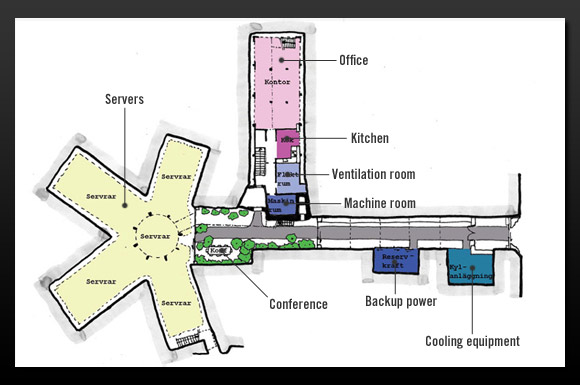
This underground data center has greenhouses, waterfalls, German submarine engines, simulated daylight and can withstand a hit from a hydrogen bomb. It looks like the secret HQ of a James Bond villain.

And it is real. It is a newly opened high-security data center run by one of Sweden’s largest ISPs, located in an old nuclear bunker deep below the bedrock of Stockholm city, sealed off from the world by entrance doors 40 cm thick (almost 16 inches).

The hosting company put some serious thinking into how you can make the data center a better environment… for the people.

Work environment with simulated daylight and greenhouses: For a pleasant working environment the data center has simulated daylight, greenhouses, waterfalls and a huge 2600-liter salt water fish tank.

Andrew – thanks for sending the link.

Read more