Dell XS11-VX8 Video & Blog

After leaks here are the official Dell Blog and video.

Dell Launches "Fortuna" -- Via Nano-based Server for Hyperscale Customers

19 May , 10:50 AM

The DCS team at Dell is known for being a bit of a skunk works for servers. With a charter to custom design optimized systems for our customers, we often find ourselves creating very unique products.

To that end, I’d like to share details about one of our more recent efforts in this space. Known officially as the XS11-VX8, but more affectionately by its code name of "Fortuna," it is arguably the most power-efficient and densest server in the marketplace. But note: these are not Dell PowerEdge servers available to all customers but are an advancement that Dell is bringing to customer's whose data center is their factory. They are hyper-scale customers in the search engine and Web hosting businesses.

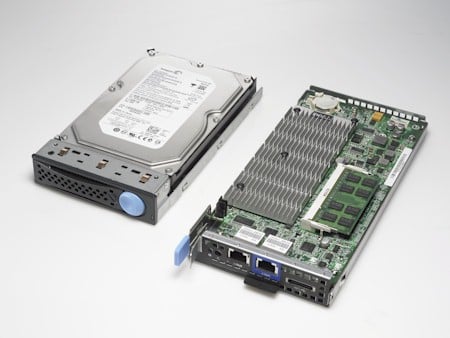
VX11 form factor is similar to that of a 3.5” HDD carrier

Before jumping into the speeds and feeds, let’s talk a little about the specific problem our DCS Architecture team set out to solve. A number of large web-hosting providers approached the DCS team with a desire for unique, physical machines right-sized for a web-hosting workload. These unique physical machines must operate and perform like an enterprise-class server in terms of applications and management, but their workloads don’t warrant multi-socket or multi-core architectures.

To fill this space today, these customers often select general purpose 1U servers or low-end tower servers. However, compromises are made around the density, power, and/or manageability aspects associated with these alternatives. The Fortuna solution was designed from day one to solve this specific customer problem without compromise. Leveraging the Via Nano CPU, we can deliver an incredibly low-power solution of 20-29 Watts/server at full load (that isn’t a typo), and 15 Watts/server at OS idle. In addition, there are no compromises on enterprise features like 64-bit operating systems, 1-to-1 virtualization, and remote management via IPMI.

However, what usually catches most customers' attention is the form factor. With a size slightly larger than a 3.5-inch hard drive, Fortuna is a “hot-plug” server with its own dedicated memory, storage, BMC, and dual 1GbE NIC’s. The chassis exists to provide power, cooling, and a mechanism to mount in a rack. This provides unprecedented density – supporting six servers per rack unit (U) or 252 servers in a 42U rack.

Returning to our customers’ problem statement, the form factor serves a purpose.

VX11 chassis houses 12 servers in 2U

For customers living with rack capacities defined by the amps of service available, Fortuna provides a 700 percent increase in server density. This translates into a compelling total cost of ownership story.

Read more

What’s next after Dell Via Nano Server?

The XS11-VX8, Dell Via Nano Server is getting lots of news and blog coverage.

My blog works well for google search on “XS11-VX8”.  Giving me #2 in search results, and I only posted my blog entry yesterday even though news has been going on for the past 3 days.

image

Energy efficiency is a new focus for many, and much to the  frustration of Intel, AMD, and Server OEMs, not everyone wants a multi-core high cost chip.

So, what’s next?

ARM based servers that can be even higher performance per watt.

Don’t know who has done this, but given the hardware ecosystem, there are people who have experimented with this and Linux OSs.  The popularity of ARM chips in mobile devices is where the knowledge exists for low power solutions.

Why not take a mobile device, an iPhone and turn it into a server.

In fact, talk a game changing move by Apple.  What if Apple shipped a server appliance that had all your music, video, on a home server, running on an ARM chip.

The problem as one friend mentioned with a Netbook type iPhone is the power consumption as low as it is for an iphone, when you are browsing the web you are drawing more power than talking on the iphone, so a netbook use is harder than talking on the phone. So, in the short term, why not ship a server?

What if Apple made the quantum jump from iphone/ipod to iServer 500 GB of your media ready to follow you.  Can Apple create the home media server hub better than Microsoft did with Home Server?  Well, yes.

Read more

Salmon Habitat Threatens Dam Survival

Part of a sustainable and green data center is thinking long term and looking at the social impacts that can effect a data center operation. Seattle Times has an article about a US district judge telling federal agencies their salmon-recovery plans need work.

Salmon-recovery plan needs work, judge says

A judge is telling federal agencies they need to do more to help Columbia Basin salmon survive, or he will find the latest restoration plan in violation of the Endangered Species Act.

By Seattle Times staff and news services

PORTLAND — A judge is telling federal agencies they need to do more to help Columbia Basin salmon survive, or he will find the latest restoration plan in violation of the Endangered Species Act.

A Monday letter from U.S. District Judge James Redden to lawyers for all sides in a long-running court battle says he continues to have "serious reservations" because the standard for success is not strong enough.

Redden also wants a contingency plan that would include funding, congressional approvals and other steps needed to breach the lower Snake Rivers dams in the event other measures fail to restore salmon runs.

The letter sets the stage for a new round of out-of-court negotiations between plaintiffs — environmental groups and others — and the federal government over the program to revive endangered and threatened salmon runs in the Columbia River basin amid the operations of federal hydropower dams.

image

What is the probability of the federal gov’t breaching a hydroelectric dam to restore the salmon habitat?

Todd True, a plaintiff's attorney with Earthjustice, said he hopes breaching the dams can become an important component of the final plan.

"We hope that it will rise to the top of any objective evaluation," True said.

In years past, Redden has twice rejected federal plans for restoring the Columbia-basin salmon runs protected under the federal Endangered Species Act.

And judge is losing his patience.

Redden said "aggressive actions are necessary to save this vital [salmon] resource." He said that the litigants are finally starting to work together, and he is optimistic for the prospects of a new agreement.

He warned that the government has spent the past decade "treading water" and "we cannot afford to waste another decade."

Here are the dams in the snake river area.

Dams of the Columbia Basin & Their Effects on the Native Fishery

Bonneville * The Dalles * John Day & McNary * Priest Rapids & Wanapum * Rock Island, Rocky Reach, Wells & Chief Joseph * Grand Coulee * Hells Canyon, Oxbow, Brownlee & Dworshak * Revelstoke, Keenleyside, Mica & Duncan


Ice Harbor Dam. Courtesy of Corps of Engineers

Ice Harbor Dam: Snake River, near the confluence with the Columbia River at mile marker 9.7, completed in 1961, federally owned , concrete gravity hydroelectric, 1 lock, 2 fish ladders, 2822 feet long, 100 feet high, spillway 590 feet, 10 gates with an earth fill embankment. The dam creates Lake Sacajawea, which extends 32 miles upstream to the Lower Monumental Dam.


Lower Monumental Dam. Courtesy of Bonneville Power Administration

Lower Monumental Dam: Snake River at mile marker 41.6, completed in 1969, federally owned, concrete gravity with a short earth fill abutment, spillway 572 feet, 8 gates, 3791 feet long ,height 100 feet, 2 fish ladders, 1 lock, creates Lake Herbert G. West, 28.1 miles to the Little Goose Dam, hydroelectric.


Little Goose Dam. Courtesy of Army Corps of Engineers

Little Goose Dam: Snake River at mile marker 70.3, completed in 1970, additional units completed in 1978, federally owned, concrete gravity type hydroelectric, spillway 512 feet, 8 gates, 2665 feet long, 98 feet high. Creates Lake Bryan which extends 37.2 miles upriver to the Lower Granite Dam.


Lower Granite Dam. Courtesy of Army Corps of Engineers

Lower Granite Dam: Snake River at mile marker 107.5, completed in 1975, federally owned, concrete gravity, hydroelectric, spillway 512 feet, 8 gates with an earth fill abutment. The dam is 3200 feet long with a height of 100 feet, and employs 2 fish ladders. Lower Granite dam was the first dam on the Snake River to use screens that protected the juvenile fish from the turbines (River of Life, Channel of Death by Keith C. Peterson, Confluence Press, 1995, p.184).

Environmentalists, the four treaty tribes (Yakama, Umatilla, Warm Springs, Nez Perce), scientists, and non-native fishermen have all called for the breaching of these four lower Snake River dams to facilitate salmon habitat restoration. Doing so would leave Lewiston, Idaho without its seaport. While many have considered drawdowns a radical solution to the region's salmon crisis, recently, the idea has gained credence. The issue is a contentious one with emotions high on both sides.

Read more

XS11-VX8, Dell’s Via Nano Server, Anti-VMware and Intel

Dell and Via are teaming up to provide low power servers.  Computerworld writes.

Dell uses Via Nano laptop chips in servers

Subscribe to this podcast in iTunes!

Dell's new ultra-light server will use low-power processors designed for use in cheap laptops. The XS11-VX8 servers will use Nano netbook processors from Via Technologies to run light server workloads such as Web hosting. Dell's move to use the Nano chips is part of a growing trend to use low-power chips in servers to reduce energy and cooling costs in data-centers. The Dell servers will be priced at around 400 dollars and will bundle 12 server boards with Nano chips in one chassis. Each server board will include Via's Nano U2250 processor, which runs at 1.3GHz, and a storage module.

interesting that Dell has 12 server boards per chassis.  Given the competition for market share i wonder if Dell will count a  XS11-VX8 as one or twelve servers?


image

image

Why would Dell create these low power, low performance servers?

The Register gives a reason.

In the Web hosting world, you can charge a premium for customers who have dedicated servers. But Moore's Law and every-more powerful processors combined with server virtualization puts pressure on Web hosting companies to do shared servers for their clients because no modest Web customer can use a whole one-socket or two-socket server today. What's a Web hosting company trying to make profit to do?

Buy servers using physically smaller and less powerful servers, of course.

And that is just what Dell's Data Center Solutions unit, which creates and sells custom-designed server platforms for hyperscale clients, wants to sell to hosting companies. According to Drew Schulke, product marketing manager for the DCS unit, five hosting providers approached Dell because they wanted the option of providing customers with smaller physical servers, perfectly capable of handling Web hosting workloads and not depending on virtualization. Schulke says that the number of machines that these companies have already deployed and their plans to offer dedicated hosting were sufficient to justify investing in custom server designs.

This is exactly the opposite (anti) of what Intel and VMware want the industry to go.

Dell looked around at Intel's Atom processor as well as a few others, but VIA Technologies' Nano processor is the only one of the low-power x64 chips that has the option of supporting virtualization through its VMX virtualization extensions. It isn't so much that these hosting companies want to be able to use virtualization to carve up these servers as it is they want to use virtualization to be able to manage the server image on a dedicated machine. You can't use Xen or KVM - as two early customers for the VIA boxes plan to - to package up a server image on an Atom processor because it does not support Intel's VT instructions.

Dell VIA Server Compared to Disk

The Dell DCS VIA server versus a disk
drive (Click to Enlarge)

Dell took the Nano chip and chipset and worked with VIA and an unnamed original design manufacturer to create what it calls a "hot plug server" based on a modified version of VIA's Nano processor and its similarly named motherboard. Using a 1.6 GHz Nano processor and the Dell XS11-VX8 server module, which is slightly longer than a 3.5-inch disk storage bay, Dell can give hosting companies a 64-bit Nano server that has from 1 GB to 3 GB of main memory and that has an idle power draw of around 15 watts and that draws somewhere between 20 and 29 watts under peak loads. That is about one-tenth the power used by a standard two-socket 1U box that is not running at a particularly high utilization.

and this continues down the idea  I had on “little green servers”

Ever so slowly, the idea of modest computing - using Moore's Law to make smaller and more energy efficient computers, not boosting component counts - seems to be starting to cache on. Just last week, motherboard and whitebox server maker Super Micro announced a server based on the Atom chip. And back in January, Rackable Systems adopted Mini-ITX boards from VIA for use in its MicroSlice rack servers, and Microsoft has been tooling around with the concept too. ®

Read more

Increase efficiency with Models, Applied in online advertising scenario

WSJ has an article about Chrysler’s use of www.organic.com

Modeling Tools Stretch Ad Dollars

Chrysler Uses Digital-Response Data to Adjust Commercials, Drive Web Visits

By EMILY STEEL

With a reduced advertising budget and a desperate need to increase sales, Chrysler is relying more heavily on new technologies to predict how ad purchases will translate into sales.

A team of statisticians, economists, software engineers and media planners at Chrysler's digital marketing agency, Organic, has designed a "media modeling" system that helps the company calculate the best ways to allocate its marketing dollars. The system calculates how much ad spending is needed to meet certain sales targets and then analyzes how both online and offline ads affect Web activity and, ultimately, sales.

Car makers and other companies have used forecasting tools for years, but digital ads have ramped up the systems' sophistication and accelerated reaction time to the data gathered.

[chrysler ads and digital marketing]

Chrysler is using digital-ad agency Organic to try to make the most of its marketing. Organic's technology was used in Chrysler's campaign to promote the new Dodge Ram truck, shown above in a video.

"As a marketer, it helps me be smarter about the dollars I need to reach the sales goals we are responsible for," says Susan Thomson, Chrysler's director of media and events. "It gives you some science."

What does this have to do about data centers is the economic use of dollars to get value. Organic is creating models of how people will  interact with media.

In refining its model, Organic learned how certain ads spur people to visit the Web. It then figured out which Web activities translate into actual auto sales. Some actions, such as scheduling a test drive online or entering a ZIP code to locate a dealer, are a good predictor of sales. Other actions, such as pricing a vehicle or playing with the colorizing features on the site, occur earlier in the shopping process and aren't a direct indicator of serious buyer interest.

The result was a system that predicted 2008 sales within one percentage point of actual sales figures for its Jeep brands, Chrysler says.

And, these ideas are good to think about how models can be created for how users interact with data centers.

Organic modeled the allocation of money

image

vs. the old way

image

Read more