Mobile data center impact, Cisco projects 39X global growth 2009 - 2014

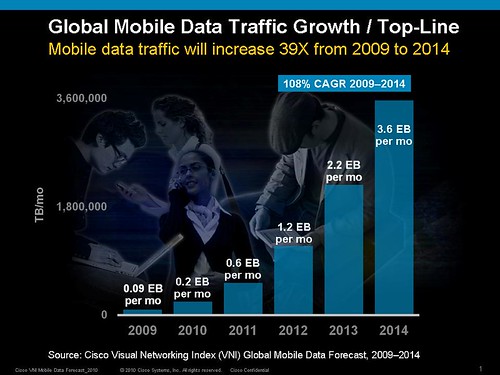
Cisco announced new marketing data projecting a 39-fold increase in Mobile data traffic from 2009-2014.

Cisco Visual Networking Index Forecast Predicts Continued Mobile Data Traffic Surge

More Mobile-Ready Devices and Mobile Video to Fuel 39-Fold Global Growth from 2009-2014

Cisco Visual Networking Index Global Mobile Data Traffic Growth

Cisco Visual Networking Index Global Mobile Data Traffic Growth

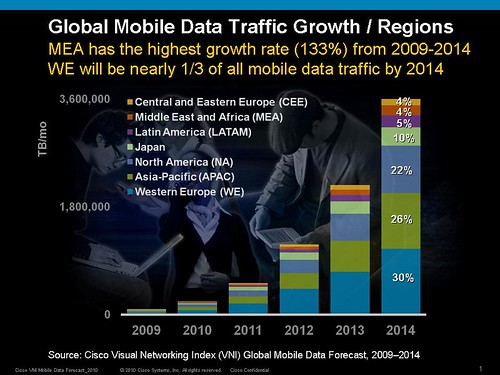
Cisco Visual Networking Index Mobile Data Traffic Growth by Region

Cisco Visual Networking Index Mobile Data Traffic Growth by Region

San Jose, Calif., Feb. 9, 2010 – Cisco today announced the results of the Cisco® Visual Networking Index (VNI) Global Mobile Data Forecast for 2009-2014.

The research projects that annual global mobile data traffic will reach 3.6 exabytes per month or an annual run rate of 40 exabytes by 2014.  Such a figure equates to a 39-fold increase from 2009 to 2014, or a compound annual growth rate (CAGR) of 108 percent.

Two major global trends are driving this increase-the proliferation of mobile-ready devices and widespread mobile video content consumption. By 2014, there could be over 5 billion personal devices connecting to mobile networks – and billions more machine-to-machine nodes. Mobile video is projected by the study to represent 66 percent of all mobile data traffic by 2014, increasing 66-fold from 2009 to 2014-the highest growth rate of any mobile data application tracked in the Cisco VNI Global Mobile Data Forecast.
Interesting little facts are

Mobile video is projected by the study to represent 66 percent of all mobile data traffic by 2014, increasing 66-fold from 2009 to 2014-

Global mobile data traffic today is growing today 2.4 times faster than global fixed broadband data traffic.

Smart phones and laptop air cards are expected to drive more than 90 percent of global mobile traffic by 2014.

If you aren’t thinking about mobile data out of your data center, you will be.

This marketing data coincides with their new mobile data switch, ASR 5000.

Cisco Unveils the Cisco ASR 5000

End-to-end IP NGN Architecture Supercharges the Mobile Internet for Service Providers

Photo
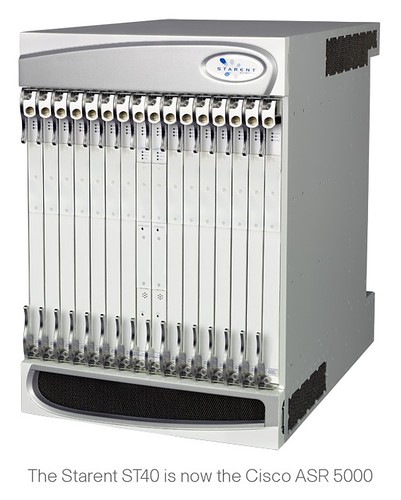
Cisco ASR 5000

Cisco ASR 5000

Cisco Visual Networking Index Global Mobile Data Traffic Growth

SAN JOSE, CA, Feb. 9, 2010 – Cisco today announced it has expanded the ASR Series platforms with the introduction of the Cisco ASR 5000 as a result of the Starent acquisition.  The addition of the ASR 5000 gives Cisco a comprehensive end-to-endInternet Protocol Next-Generation Network (IP NGN) architecture and offers mobile operators a platform specifically designed to accommodate the rapid growth of mobile Internet traffic and mobile multimedia applications.

Read more

StorageMojo Blog votes for Emotions drive Private Cloud, commenting on James Hamilton’s post

I wrote on Mike Manos’s comment regarding James Hamilton’s post that Private Clouds are not the future.

Jan 25, 2010

Private Clouds Dead or Alive, views from James Hamilton and Mike Manos, logic vs. emotional

I’ve been thinking about what to write as a response to James Hamilton’s blog post on Private Clouds are not the Future.  It is well written and logical in its efficiency.

Last week Alistair Croll wrote an excellent InformationWeek article arguing that “the true cloud operators will have an unavoidable cost advantage because it's all they worry about. They'll also be closer to consumers (because they have POPs everywhere and partnerships with content delivery systems), and connecting with consumers and partners will become an increasingly essential part of any enterprise IT strategy.” Have a look at Private Clouds are a Fix, Not the Future.

Private clouds are better than nothing but an investment in a private cloud is an investment in a temporary fix that will only slow the path to the final destination: shared clouds. A decision to go with a private cloud is a decision to run lower utilization levels, consume more power, be less efficient environmentally, and to run higher costs.

StorageMojo’s Robin Harris also votes for emotions keeping private clouds future bright.

Why private clouds are part of the future

by ROBIN HARRIS on FRIDAY, 5 FEBRUARY, 2010

James Hamilton, Amazon architect and a very smart guy, recently blogged about private clouds. In Private Clouds Are Not The Future he argues that economies of scale make public clouds much more efficient than private clouds.

I think we agree that several effects make web scale public clouds more efficient

Robin adds his view it isn’t all about economics.

It isn’t all about the Benjamins
Economics is not the driver many assume. Individuals and companies often select less economic choices. Some people buy cars that cost $200,000 and get 12 miles to the gallon. Some companies buy $6/GB storage and then utilize just 1/3rd of that costly capacity.

Often perceived benefits are not well measured in dollars. Convenience, availability, consistency and control often relate to emotional needs and wants that are rarely quantified or questioned.

But we don’t have to invoke those to understand why private clouds will be part of the computing landscape. Just a quick look at one of the large Internet data centers will tell us what we need to know.

As much as people talk about Cloud Computing it is rare to hear someone talk about power.  Robin is the exception to the rule.

Show me the power
All the advantages of public clouds have analogs in the world of power generation and distribution. Power generation is cheapest when centralized and large-scale distribution systems move power at the lowest cost per watt.

Electrical power generation and distribution is over 125 years old. The technology is well understood, the industry is mature, and a massive infrastructure — including mile-long coal-hauling trains — supports production and distribution.

And yet, Google’s massive Dalles, Oregon data centers, built next to a substation a few miles from the nation’s largest hydropower system – one of the world’s most reliable power sources – flanks each data center with generators. I expect Amazon does the same.

Read more

Data Center as a Thermodynamic System

Thanks to a conversation with Stewart Young from OSIsoft where we were bouncing around different ideas and the latest Green Grid meeting it hit me.  As much as The Green Grid and folks there discuss power and cooling systems is there a different way to think about how to green the data center.

By its nature The Green Grid with its vendor members will organize itself around those things that sell the vendors products.  PUE drives energy efficiency benchmarking which gets people to upgrade equipment.  Energy efficient servers the same.

So, let’s go to a different holistic view of the green data center problem.  Looking at the Data Center as a Thermodynamic System.

System boundary.svg

In thermodynamics, a thermodynamic system, originally called a working substance, is defined as that part of the universe that is under consideration. Anything under consideration is called a system. A hypothetical boundary separates the system from the rest of the universe, which is referred to as the environment, surroundings, or reservoir.

If the data center is the system and the boundary is the physical connections to the rest of the surroundings does this work for data centers.

A useful classification of thermodynamic systems is based on the nature of the boundary and the quantities flowing through it, such as matter, energy, work, heat, and entropy. A system can be anything, for example a piston, a solution in a test tube, a living organism, an electrical circuit, a planet, etc.

Data Centers are closed systems.

Closed systems are able to exchange energy (heat and work) but not matter with their environment. A greenhouse is an example of a closed system exchanging heat but not work with its environment. Whether a system exchanges heat, work or both is usually thought of as a property of its boundary.

Data centers are actually composed of bunch of thermodynamic systems. Like:


[edit]Psychrometry

Psychrometry is the study of air and water vapor mixtures for air conditioning. For this application, air is taken to be a mixture of nitrogen and oxygen with the other gases being small enough so that they can be approximated by more of nitrogen and oxygen without much error. In this psychrometry section, vapor refers to water vapor. For air at normal (atmospheric) pressure, the saturation pressure of vapor is very low. Also, air is far away from its critical point in those conditions. Thus, the air vapor mixture behaves as an ideal gas mixture. If the partial pressure of the vapor is smaller than the saturation pressure for water for that temperature, the mixture is called unsaturated. The amount of moisture in the air vapor mixture is quantified by its humidity.

Diesel Cycle

Diesel Cycle

The Diesel cycle is the idealized cycle for compression ignition engines (ones that don't use a spark plug). The difference between the Diesel cycle and the Otto cycle is that heat is supplied at constant pressure.

  1. Heat is supplied reversibly at constant pressure in 1-2.
  2. Reversible adiabatic expansion during which work is done in 2-3.
  3. Heat is rejected reversibly at constant volume in 3-4.
  4. Gas is compressed reversibly and adiabatically in 4-1.

An example of Thermodynamic Systems in Data Centes is Syracuse University Data Center.  When you watch the video it discusses many ideas you would use if you looked at the data center as a Thermodynamic System.

Maybe we need more thermodynamic engineers working on data centers?  How many data center design firms take a thermodynamic system approach?  Low PUE is the current topic, but what happens if you do as IBM did and brought power generation on site and change the boundary of the system?

Read more

Owning the Network commoditized, as Apple & Google’s Mobile browser devices with data centers drive customers

Newsweek has an article on Apple and Google’s move to wrestle control away from wireless carriers which commoditizes the network.  Verizon started the battle discussing the 3G network with videos like this.

ATT fires back with Apple’s help.

But, how many people really like being locked into one carrier for 2 years?  Did all this advertising really work or did it just piss off people more as they knew their networks didn’t work as well as advertised.  Apple and Google are changing the game by having users buy devices, and the network is a lower priority.  How many users who bought iPhones really wanted to be on the AT&T network? We’ll see if Google’s strategy to be on all the networks works vs. Apple.

Buh-Bye, Wireless Guys

How Silicon Valley conquered the carriers.

TECHNOLOGY
Handheld History

Remember life without your iPhone, Blackberry or Treo? From the Apple Newton to the newest Palm Pre, here's a look at the evolution of the personal digital assistant.

The Best of Apple's Innovations

By Daniel Lyons | NEWSWEEK

Published Feb 4, 2010

From the magazine issue dated Feb 15, 2010

I like to imagine that it happened this way: One day the computer guys in Silicon Valley looked over at the mobile-phone industry and realized those carriers have figured out the ultimate racket. They sell you a phone, lock you into a two-year contract, and anything you want to buy for the phone—accessories, ringtones, games—you have to buy from them. They control the whole thing, from top to bottom, and instead of getting a one-time sale, they get a recurring revenue stream. "Wow!" the computer guys said. "Why aren't we doing that? "

Well, now they are. Slowly but surely, companies like Apple and Google are wresting control away from the mobile carriers. Instead of a world where the companies that make the phones are just dumb hardware makers—silent partners who never get to touch the customer—Google and Apple are using the transition to smart phones as a way to flip the mobile-phone business model on its head.

But, as the article mentions this is just changing customer behavior from wireless carrier to device maker.

Eventually, this means that we'll all be able to buy a phone and run it on any network we want, which is what we should have been able to do all along. There's a risk, however, that we're fleeing one cage only to run straight into another, and the only thing that will change is the name of our jailer.

Part of the reason why Apple and Google have been able to do this is how well their device works with data centers that the company owns to provider a richer experience that consumers want.

RIM made the same mistake Windows Moblie did in having a browser that sucked.  Windows Mobile 7 will fix this problem, and RIM is joining as well.

The latest info we’ve heard has the browser being completely re-developed from the ground up and based on Webkit — a far cry from the POS Java relic BB’s currently run. RIM is gunning to take it even further than “just a webkit” browser however. Previously leaked documents and other claims from various sources have RIM tightly integrating their BIS/BES services and server side technology into the mix (which any Opera Mini users should know…) greatly speeds up browsing speeds, rending accuracy, and manages to drastically cut down on bandwidth.

Read more

Are Cloud Computing Data Centers Green? IBM announces its greenest Cloud Computing DC in North Carolina

I’ve been writing about cloud computing more as cloud computings are more efficient using less resources.  Here is IBM’s latest press release that demonstrates cloud computing is green.

The data center uses advanced software virtualization technologies that enable access to information and services from any device with extremely high levels of availability and quality of experience.  The facility aggressively conserves energy resources; saving cost and speeding services deployment through a smart management approach that links equipment, building systems and data center operations.

“I thank IBM for its continued commitment to North Carolina. This facility promises to be one of IBM's greenest data centers in the world, proving once again that green is gold for North Carolina,” Gov. Bev Perdue said. “Growing North Carolina’s green economy plays a critical role in my mission to create jobs and to ensure our state’s economy is poised to be globally competitive in the long term.”

As I’ve discussed the ideas working with University of Missouri, IBM has taken the same approach working with North Carolina Universities.

The data center is showcasing a cloud computing solution in partnership with North Carolina Central University (NCCU) and NC State University that enables Hillside New Tech High School students in Durham, NC to access educational materials and software applications for the classroom over the Internet from the high school’s computer lab, as well as from any networked device.  This means that the learning environment can be extended to nearly any place at any time without the restrictions many schools face such as limited support, hardware resources and lack of access. The Hillside outreach project with NCCU, using cloud computing as a vehicle in support of education, is one of several such K-12 projects that IBM supports.  The new data center also currently hosts IBM’s global web site, ibm.com, and the IT operations of strategic outsourcing clients such as the United States Golf Association (USGA).

The green features are listed here.


  • Smarter data center management:
      Thousands of sensors, connecting IT equipment, data center and building automation systems, provide data that can be analyzed to plan future capacity planning, conserve energy and maintain operations in the event of a power outage.
  • Energy efficiency: The data center uses half the energy cost to operate compared to data centers of similar size by taking advantage of free cooling – using the outside air to cool the data center.  Intelligent systems use sensors to continuously read temperature and relative humidity throughout the data center and dynamically adjust cooling in response to changes in demand.
  • Cloud computing capability:  Support for cloud computing workloads allow clients to use only the resources necessary to support their IT operations at any given moment - eliminating the need for up to 70 percent of the hardware resource that might have been previously needed to perform the same task. The data center also hosts recently announced “Smart Business” cloud computing offerings - each of these solutions can significantly reduce a clients total cost of ownership by up to 40 percent.
  • Built for expansion: Due to an innovative modular design method, IBM will be able to add significant future capacity in nearly half the time it would take traditional data centers to expand.  This design/build method – called IBM Enterprise Modular Data Center  (IBM EMDC) – also enables IBM to rapidly scale capacity to meet demand by adding future space, power, and cooling to the data center with no disruption to existing operations.  This means up to 40 percent of capital costs and up to 50 percent of operational costs may be deferred until client demand necessitates expansion.  The new data center can also quickly and seamlessly expand its power and cooling capacity.
  • New building standards: IBM started building the data center in August 2008 and it began to support client operations within 15 months compared to the industry benchmark of 18-24 months.

In constructing the new data center, IBM renovated an existing building on its Research Triangle Park campus by reusing 95 percent of the original building's shell, recycling 90 percent of the materials from the original building and ensuring that 20 percent of newly purchased material came from recycled products.  The result lowered costs and reduced the carbon footprint associated with building by nearly 50 percent allowing IBM to apply for Leadership in Energy and Environmental Design (LEED) Gold certification. LEED is a third-party certification program and the nationally accepted benchmark for the design, construction and operation of high performance green buildings.

Read more